Introduction
The reason your swing points are failing, the reason you are unable to get on side with intraday moves, and the reason reversals often come back against you, is that you are neglecting to use true reversal logic.
The idea of a true reversal is rooted in SMT, or crack in correlation, logic. Today I expand on how swing points form, how we can use our understanding of SMT and PSP, and how we combine these concepts to trade the highest probability reversal fractals in the market.
How To Trade True Reversals
What Is A True Reversal
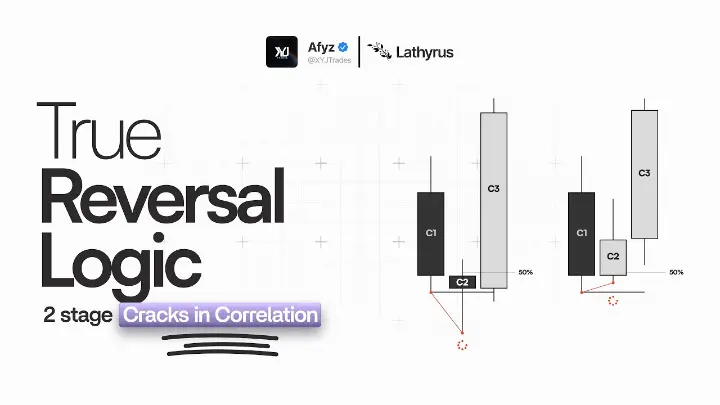
When I say true reversal, I am referring to a swing formation with a 2-stage crack in correlation. If some of this logic or some of these words do not make sense to you yet, you are probably missing some foundational components, which are covered in our YouTube videos and in the Lathyrus course: SMT, consecutive candle SMT and Precision Swing Points. If you understand that logic, you are in the right place.
These true reversals are the ones I trade away from on an intraday time frame. They are also the reversals that form higher time frame wicks, and they are the reversals that allow me to engage a Candle 2.
True Reversals In The Trading Plan
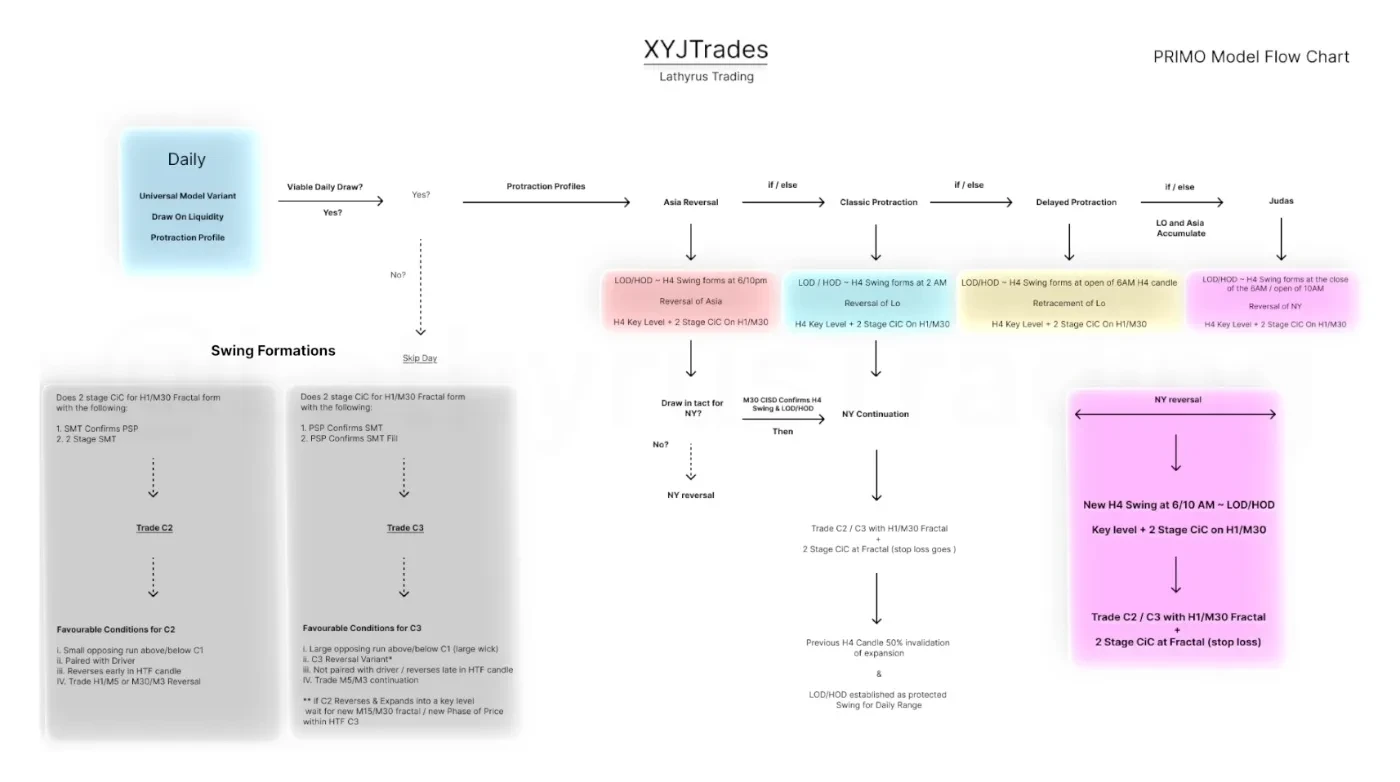
Let's step back and look at true reversals in the context of my trading plan. The trading plan is built out in depth within the Lathyrus course, but what I want to focus on here is swing formations: how I get on side with high probability swing formations in conjunction with daily profiles and draws on liquidity. We are focusing on the formation of Candle 2s and Candle 3s, and using true reversal logic to get on side with those specific swing formations.
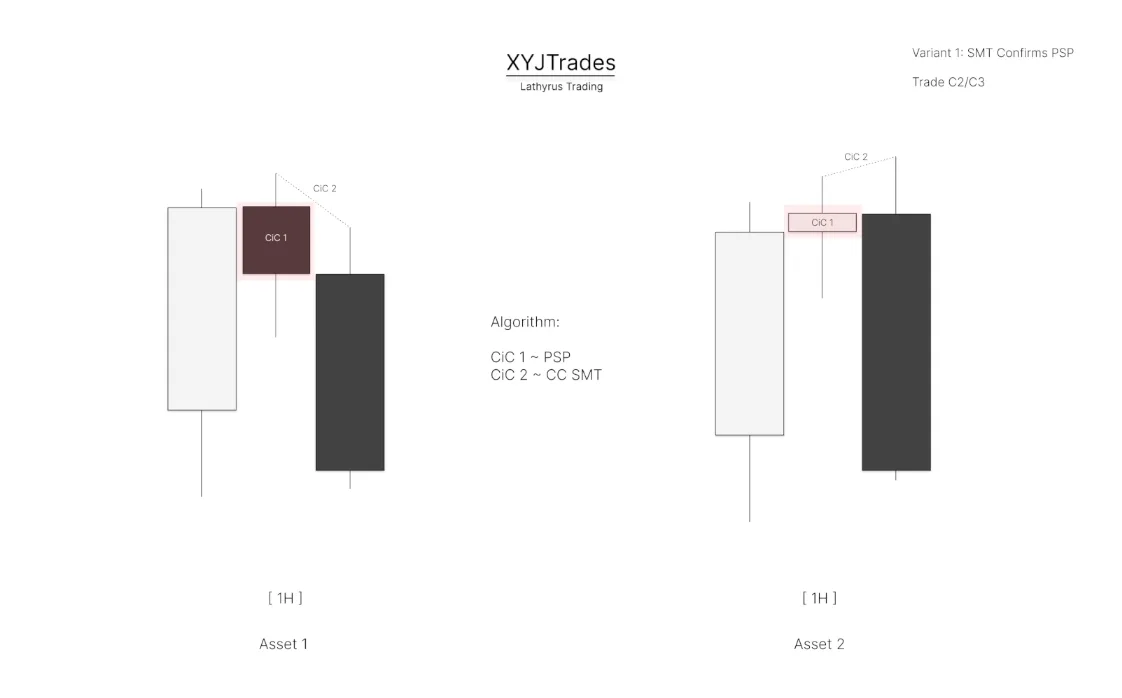
Variant 1: SMT Confirms PSP
Assuming you understand what a Precision Swing Point is, the first variant of a true reversal, a 2-stage crack in correlation at a swing point, is when first a Precision Swing Point forms. Candle 1 trades into some key level, internal range or external range, and then Candle 2 sweeps the previous candle's high and closes as a Precision Swing Point. This logic is true on both asset one and asset two, which can be any correlated assets in a triad.
The second stage of crack in correlation forms when we see a consecutive candle SMT at that Precision Swing Point. That functionally results in one asset creating a new C2, which you can trade as a reversal lower, and the other asset creating a continuation lower. I expand on this logic, along with concepts of Strength Switching, in the Lathyrus course.
What is important to notice is that in this variant, where an SMT confirms our Precision Swing Point, we can engage both Candle 2s and Candle 3s lower, if there are more consecutive candles to the right. The 2-stage crack in correlation forms at the Candle 2 high on asset two, and we have a Candle 3 continuation on asset one.
Learning it alone isn’t easy...
Learn The Lathyrus Model with direct guidance from our coaches.
- 10 live streams every week
- Regularly updated in-depth course
- 450+ hours of live stream recordings
+ more
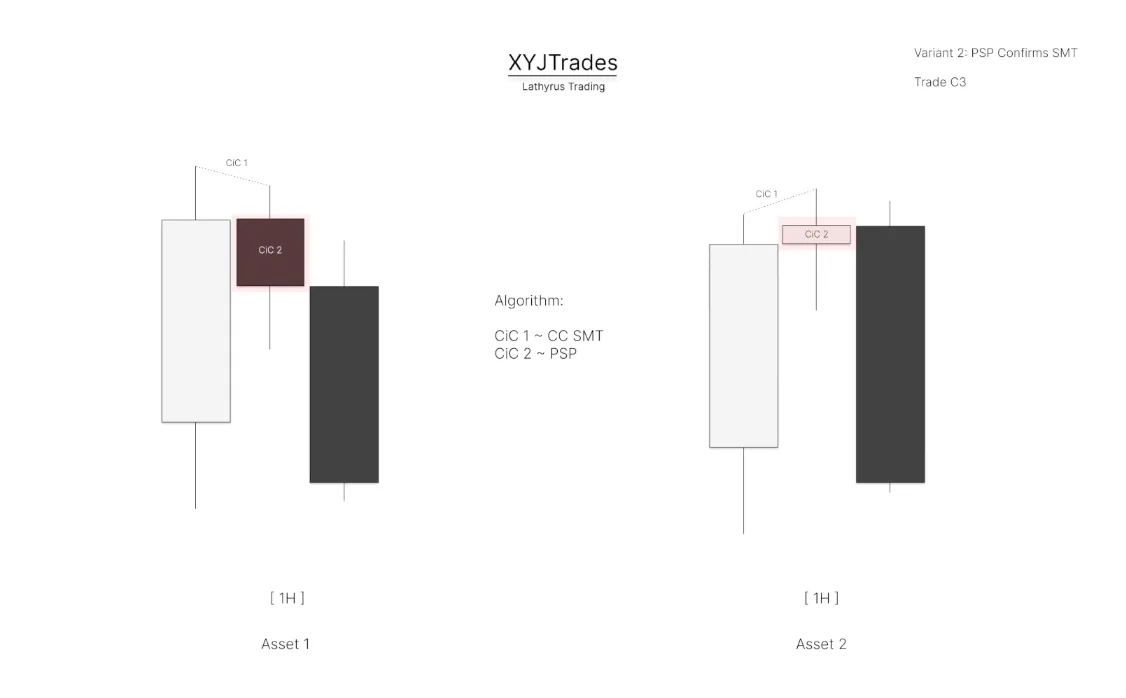
Variant 2: PSP Confirms SMT
In the second variant we cannot trade Candle 2 as a reversal, because it lacks a 2-stage crack until the candle closes. Here the Precision Swing Point confirms the SMT. First we have a crack in correlation between relevant swings or consecutive candles: a relevant level, which could be a higher low to the left. Then the candle that forms the SMT closes as a Precision Swing Point. So the first crack in correlation is an SMT, a one-stage crack, and the second is the formation of the PSP.
It is extremely important to note that we cannot engage this Candle 2 formation, because at the time it forms the SMT we only have a one-stage crack in correlation. Once the candle closes, we have confirmed a 2-stage crack with the Precision Swing Point. Compare this with the first variant, where the Precision Swing Point comes first and the second phase of divergence is the SMT, which lets us engage Candle 2 at the 2-stage reversal. Here we wait for Candle 3 and trade its opposing run and an intracandle CISD toward our draw on liquidity.
Variant 3: 2-Stage PSP And 2-Stage SMT
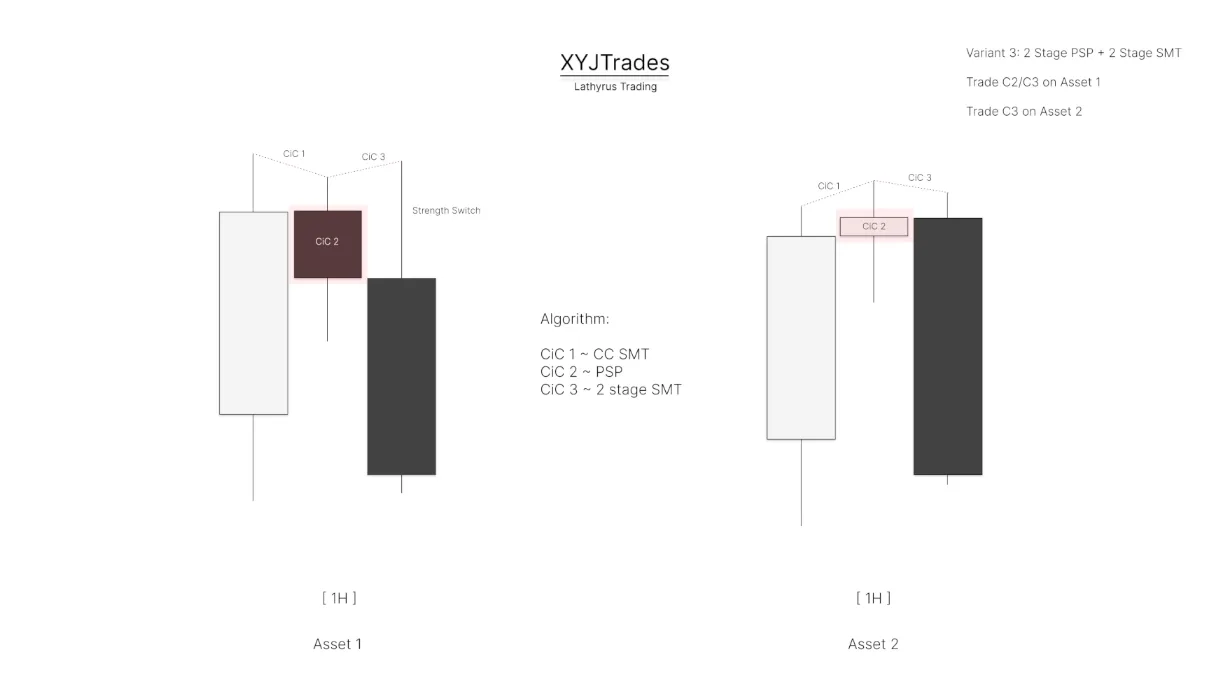
The final variant I will share today, of the five variants that exist, is a 2-stage PSP with a 2-stage SMT divergence. It combines our logic of Precision Swing Points, specifically 2-stage Precision Swing Points, with our understanding of 2-stage SMTs. Functionally this is a three-stage crack in correlation. That might sound complex, so let me walk through it.
- A consecutive candle SMT forms first, or an SMT with a key swing to the left, as in the previous variants.
- The candle then closes as a Precision Swing Point. So far this is identical to Variant 2.
- Then a 2-stage SMT of that high forms, typically with a Strength Switch: the Candle 2 that closed as a reversal on one of the assets is swept out by the opening of the next candle.
In this variant we can still trade that Candle 2 with a Strength Switch framework, or trade the other asset as a continuation candle, C3 logic.
Swing Formations In The Daily Protocol
These three variants are exceptionally common in the market. I will not trade away from a swing point without seeing one of these three swing formations, alongside my daily protocols: daily profiles, draws on liquidity and a universal model variant. I will build on the daily protocol in depth in the future; for now we focus on the swing formations.
You’ve probably got some questions...
Learn The Lathyrus Model with direct guidance from our coaches.
- 10 live streams every week
- Regularly updated in-depth course
- 450+ hours of live stream recordings
+ more
Chart Examples
The chart examples were all live-conducted examples, so please refer to 8:00 in the YouTube video accessible on the right-hand side of this page.
That's the end of this lecture, I hope you found value reading this and you learned something new that you can apply, or further refined your knowledge on this subject.
Back to the top