Introduction
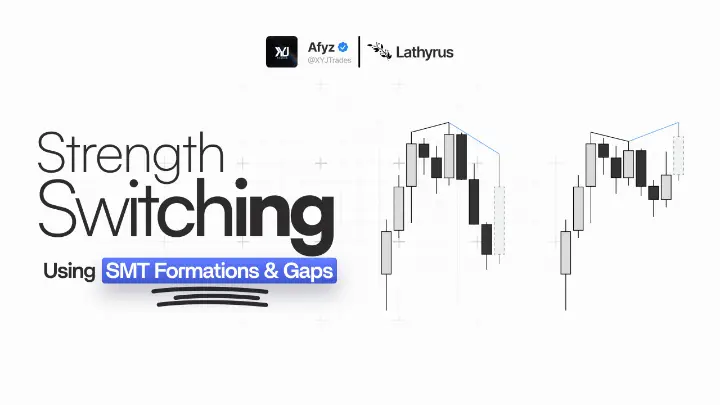
Today we are touching on Strength Switching, and applying a universal framework to mechanically observe this concept and pair it with the concepts you have learned previously. We go through the core logic of Strength Switching, and then apply it to both reversal and continuation logic.
This lecture should be paired with my previous two lectures, so you better understand how markets interact with one another in a triad, and how true reversals and high probability continuations are framed using the confluence of Strength Switching.
The Universal Approach To Strength Switching
Core Logic
To understand the core logic of Strength Switching you need two ideas: liquidity dispersal theory and asset synchronization.
Liquidity dispersal theory is simply a way of saying that markets do not evenly inject liquidity into all the assets in a triad. That results in the relative strength and relative weakness you observe nearly every single day across all correlated markets. In this generic assessment of the index futures triad there is a leading asset, which trades away from a point of interest and expands toward the other side of the range; a middle asset, which is weaker; and a lagging asset, which is the weakest and the furthest away from the relevant level.
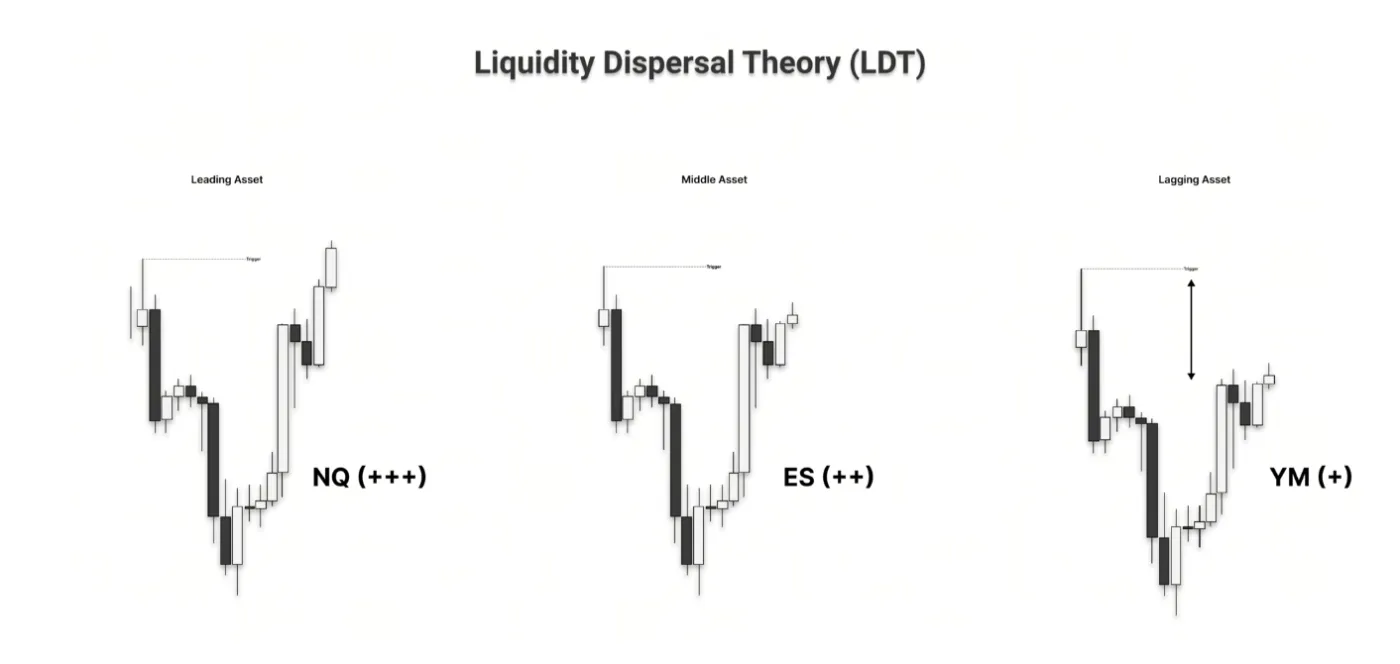
This relative strength is the result of market makers not injecting equal amounts of liquidity into these highly correlated assets. We can go one step further and say that the uneven dispersal of liquidity is what results in SMT formations in the market.
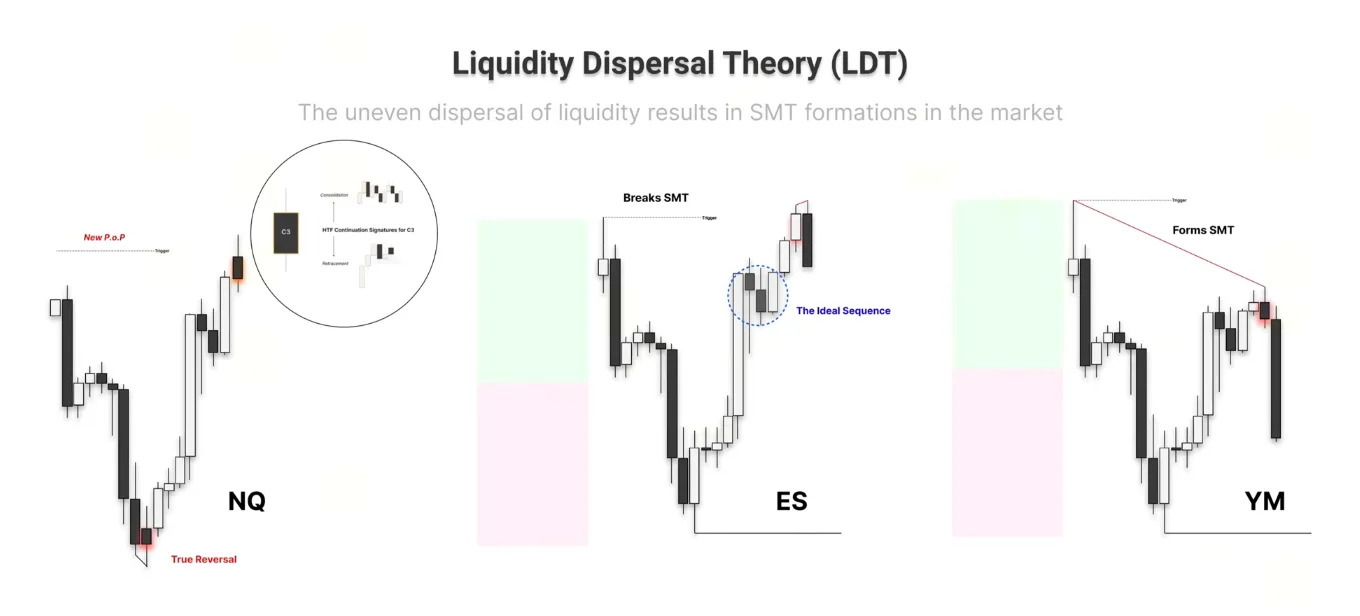
The signatures this uneven dispersal leaves in price are the basis of what we define as Strength Switching, and they let us determine what is happening at extreme levels: whether a true reversal or a continuation is going to form at a key level. Is price going to break this SMT, or form an SMT and reverse? We use Strength Switching at key levels, with all three markets of the triad in mind, to better understand if we are going to get a true reversal, which is why it is such a powerful and important concept.
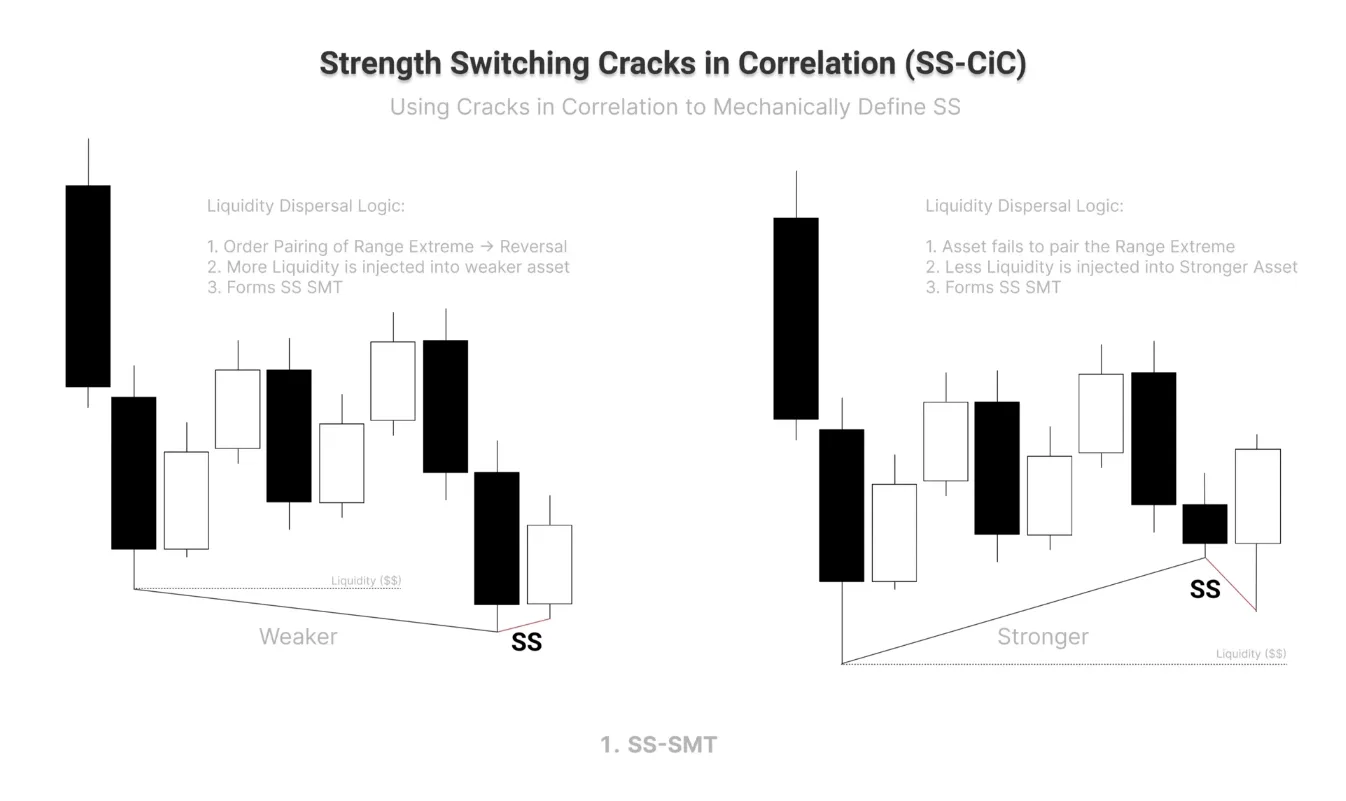
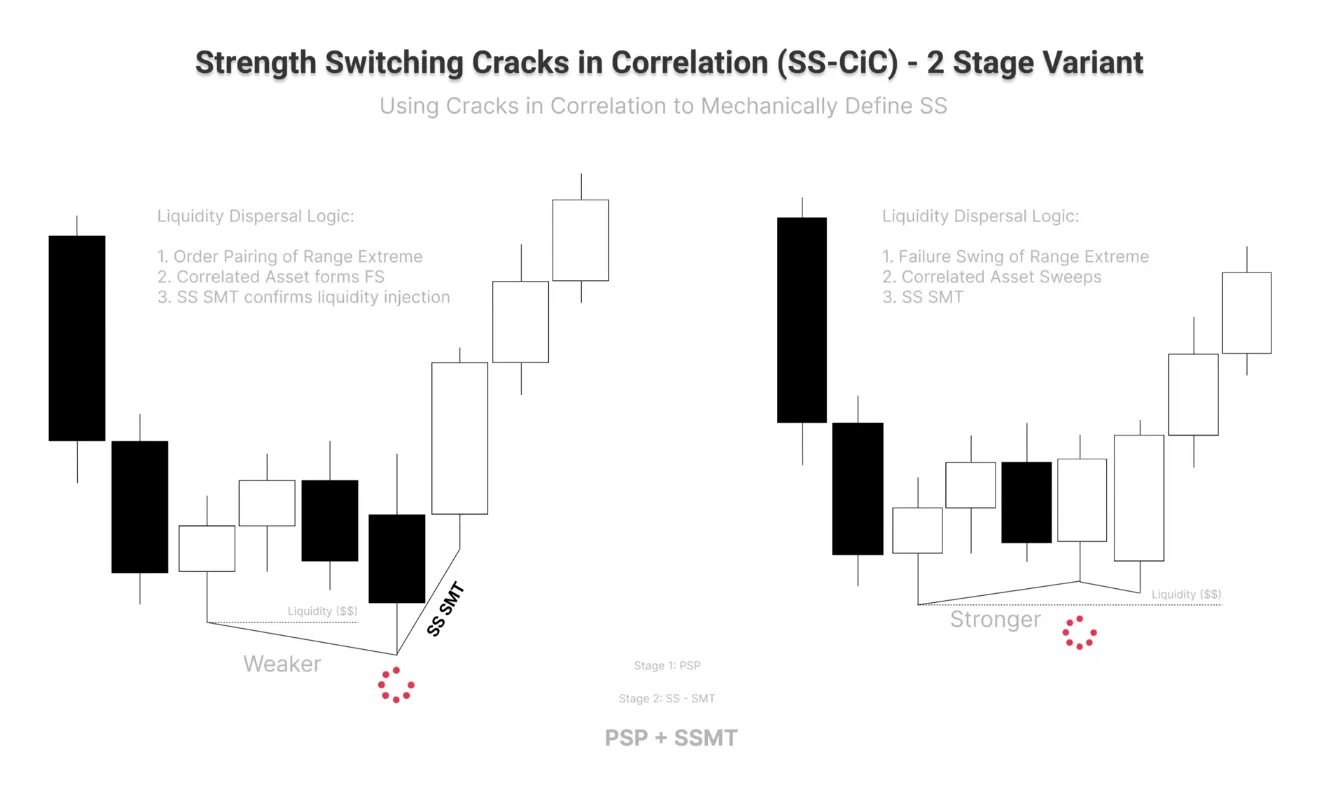
So let's look at what these Strength Switch cracks in correlation really are. We use cracks in correlation to mechanically define the otherwise vague concept of strength between markets.
The first is a Strength Switch SMT. Consider the weaker asset, the one that takes out a low, or fails to take out a high. If that weaker asset gives us a Strength Switch SMT between consecutive candles at the point of reversal, before expanding away, it is a sign that price is reversing off the low and liquidity is being injected into the market. Why does that make sense? We are order pairing the extreme of the range. Those sell stops form liquidity that is injected into the market, and the Strength Switch SMT you are observing is a function of that order pairing: momentary strength from the sell stops being absorbed.
The same logic is true for the once-stronger asset. The asset that fails to pair the range extreme has less liquidity injected into it, so at the point of reversal, when it trades lower to form the consecutive candle SMT, that Strength Switch shows it is being paired with the strength of the other asset to trade higher. So the Strength Switch SMT is one mechanical filter to define a Strength Switch at a key level: an old low, an old high, or, in the case of a continuation, a gap.
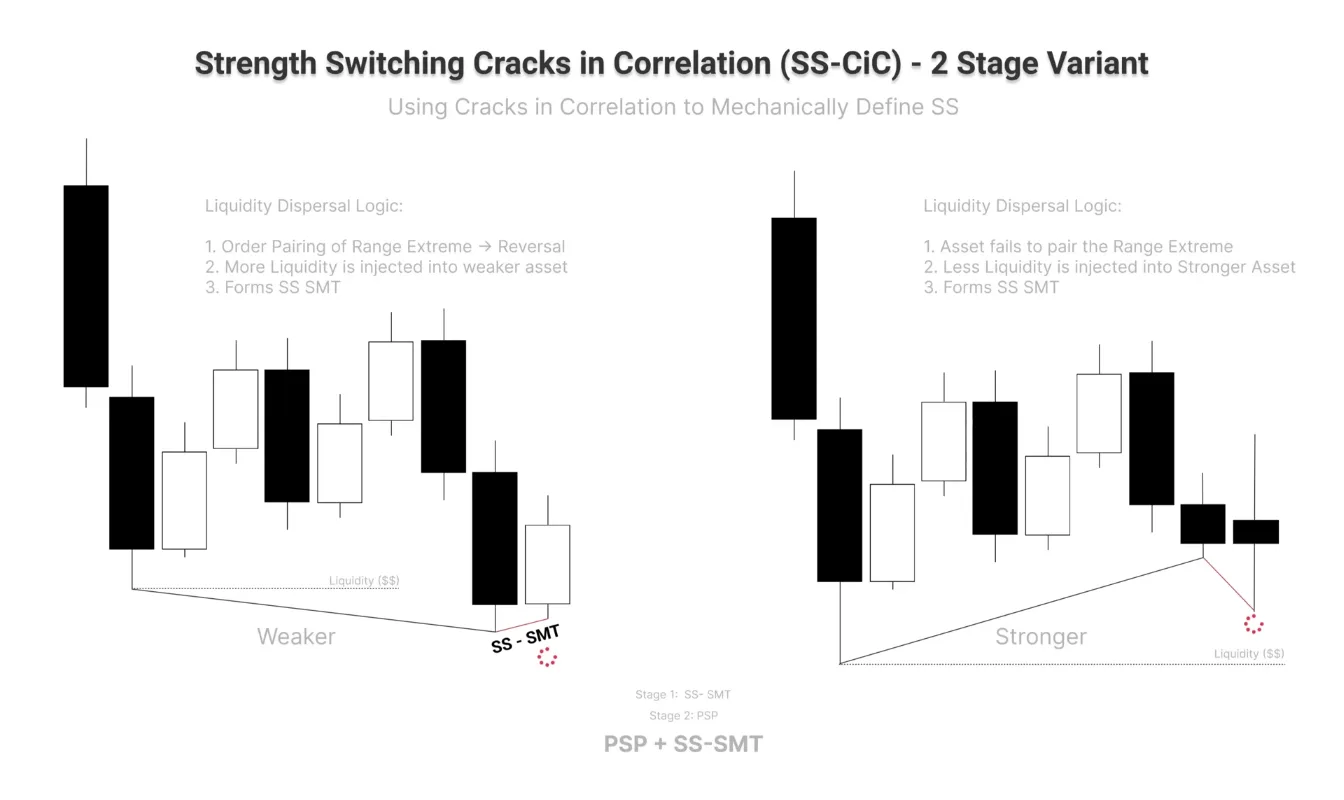
The 2-stage variant of a Strength Switch SMT is a PSP forming after the Strength Switch SMT. There is order pairing of the range extreme, an expansion candle, and as liquidity is injected into the market we form both the Strength Switch SMT and the PSP, which can be a bullish or a bearish PSP. What matters is that there is a 2-stage component to this crack in correlation.
The Strength Switch PSP shows something very similar. Price trades into a low on the weaker asset and closes as a bullish candle, showing on the candlestick chart that liquidity is being paired and that the Strength Switch, via the closure of this swing point, is bullish. On the other side, the asset that was once stronger fails to pair the low, forms a failure swing and closes as a bearish candle right at the point of reversal, showing that less liquidity is being injected there because it has not order paired the low. So this asset is Strength Switching.
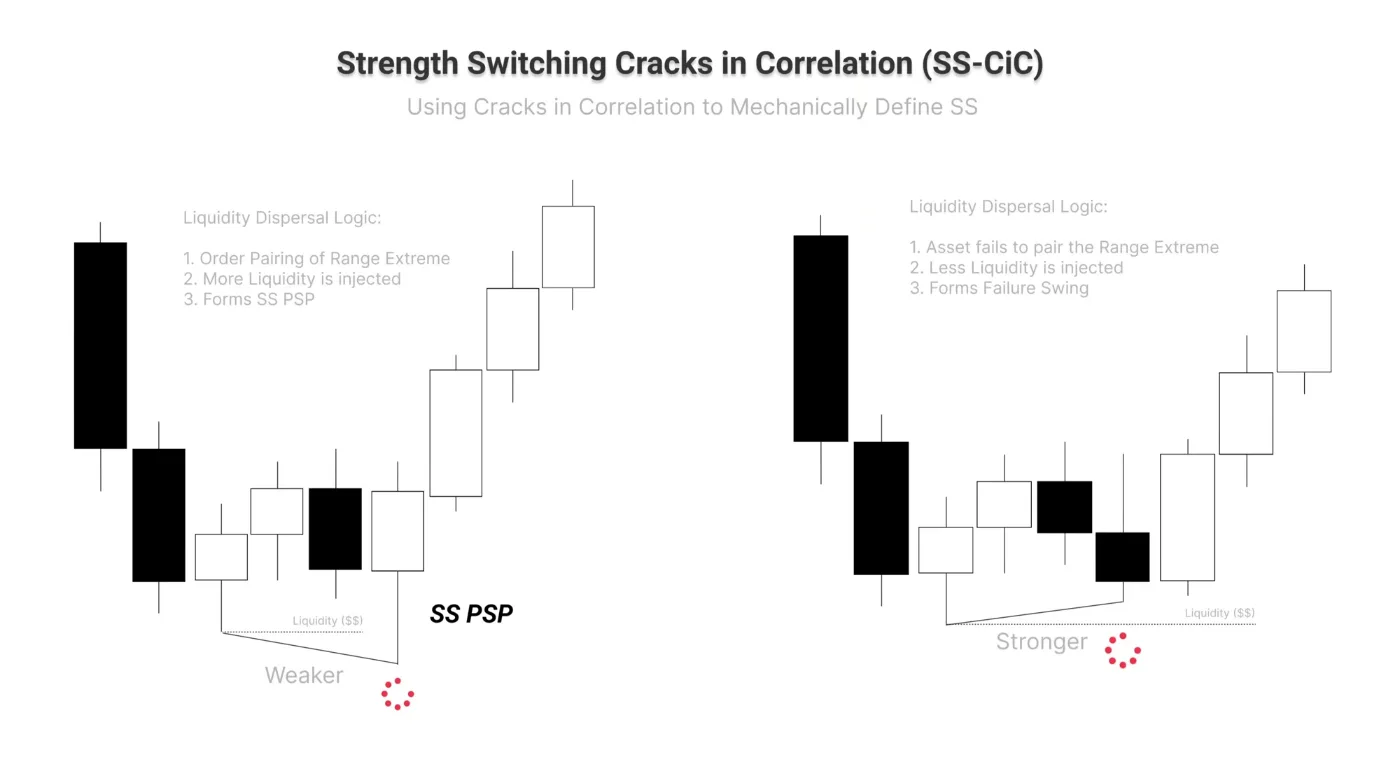
Just as with the Strength Switch SMT, there is also a 2-stage Strength Switch PSP: we form the PSP and then also get the consecutive candle SMT, forming a Strength Switch at the lows. Here the weaker asset closes as a bearish candle, so that is not Strength Switching yet, it is just a PSP. Once we get the Strength Switch SMT, it confirms that we are trading away from this low and away from this failure swing. These are the cracks in correlation we use in our analysis moving forward.
Now asset synchronization, and how Strength Switching can confirm it. I teach this as a function of a universal model, meaning there is a universal application to the idea and to where you should consider Strength Switching as a filter. Take two generic Market Maker Models, a leading asset and a lagging asset, and consider the leading asset trading into a range extreme. This is where you want to consider liquidity dispersal theory and Strength Switching. There are two things the lagging asset can now do: catch up through asset synchronization and Strength Switching and break the SMT, or reverse through Strength Switching of the leading asset into bearish order flow. Markets synchronize to either break the SMT, the catch-up leg, or hold the SMT and reverse.
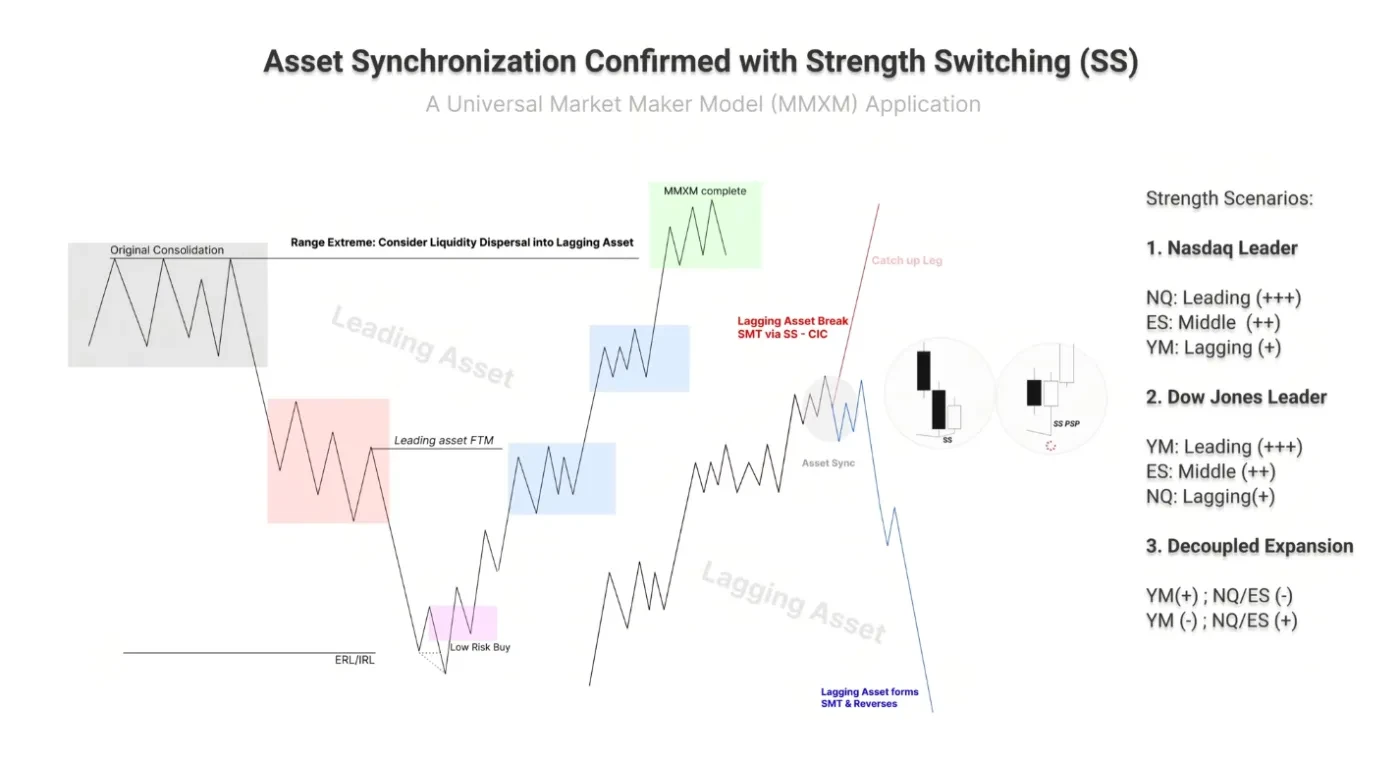
There is an intrinsic logic to using Strength Switching for asset synchronization. If the lagging asset is going to break the SMT high and catch up, we will see some form of Strength Switching, or liquidity dispersal into the lagging asset, so that it can break the SMT and pair that same level. If we are going to form an SMT and reverse, we will see the leading asset reverse and not Strength Switch with the lagging asset. That way we understand both where reversals are likely to hold and where continuations are likely to occur. This concept is a confluence for any strength scenario of a triad.
Reversal Frameworks
How can we better understand range extremes and true reversals using Strength Switching? The first framework is an advanced premium and discount sequence paired with a Strength Switch. One asset reverses off a high, as in a Market Maker Model where we trade to an external high and expand lower. During the reaccumulation phase of this leading asset, we see a Strength Switch SMT as the other asset breaks the high and then reverses. The asset that was once weaker Strength Switches to break the SMT and then reverses, while the asset that was once stronger is now in continuation: it forms the SMT, meaning it is weaker, and continues toward the draw. The 2-stage variant shows a local Strength Switch as well, paired with the higher time frame model.
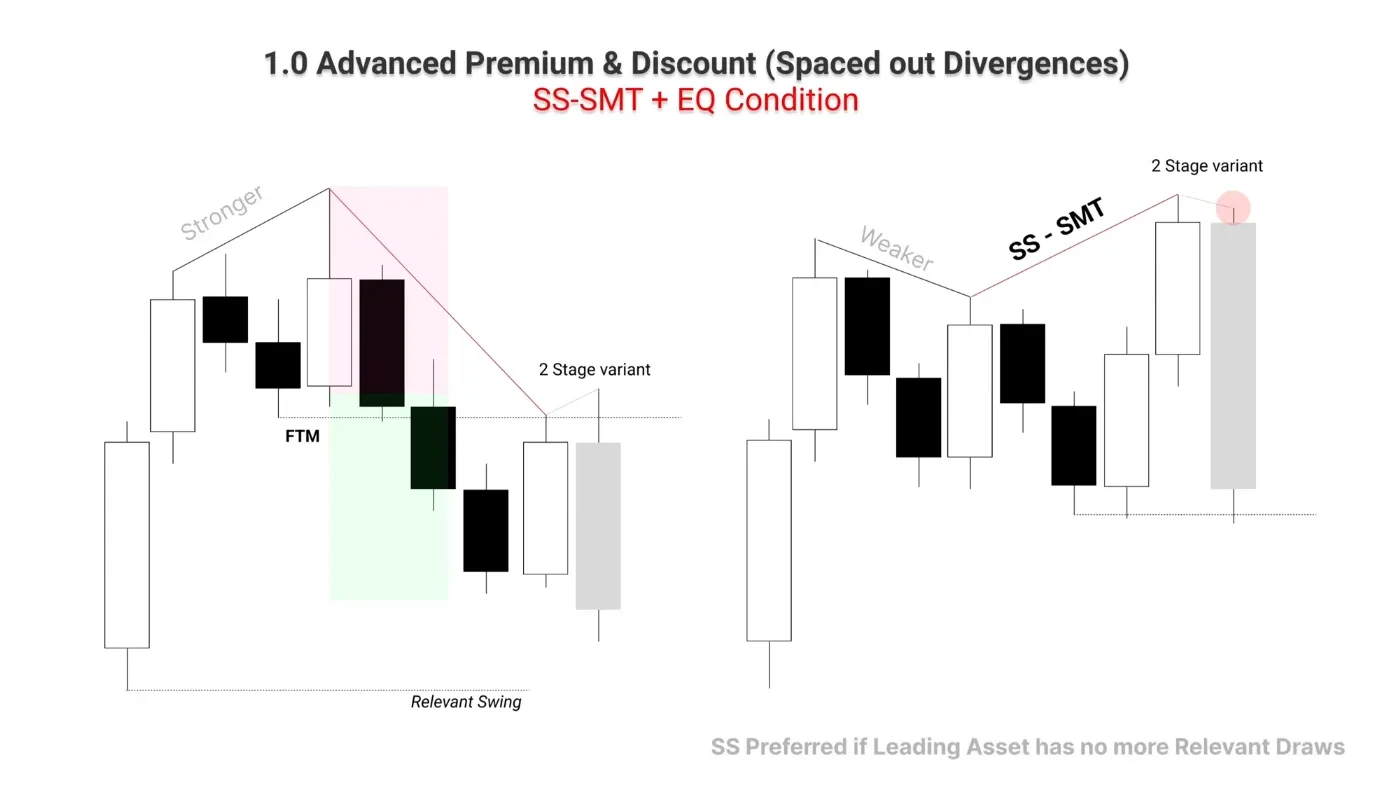
The bullish case: the weaker asset reverses at the range low with a V-shape, then the asset that was once stronger breaks the SMT and reverses as well, while the first asset is in continuation. We use equilibrium paired with the Strength Switch SMT, and again you can see the local 2-stage variant, with a PSP or another SMT, where the reversal happens at the lows and the continuation happens on the leading asset that already reversed.
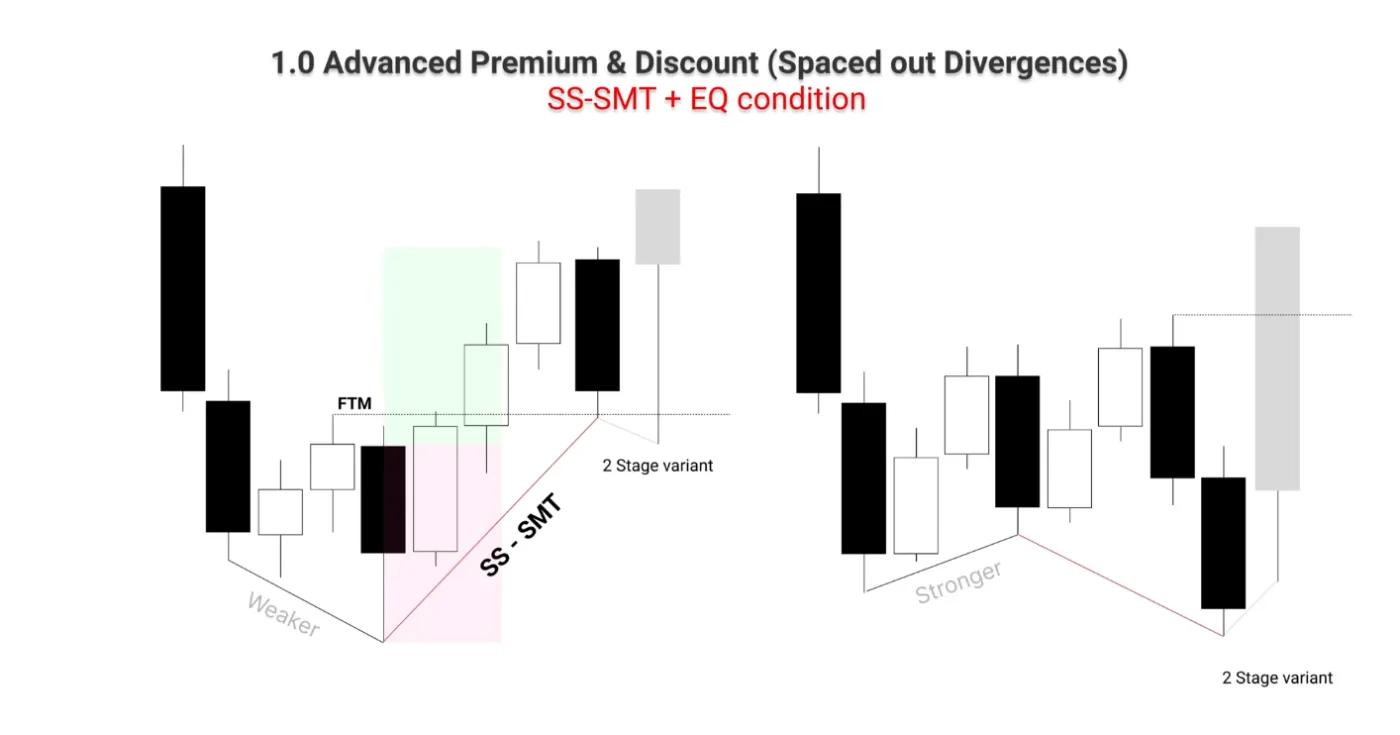
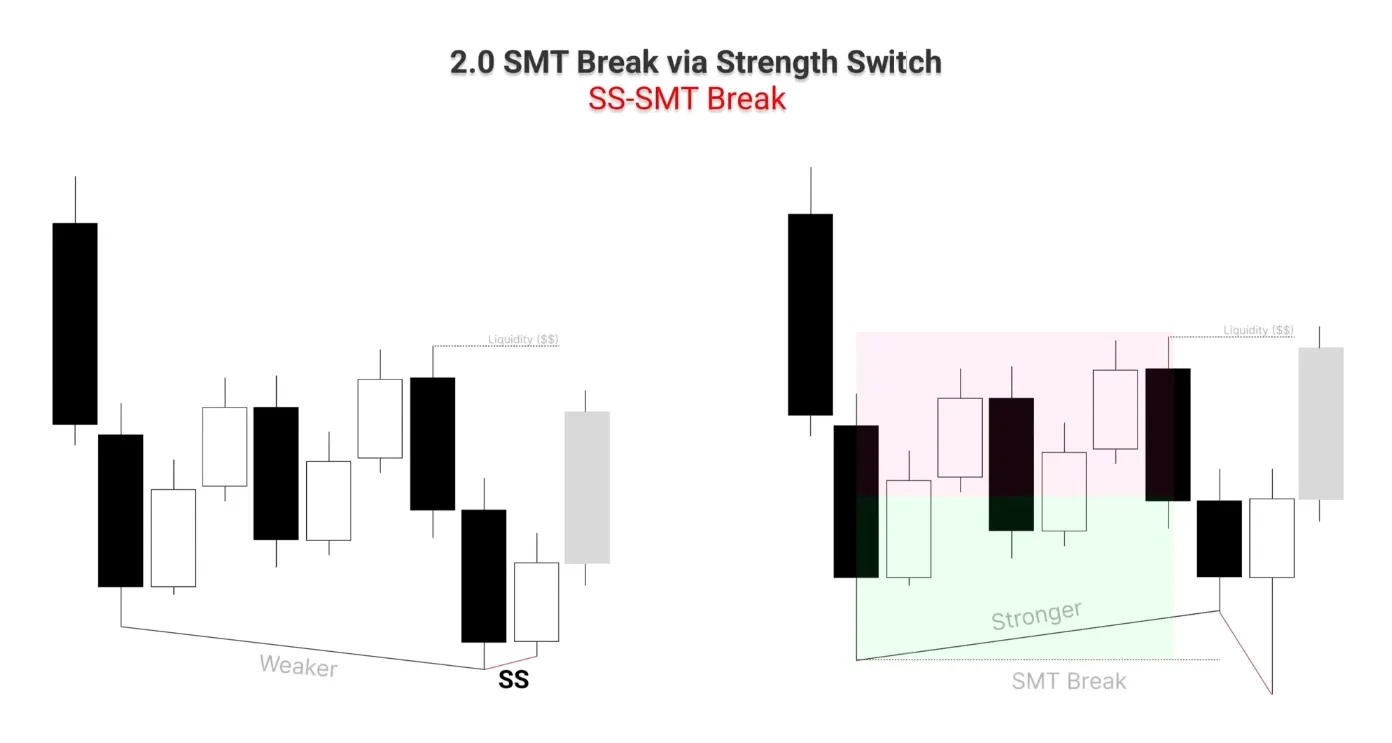
Here is another example, where we don't see the expansion away from the low on the previously weaker asset. The asset that was stronger lingers near the high, and we get the SMT break I talked about in my advanced premium and discount sequence: when assets are extremely close to the high, they are likely to break it. When they do, we see the Strength Switch SMT, the previously stronger asset becoming momentarily weaker, and then expanding toward the draw. We use asset synchronization, the idea of relevant swings, to demand Strength Switching at times. Here, because there is an open draw on all assets, we don't strictly need to see it, but it is preferred and more probable.
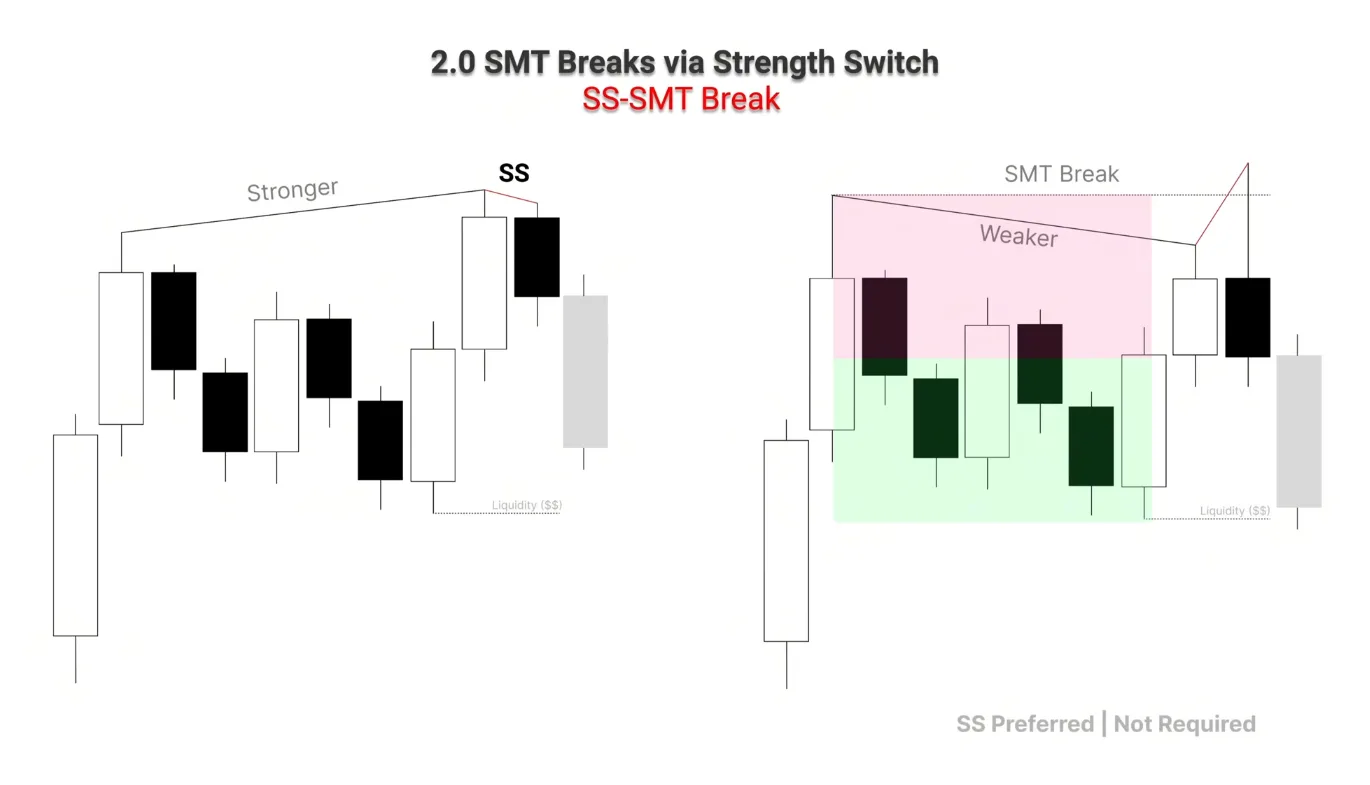
The bullish case: the weaker asset momentarily Strength Switches as the stronger asset breaks the SMT and then reverses. We have already order paired the low, and now we are continuing from that reversal, with this asset breaking the SMT and then reversing itself.
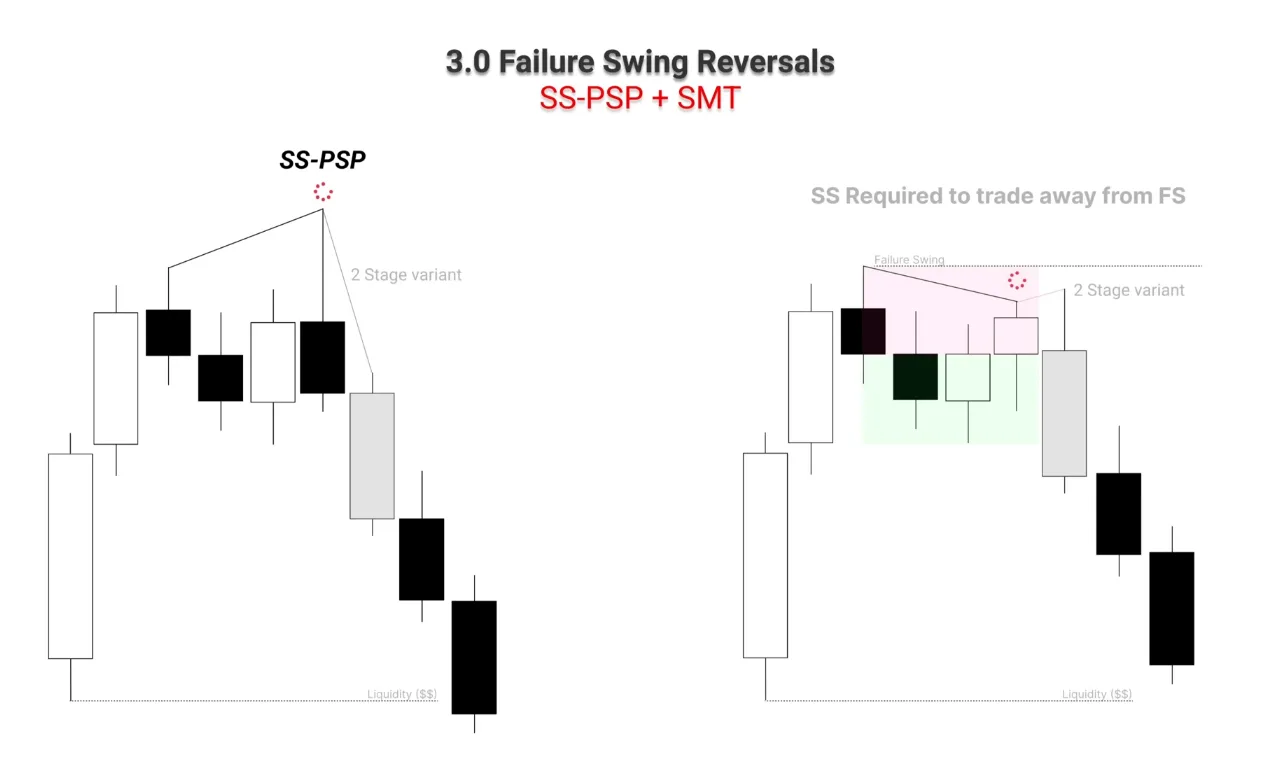
Now the PSP variants. What happens when the leading asset trades into a high and forms a bearish close? That is a Strength Switch PSP, and it lets us trade away from failure swings. To trade away from a failure swing I need to see this Strength Switch, because it shows me the leading asset is reversing off the range high and wants to expand toward the other side of the range. The SMT in premium can hold because the asset that was once stronger forms that bearish close. This is the only way I will trade away from failure swings: if I see a Strength Switch signature. The 2-stage variant adds the consecutive candle SMT, the Strength Switch SMT, paired with the PSP.
In the bullish case, the weaker asset forms a bearish close, so I don't trust that on its own. When I see the 2-stage form on this PSP, a Strength Switch SMT, I can validate trading away from the failure swing. So in the case of a failure swing, with a deep retracement into the lower high, I need to see a Strength Switch of some sort, via PSP, via SMT, or both, to trade away from it.
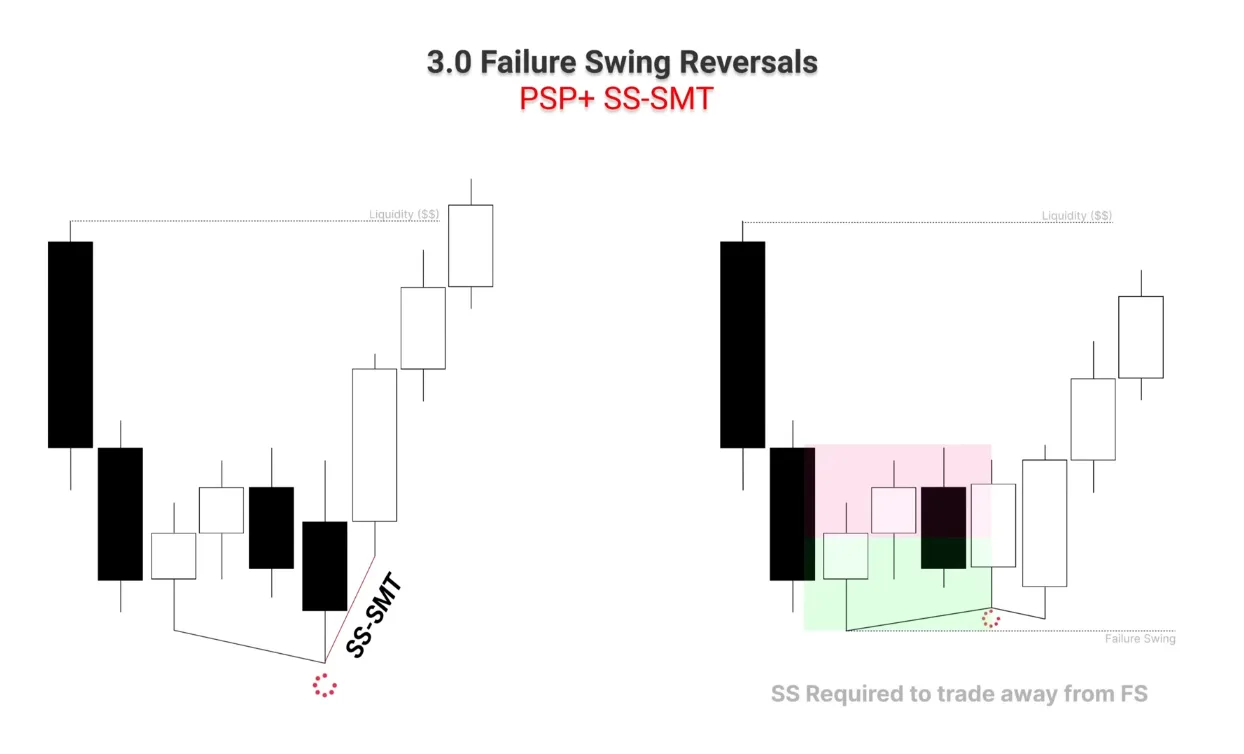
The other way to trade away from a failure swing is a continuation sequence, covered in the next chapter: waiting and demanding a gap to be printed away from the failure swing low or high, and then trading the universal sequence, the continuation sequence, that forms after it. That is the core idea of failure swing reversals and how we use Strength Switching to validate them.
There is one more way to use Strength Switching at reversals, and that is for decoupled markets. This is when the leading or middle asset and the lagging asset diverge at a key level: one asset expands into a low while the others expand into a high. Markets resynchronize through these Strength Switch cracks in correlation. I will build out more of this logic in a future lecture, but what you have to understand is that the asset that expanded forms some sort of Strength Switch with the assets reversing at the high, and you see the same sequences. That is how we confirm that these markets are going to resynchronize: by seeing these Strength Switching signatures between the leading, lagging and middle assets.
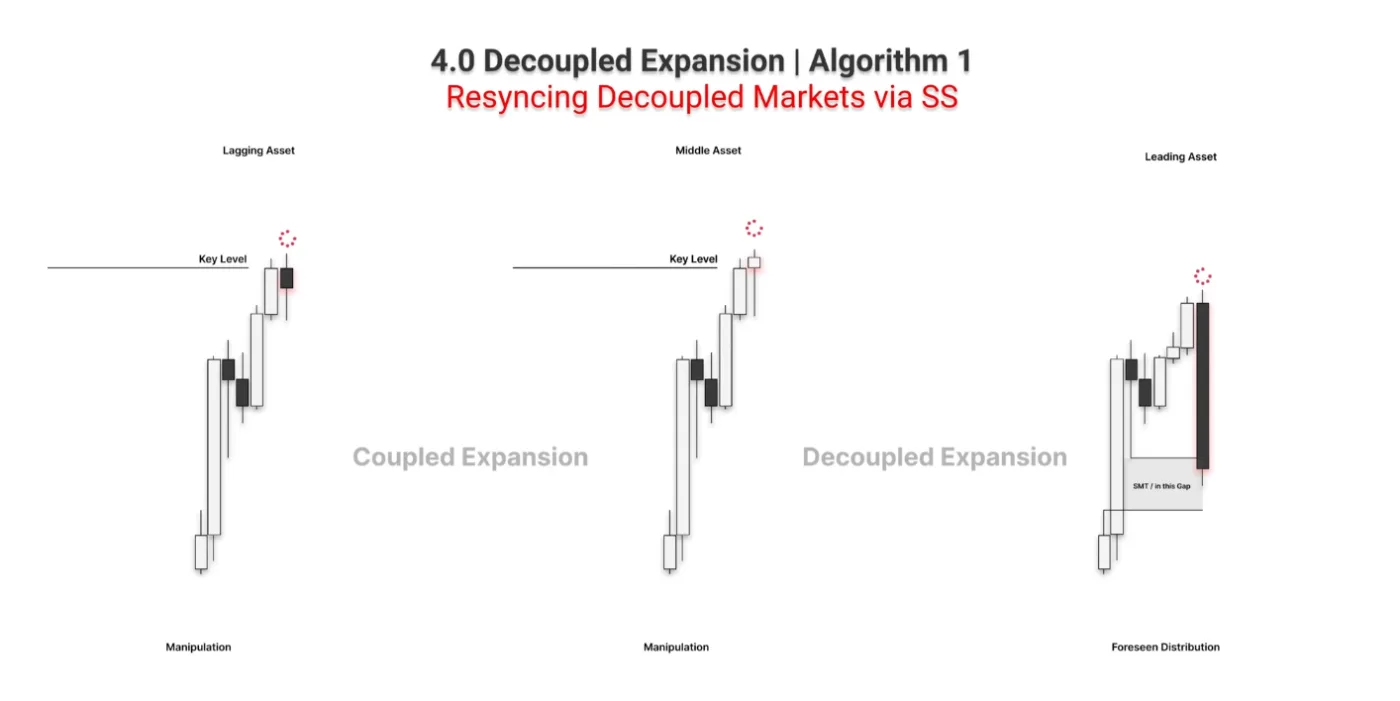
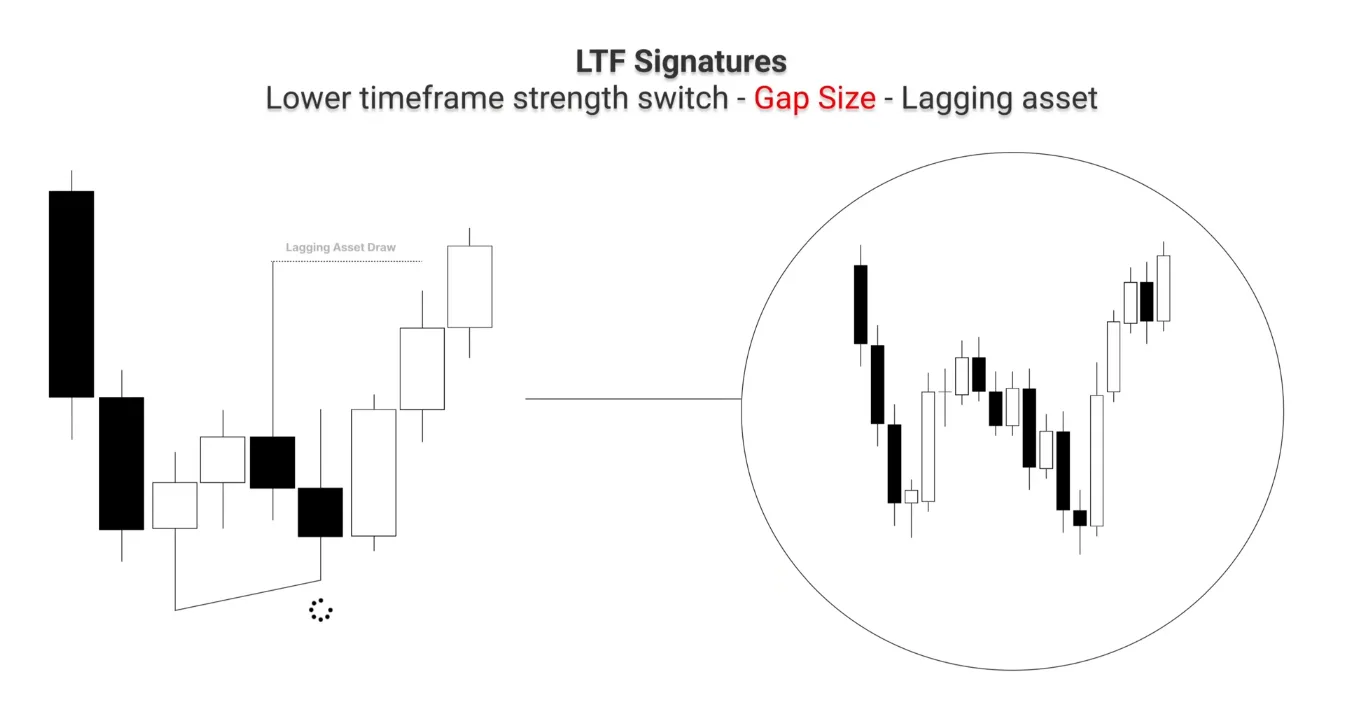
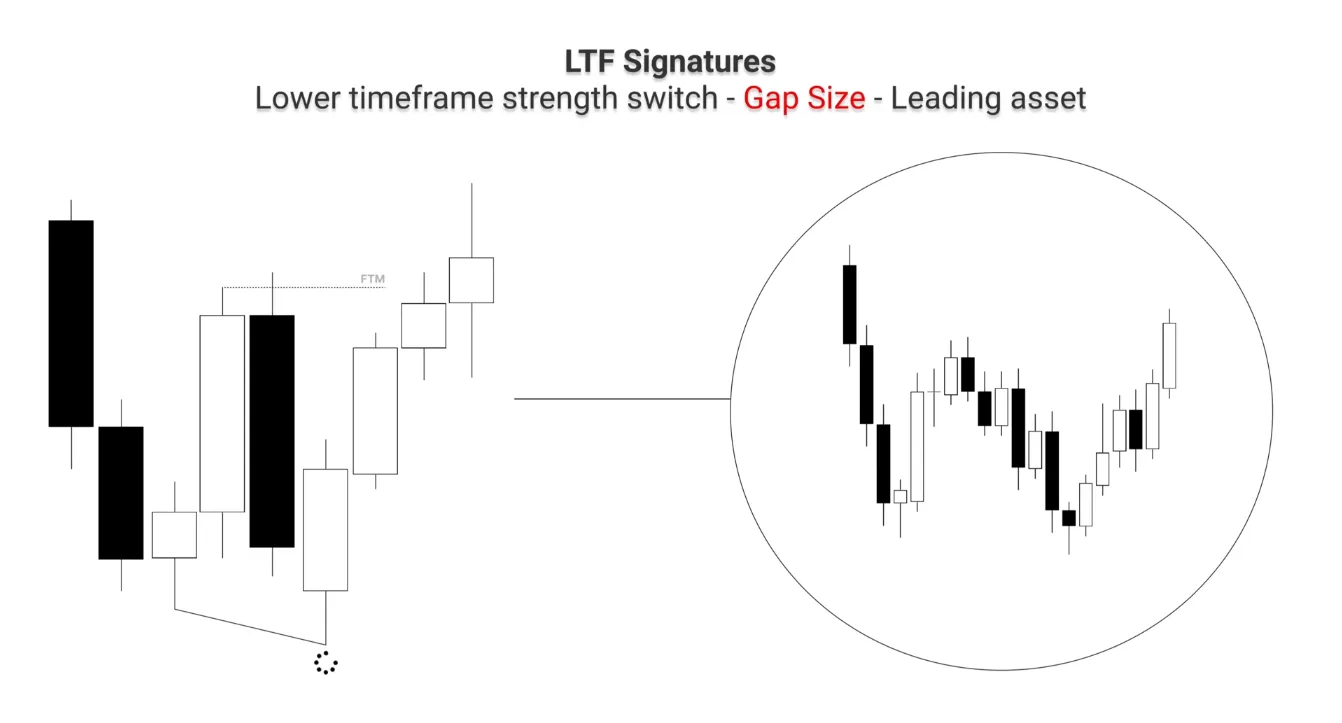
There are lower time frame signatures for Strength Switching too. Beyond the higher time frame cracks in correlation and candle closes, on the lower time frame we can see faster CISDs. The lagging asset has a draw on liquidity and is reversing with Strength Switching at the low: we might see a faster CISD to break the high, while the leading asset, which has already taken out a high, more or less consolidates. The lagging asset Strength Switches and starts to trade into that high with faster expansion and quicker V-shapes.
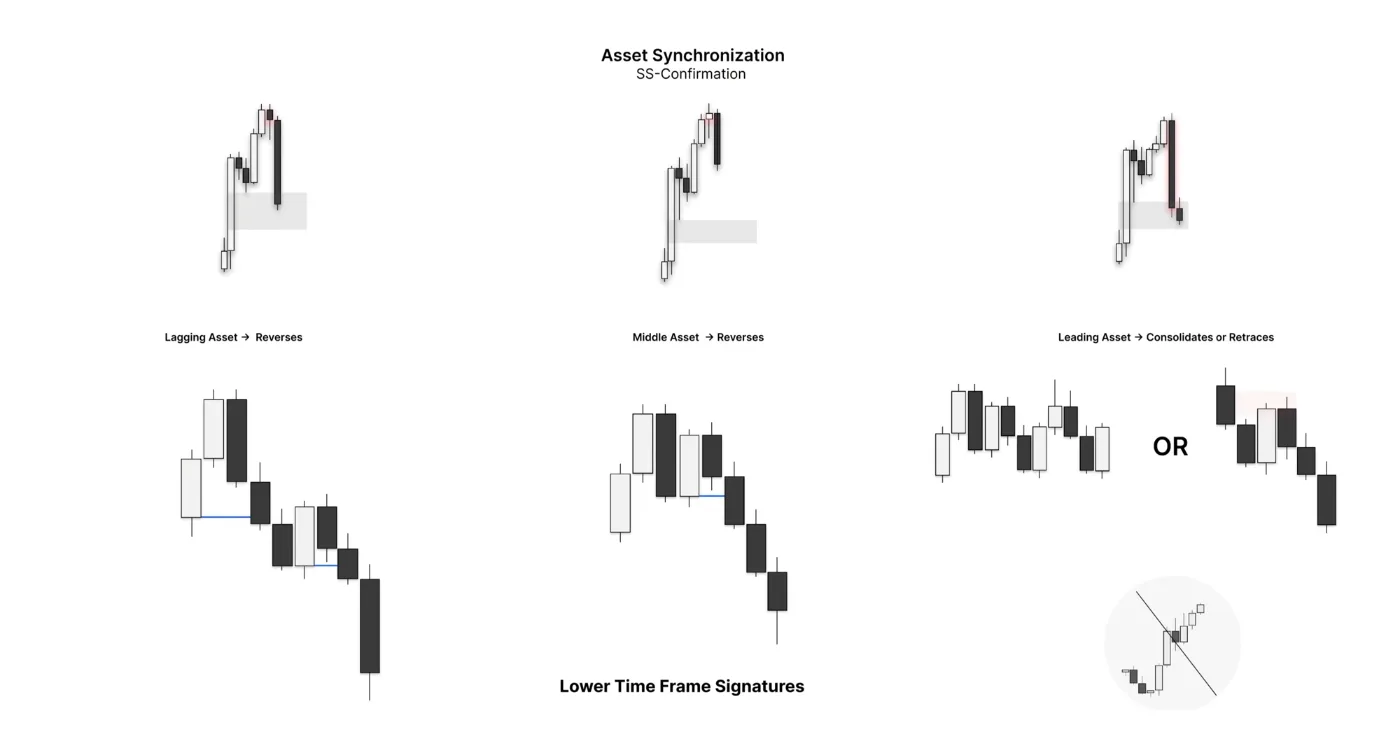
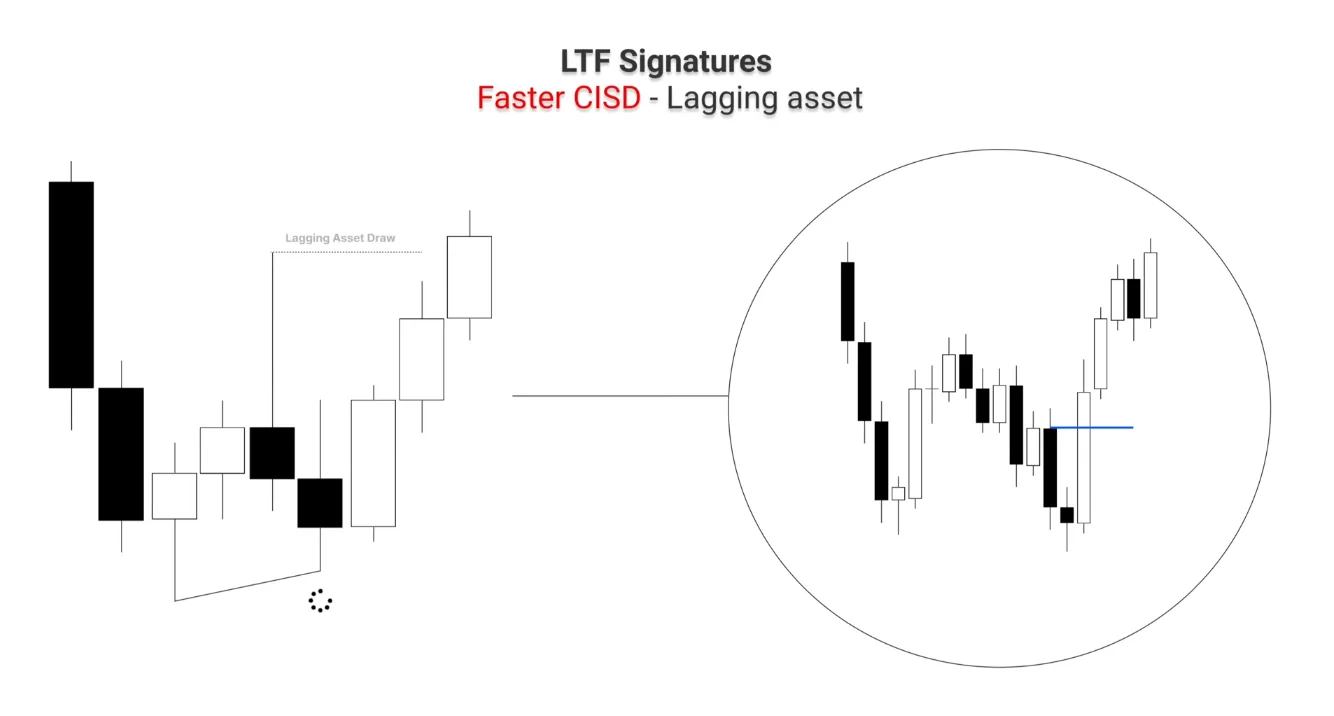
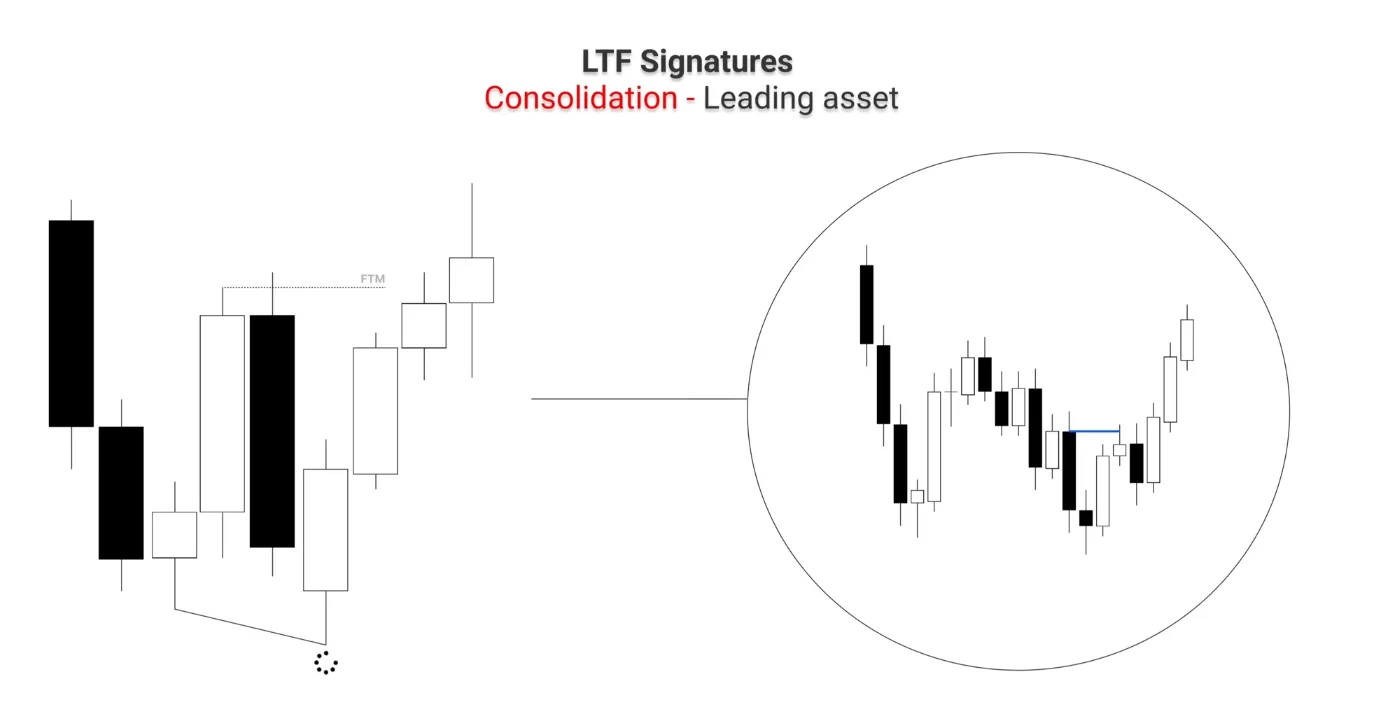
We can also use gap size. With a Strength Switch on the higher time frame, the lagging asset may draw into the same high through asset synchronization via larger fair value gaps created at the reversal, with smaller fair value gaps on the leading asset that already manipulated the high. These lower time frame signatures can be paired with the higher time frame cracks in correlation.
Continuation Frameworks
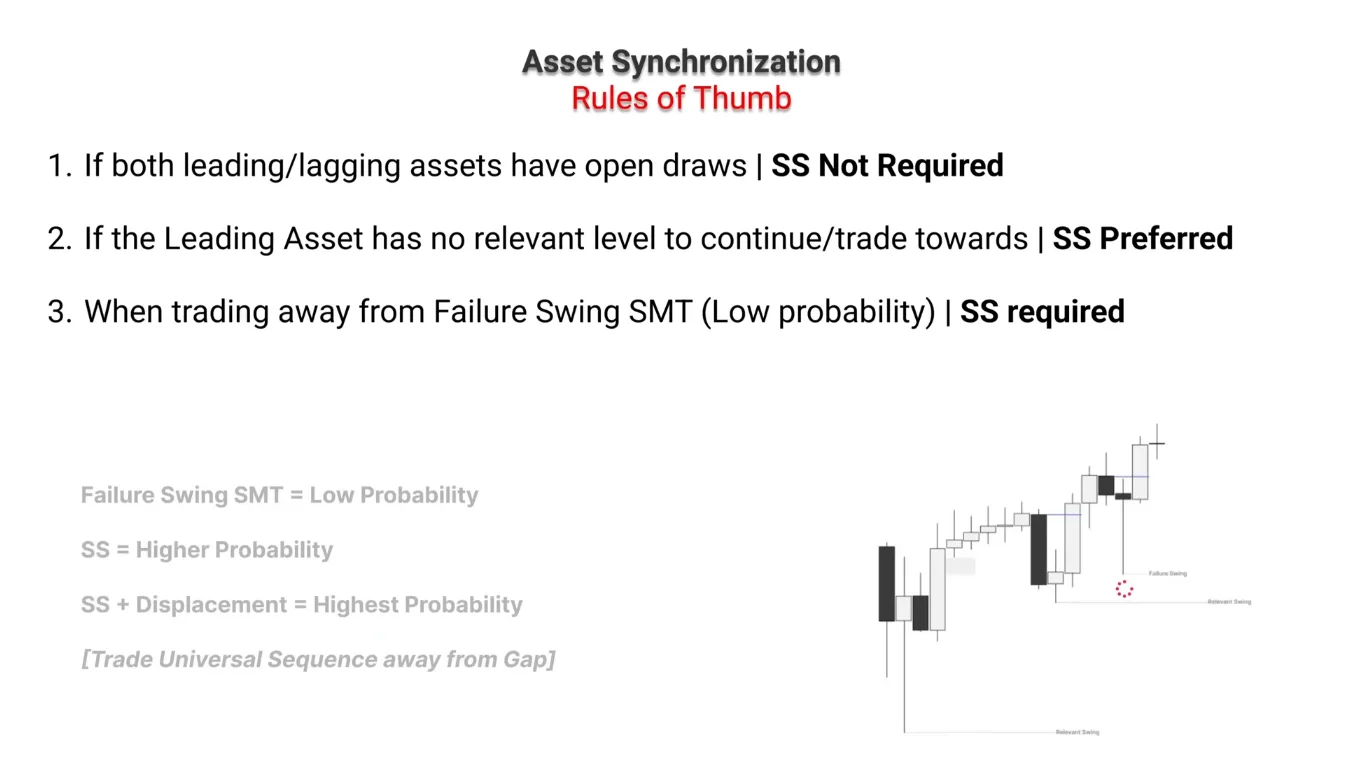
Now the continuation sequences, the framework by which assets synchronize through Strength Switching to break SMTs. Some rules of thumb first:
- If both the leading and the lagging asset have an open draw, a Strength Switch is not mechanically required, meaning we do not need to see it before we can trade.
- If the leading asset has no relevant swings to continue trading toward, we prefer a Strength Switch. For example, if there are no relevant levels to the left in the daily range, there is nothing for the leading asset to draw into in continuation.
- When we trade away from a failure swing SMT, at either the range high or the range low, I require a Strength Switch. SMTs that form deep in the range are low probability; a Strength Switch makes the reversal higher probability. What makes it highest probability is then waiting for displacement away from the failure swing: if price creates a gap, we can trade a universal sequence away from that gap as the highest probability failure swing sequence.
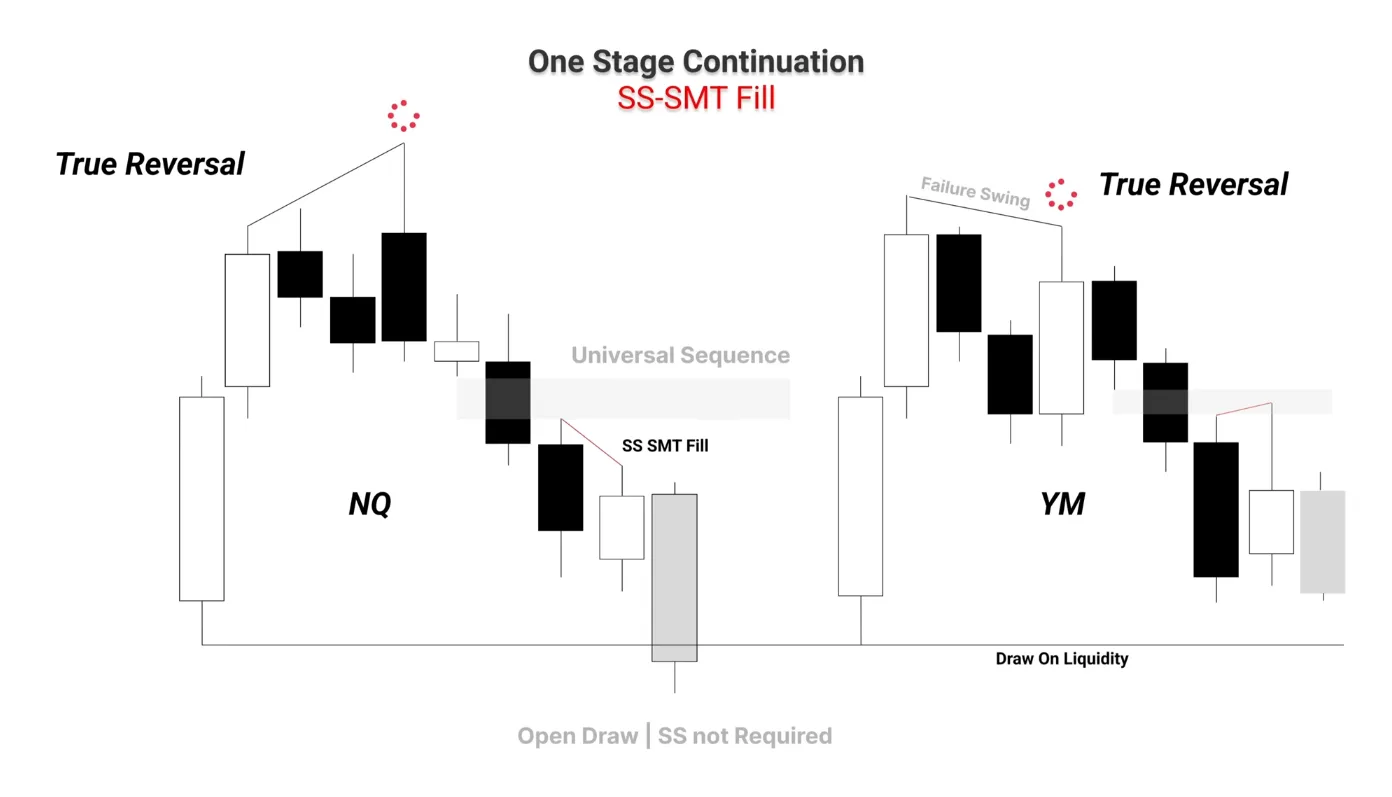
One-stage continuations are Strength Switch SMT fills from gaps. Take a true reversal, where the asset that was once stronger forms the PSP, indicating the failure swing will hold. To validate it, instead of trading that first leg, we wait for expansion away from the high, a gap to be created, and then trade the universal sequence from the gap using the Strength Switch SMT fill. Both assets have open draws here, so we don't demand it, but you can see the universal sequence paired with the Strength Switch SMT fill. You want to trade the asset that was once stronger and is now weaker toward the low; the asset that was once weaker is now stronger. That is a one-stage continuation: a Strength Switch SMT fill.
Now the case where the draw is met by the leading asset. This asset reverses and expands into the high, and here we use asset synchronization via Strength Switching for the SMT to break. Once the leading asset hits the high, we expect a universal sequence: we get a Strength Switch SMT fill in the gap, and the next candle expands into the high. We want to trade the lagging asset, because we are getting asset synchronization, an SMT break, via a Strength Switch. When the draw is met, we prefer to see this sequence form to trade higher.
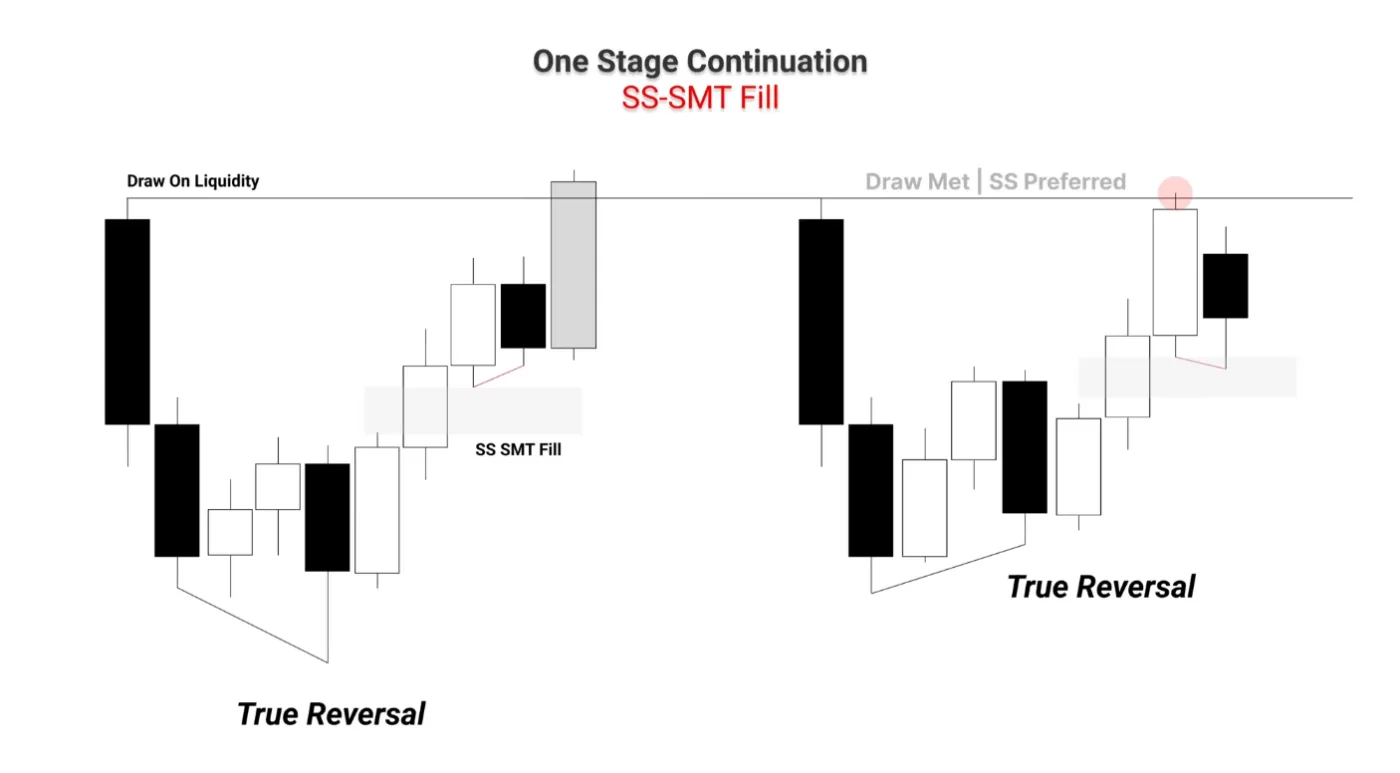
The 2-stage examples use the same logic. If the draw is met on the leading asset, sometimes we see a retracement, which is not a reversal signature (there is no V-shape), and then some sort of SMT fill paired with the PSP, indicating a retracement of the leading asset, and again continuation to the draw. That is a 2-stage Strength Switch continuation.
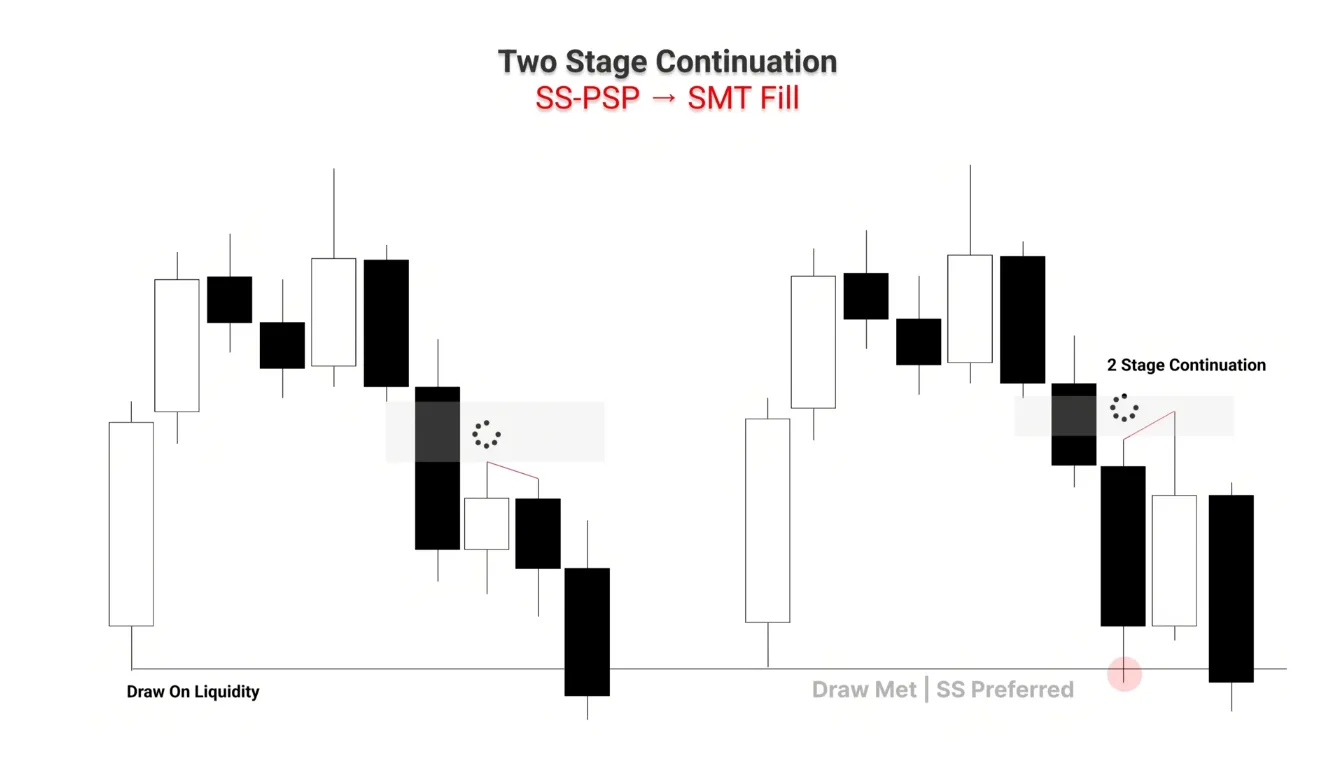
In the bullish case there is an open draw on both assets, so we want to trade the leading asset. A good rule of thumb: trade the leading asset until the draw is met, at which point look for asset synchronization via Strength Switching to trade the lagging asset. Even though the leading asset forms the bearish SMT and the other the bullish SMT, it is still the asset to trade toward the draw, because it is in closer proximity to the draw and it is the bullish asset. The Strength Switch signature is just telling us that all assets are very likely to hit the high, with liquidity being dispersed into the lagging asset to break the SMT once it forms.
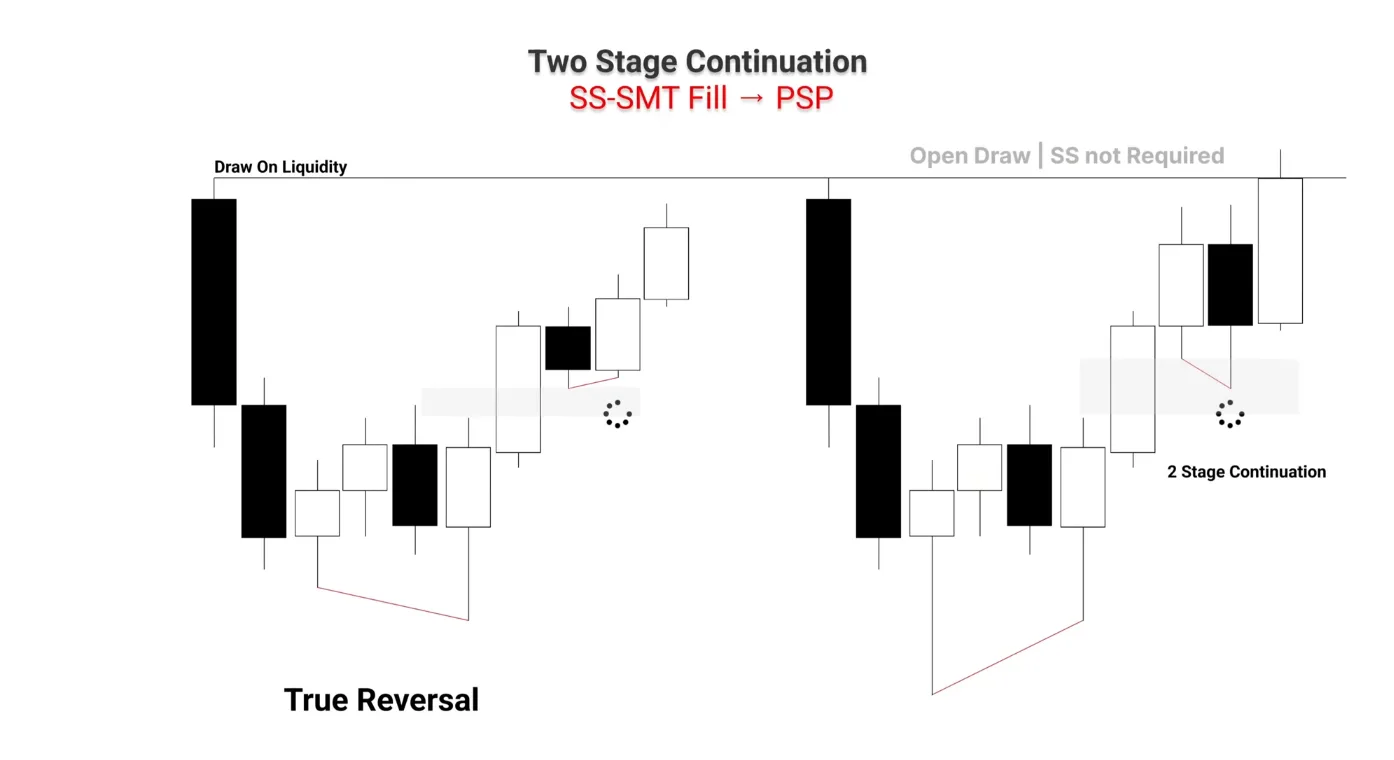
Now that idea of lagging assets redistributing and breaking SMTs via Strength Switching. In the generic example, the leading asset trades into a key level (a high) and puts in a continuation signature, which looks like a consolidation or a retracement, not a V-shape. We then evaluate whether liquidity will disperse into the middle and lagging assets to break the SMT via a Strength Switch. At the lows we had a Strength Switch SMT, we expanded away, and now we have an SMT at the highs. Will we get Strength Switching to reach that high, or form the SMT and reverse? The answer lies in Strength Switching: it validates whether a reversal will hold or whether we will get a break of that SMT level.
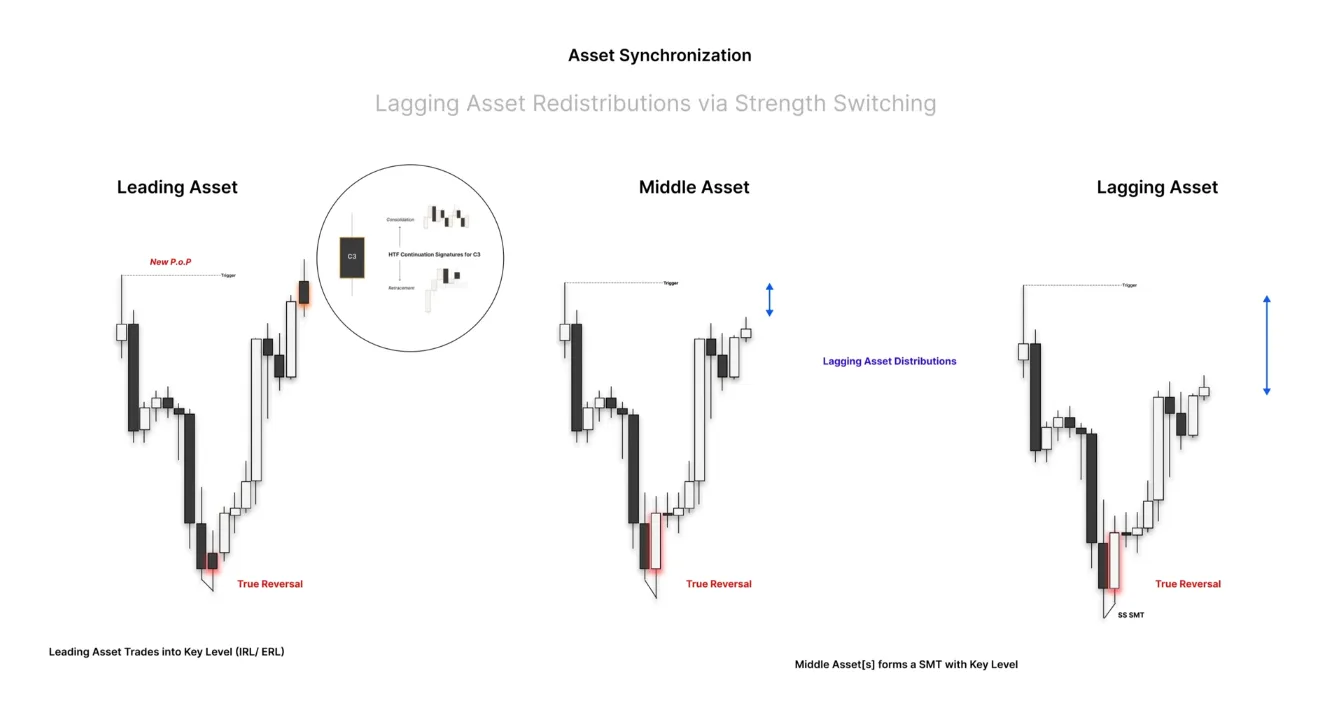
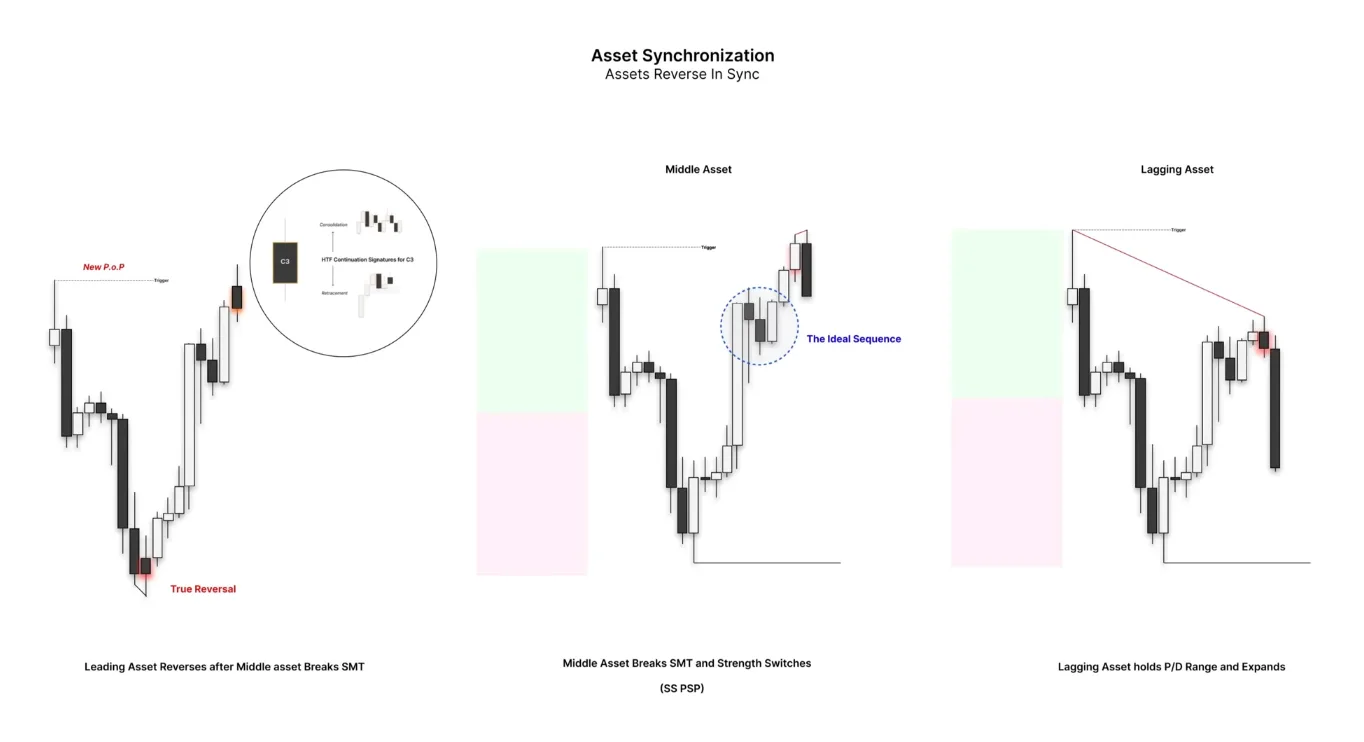
The ideal sequence is when the leading asset trades into a key level and forms a PSP, signifying that it is not reversing but consolidating or retracing, because it leaves a gap. Then we trade the lagging asset via a Strength Switch SMT toward the SMT break. What you see on the middle asset is exactly what you observe on the lower time frame to reach the key level.
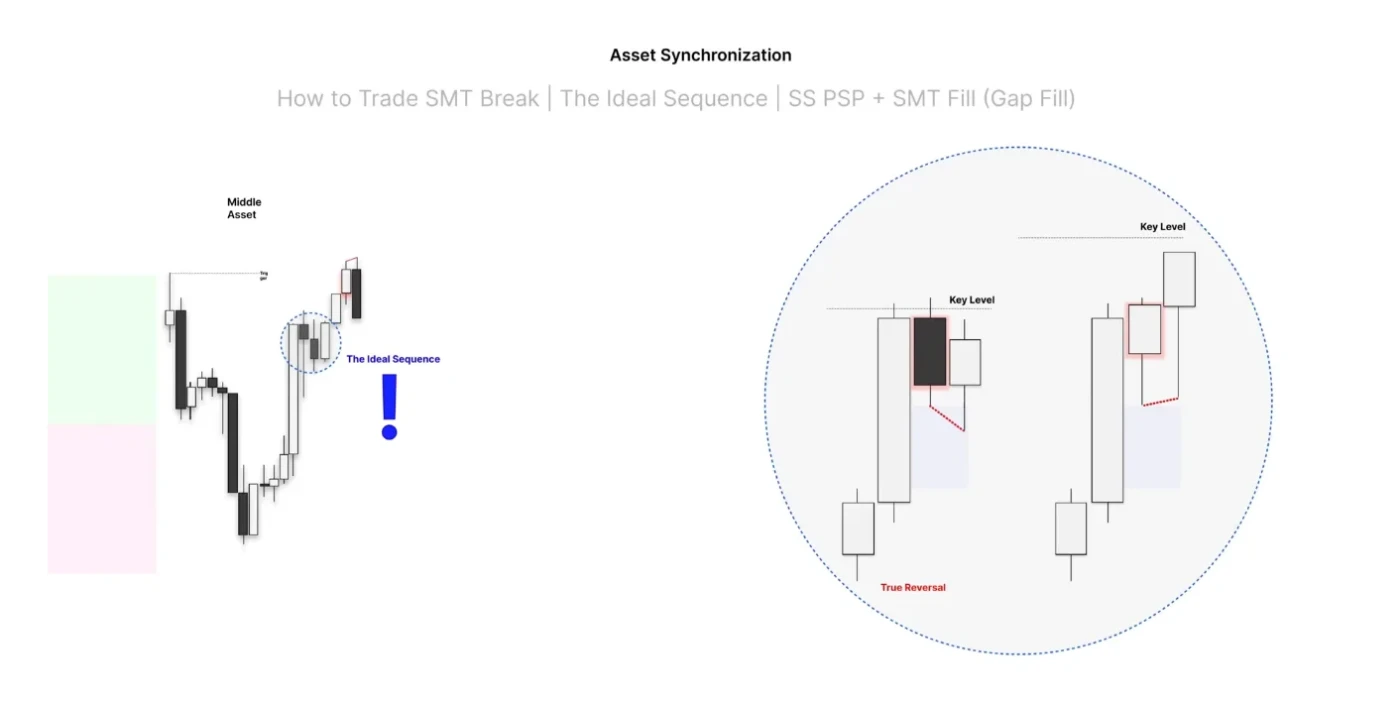
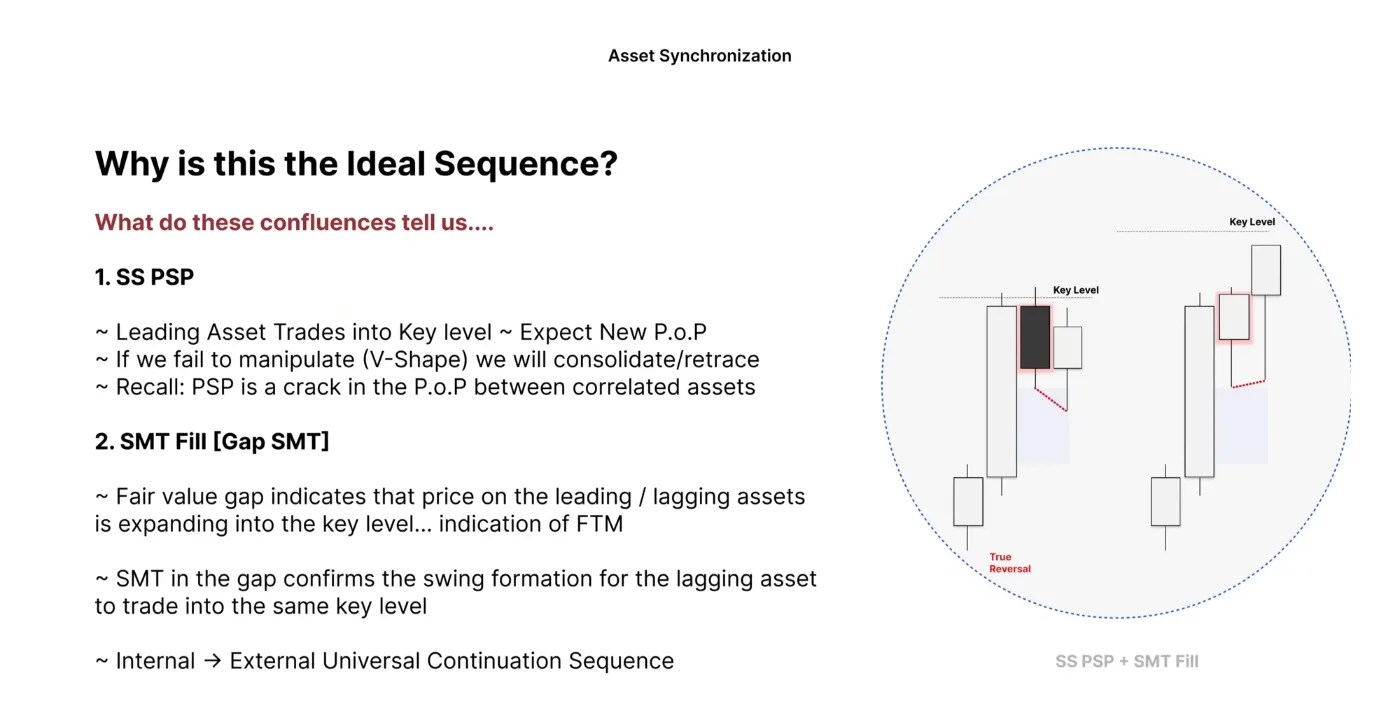
Why is this the ideal sequence? The Strength Switch PSP tells us that the leading asset, once it trades into the key level, is failing to reverse or V-shape. We know that because it creates a gap, and we can look at the lower time frame signatures: are we getting CISDs out of the range faster, are we getting consolidation, are we creating gaps or not? These are the signatures of Strength Switching, and if we do not see a reversal, we anticipate an ideal sequence forming. Once we get the Strength Switch SMT paired with the PSP, the lagging asset reaches the high, and we ask the same question again: are we going to reverse, or is the weakest asset going to do the same thing and hit the high, perhaps with another sequence? The fair value gap tells us about displacement, and the Strength Switch tells us about liquidity dispersing into the weaker assets, and then you can trade your universal sequence toward that high or low.
That is the universal approach to Strength Switching. You now understand the core logic, how to apply Strength Switching to asset synchronization and lagging assets, and how to validate reversals away from SMT breaks or failure swings, as well as how to use equilibrium and the conditions around it with Strength Switching.
Learning it alone isn’t easy...
Learn The Lathyrus Model with direct guidance from our coaches.
- 10 live streams every week
- Regularly updated in-depth course
- 450+ hours of live stream recordings
+ more
Chart Examples
The chart examples were all live-conducted examples, so please refer to 26:38 in the YouTube video accessible on the right-hand side of this page.
That's the end of this lecture, I hope you found value reading this and you learned something new that you can apply, or further refined your knowledge on this subject.
Back to the top