Introduction
So far we have defined swing formations in the context of Market Maker Models. In this lecture we build on that and get into continuations: how to trade away from a true reversal toward the opposite side of the range.
Trading Continuations Away From True Reversals
Universal Market Models
First, a recap. Reversals happen at key levels: swings or gaps, ERL or IRL. For the daily range that means a 4-hour gap or a 1-hour order paired range. Swing extremes, these C2 candles, are what we have become proficient at identifying, and we use cracks in correlation as the first filter to define a swing formation. When we have key levels to trade reversals from with higher time frame sponsorship, we use cracks in correlation and candle profiles (open-high-low-close, protraction profiles) to get on side with these universal models.
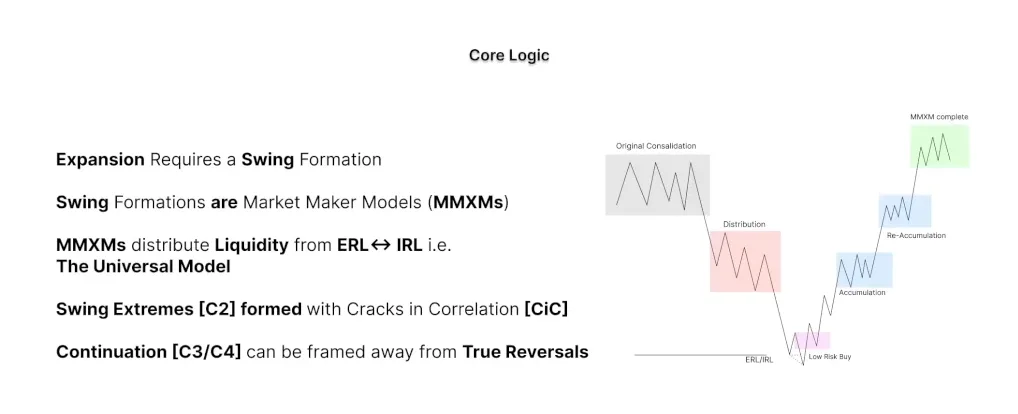
The order of operations is always the same: expansion requires a swing, which is a Candle 2 and Candle 3 formation. Swing formations are the Market Maker Models you have learned, which are forms of liquidity. And when we identify swings, we filter them with cracks in correlation and candle profiles.
Trading Reversal Extremes
Once we identify the extreme of a Market Maker Model, the smart money reversal, we want to trade away from that established swing point toward the opposite side of the draw.
If we don't trade the reversal itself and instead wait for a candle closure to confirm it, there are three types of closure: C3 closures, C2 reversal into expansion, and C2 reversal candles. The point to take from this is that whether or not we have a true reversal at the swing is largely irrelevant when trading continuation.
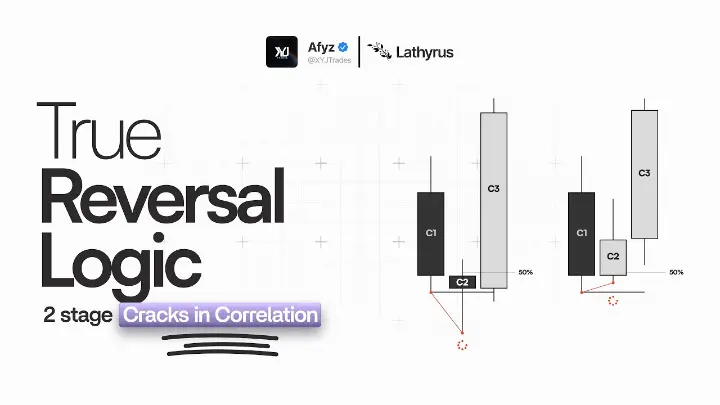
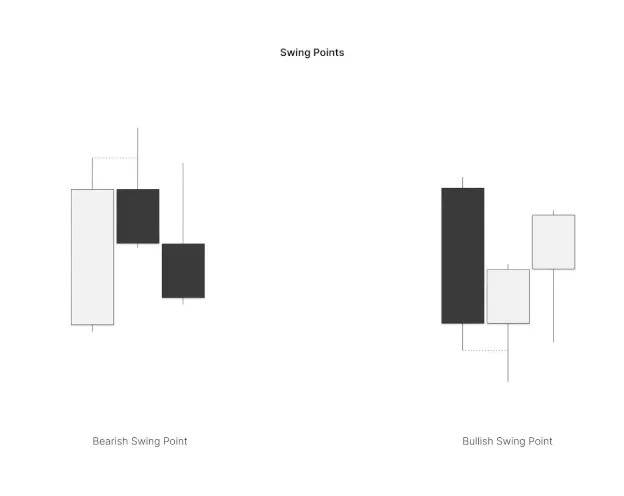
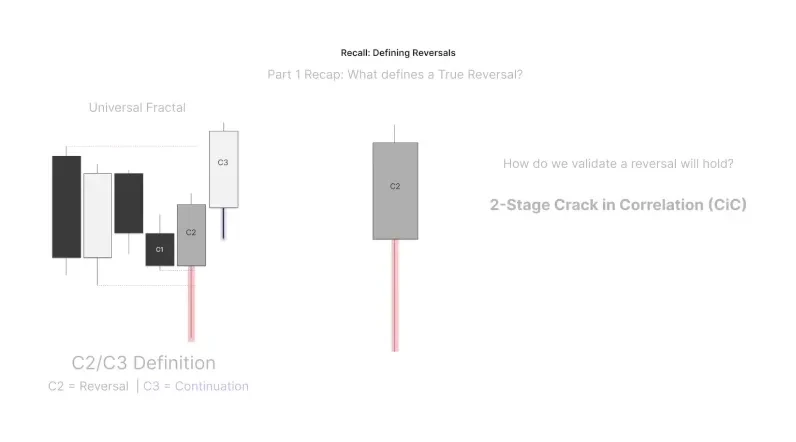
A 2-stage crack in correlation paired with a key level at the C2 extreme, followed by the candle closure, is a C2 reversal, and also a true reversal: we have the cracks in correlation to say the candle's high should stay intact before it closes. Trading a reversal requires you to establish the swing point before the candle closes. The higher time frame swing has not closed as a reversal candle yet, it is still printing, so we use our filters, cracks in correlation, the key level and the candle profile, to trade the reversal candle as it prints, before it confirms the swing by closing. That is the key caveat of trading reversals: we are assuming the high will stay in place.
Once the candle closes, the swing point is confirmed, and the logic for trading continuations relies heavily on that. Once the swing is confirmed by the C2 closure, we don't need the same confluences to trade away from it. When we have less information about a candle, while it is still forming its extreme, we need more confluences to say that is the high, because we don't yet have the candle closure, which is itself the mechanical reversal. The cases where a C2 prints an intra-candle high and then goes on to make a new high are typically reversals that lacked the confluences we need to trade away from them.
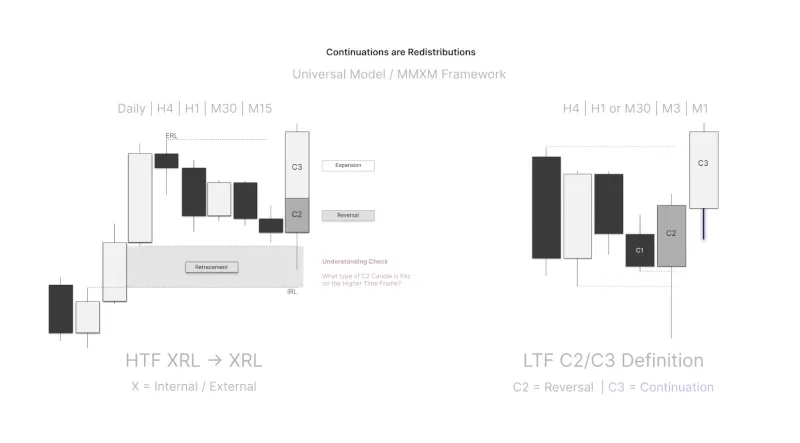
Our focus in this lecture is the next candle, and every candle after it, until the draw is hit. In liquidity imbalance theory the universal model has two types of liquidity, external and internal range liquidity, and the second word in both is range. So when we trade continuation, we frame it until the opposite side of the range is met. It is always a range. If the low below is just a short-term low, it is not the draw; the real draw is the opposite side of the range.
What determines which low is the relevant swing, the opposite side of the range? Proximity. The spacing between swing points is what makes them ranges; without it the market would just have price action. When the proximity is large enough, if a swing is manipulated it can react to the opposite side of the range. This is why we call manipulation ranges order paired ranges: you are always order pairing levels in the market. Swing formations are Market Maker Models, and those models are ranges, internal and external, and we trade candles away from extremes toward the opposite side of those ranges.
In the universal model, IRL and ERL, continuations are framed within any higher time frame order paired range, whether internal to external, external to external, or external to internal as a retracement. On the lower time frame you always see a C2 and C3 definition. C1 is always defined as the candle range that is manipulated, and what gives this real logic is that C1 must be in relation to a key level, a gap or a swing. We are not looking at Candle 1, 2 and 3 formations anywhere; markets need a relevant level for a swing to form, or it won't form there, or it will form and be traded against.
Every true swing formation delivers the opposite side of the range; every false swing formation fails to. That is liquidity imbalance theory: the opposite side of the range must be delivered from the key level if it is a real swing, or we form a fake swing, liquidate it, and then deliver the other side of the range.
To filter a C2 and define it as a true swing formation you already use: the key level, the V-shape, 2-stage cracks in correlation, gaps, displacement, a small wick, and open-low-high-close or open-high-low-close confirmed by wick size. We use similar logic for Candle 3, but as you will see, Candle 3 needs less confluence and forms in specific areas.
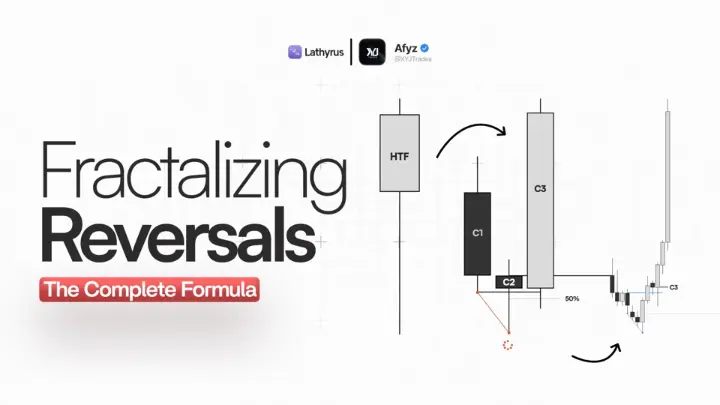
For every higher time frame swing, the Market Maker Model involves the reversal, the reaccumulation, and the liquidation of the original consolidation. C2 is the reversal; C3 is the continuation. Continuation can also happen within the reversal candle on the lower time frame: that is the C2 reversal into expansion, where both phases, the reversal and the expansion away from it, happen in one candle, typically defined by intra-candle CISDs.
To recap, a true reversal is defined by a 2-stage crack in correlation, a key level, an appropriate wick size, and displacement. It is entirely mechanical. Once you identify the reversal, your job is to understand how to trade the candle in continuation.
If we do not see a true reversal signature at Candle 2's extreme, but it closes as a mechanical reversal candle, can we still trade continuation away from Candle 2's low? Yes. Once the swing is confirmed by a mechanical closure, what prints in the range of Candle 2, a gap or an order paired range, becomes an invalidation. If you ever distrust the area of reversal, allow the reversal to form and then trade from a new invalidation.
An invalidation is a swing formation where price will not return before delivering the opposite side of the range.
So if we meet a Candle 2 extreme with no clear invalidation, we wait for the mechanical closure and a new invalidation to print in the continuation. We don't trade away from the original swing that we distrust; we trade away from a new, established, relevant invalidation.
The red flags for trading away from C2 before it closes:
- Failure swings. The biggest one: the reversal is failing to pair the liquidity on the opposite side of the range, the single most telling sign of a swing not to trade away from. Once price expands away from failure swings, the gaps it creates become your new invalidations.
- Lower time frame dynamics, the way price delivers: a failure to manipulate, or a continuation signature instead of a reversal.
- A lack of 2-stage crack in correlation, so no true reversal logic.
- An exaggerated protraction phase, a large wick. There is an inverse proportion between the depth of manipulation and the expected expansion: the larger the wick, the smaller the body, because more time is spent in the manipulation phase.
In those cases it is better to wait for Candle 3 to open, form a new invalidation, and then trade the expansion. Protraction is defined mechanically as the distance between the opening price and the low or high of the candle, and it is based in time as well as price: if the candle has another 3 hours left, a large wick is more permissible than with 1 hour left, because there is more time to print expansion. Many large wick candles still go on to form expansion candles, usually because of drivers, volatility, time and order pairing. We never pattern trade any of this.
The major reversal sequences:
- PSP confirming SMT: the candle closure confirms the second-stage crack in correlation of the swing.
- SMT confirming PSP: typically when Candle 1 engages a key level (IRL or ERL) and C2 sweeps, or when Candle 1 creates the key level and C2 reverses off it.
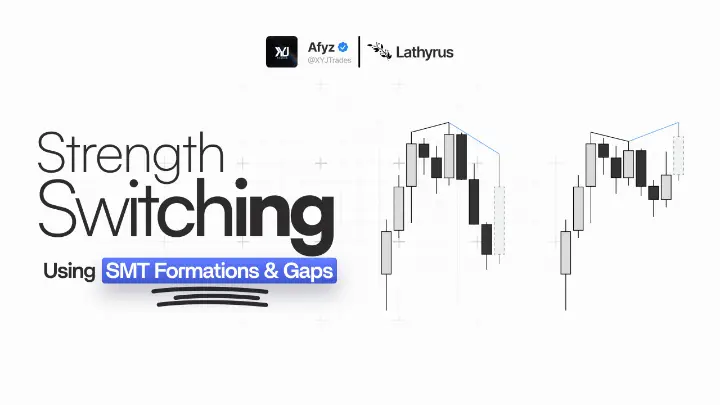
- 2-stage SMT, which is where Strength Switching comes in later: the roof shape you are used to seeing.
There is a definitive sequence at every swing. Either C1 trades into the key level and C2 forms the swing and expands, or C1 creates the key level and C2 reverses off it. Candle 1 trading into the key level does not have time to form a C2 there; it does not reverse yet, and expansion requires a swing, so Candle 2 forms it. It is only ever one of those two. Swings form no other way.
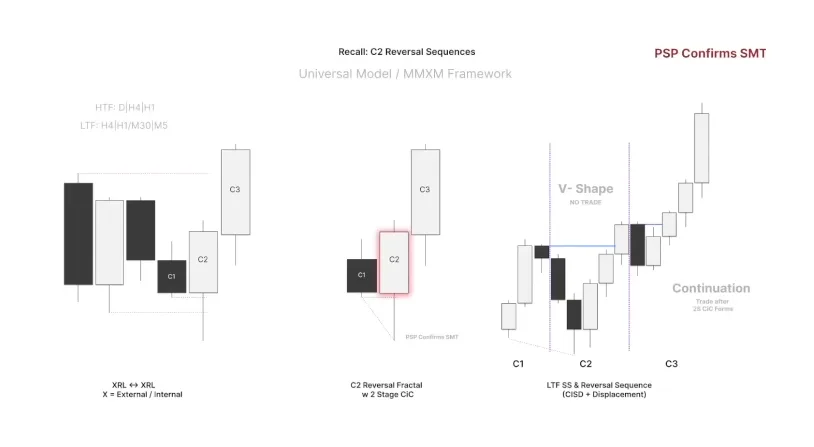
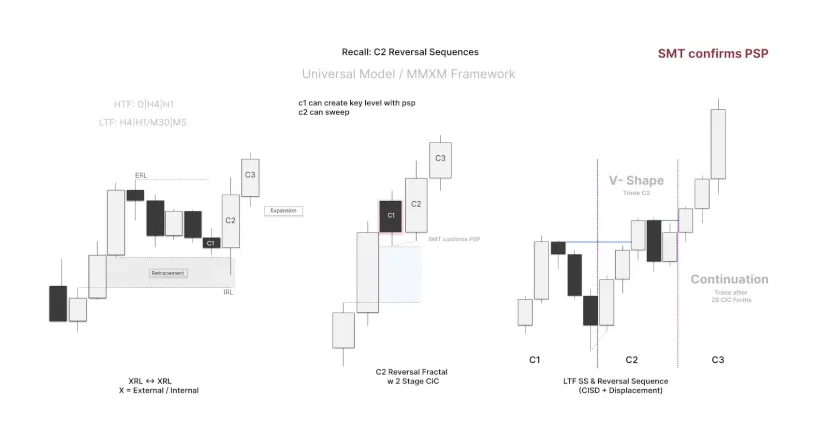
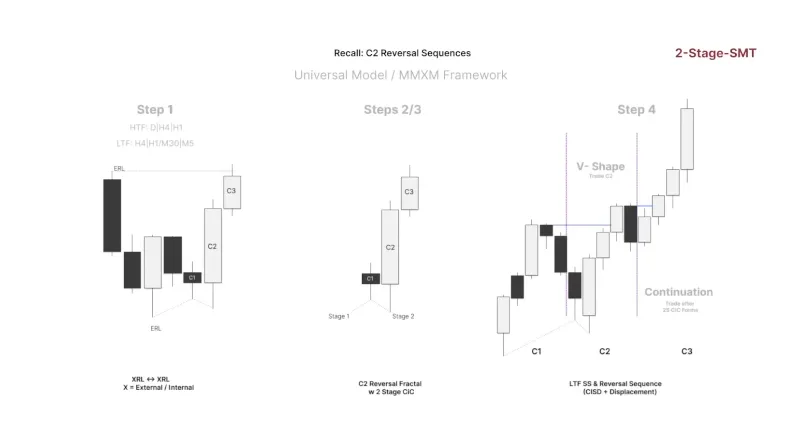
Swing Invalidations
The invalidations we trade away from are logical ones: the equilibrium of the previous candle, and the wick of the previous candle's range. Expansion does not offer a deep retracement, so equilibrium and the PD arrays, in this case fair value gaps near the EQ of the range, become the most critical key levels. Look for gaps in the upper half of the previous candle's range, near the opening price of the new candle, not near the opening price of the previous candle, deep in the range. The opening of a higher time frame candle forms its wick, and ideally it expands away from that. These are the two axial filters, time and price: price does not want to form a deep wick, and that would also waste time coming far back into the range.
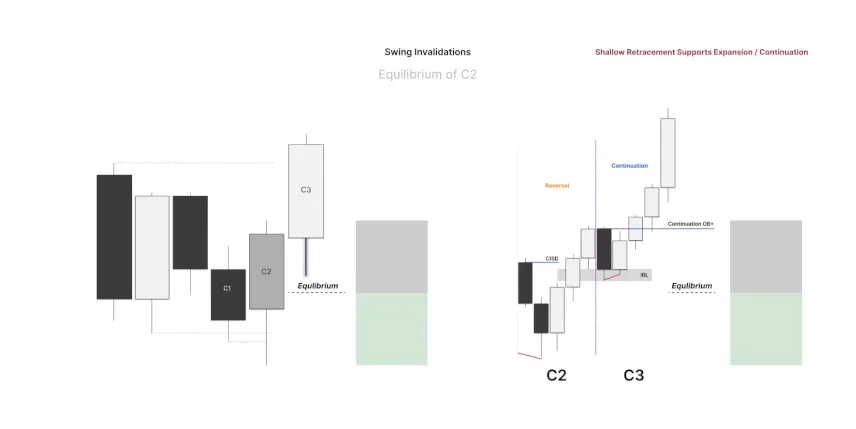
When large wicks don't support expansion, you will often use the Candle 3 continuation as a new invalidation and look for Candle 4 to expand. You would hesitate to trade C3 away from Candle 2's low in this case because of the large wick and the failure swings: expansion does not offer deep retracements into the range, and failure swings are low probability to trade away from. So we wait for the candle to close with the low still respected, then for the new candle to open, form its wick in a key level, and expand.
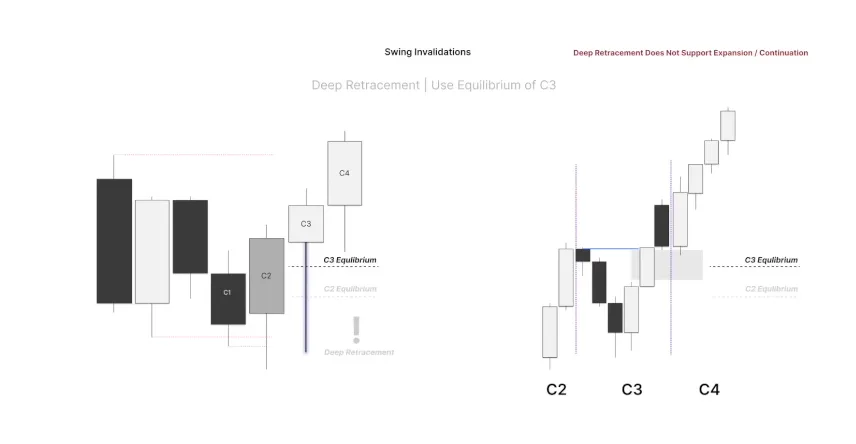
Swing grading. Between the point of reversal and the opposite side of the range, there will usually be several failure swings on the left-hand side of the curve, and we don't expect reversals from them. When price trades into a failure swing on the left side of the Market Maker Model, we expect a new phase of price, since we are trading into the opposite side of the range. Those signatures are continuation signatures: retracement and consolidation, not a V-shape, not expansion met with expansion. SMTs that form in these failure swings, away from a true reversal, are unlikely to hold; this is where asset synchronization with Strength Switching in continuation comes in later.
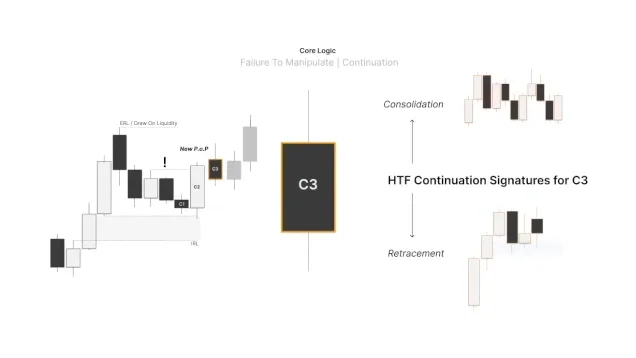
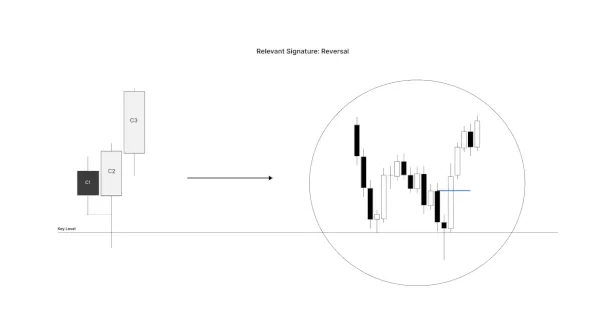
Phase of price is another invalidation. A higher time frame continuation from a key level is still a reversal on the lower time frame, which is why reversals were taught before continuations. You want to trade V-shape recoveries and the creation of gaps, which show institutional sponsorship of a price leg, not choppy consolidation out of key levels. This reversal signature is the fundamental truth by which all key levels are filtered, on any asset, any time frame, from any level, old high, old low or gap. Pair it with your cracks in correlation and everything else, but it does not change.
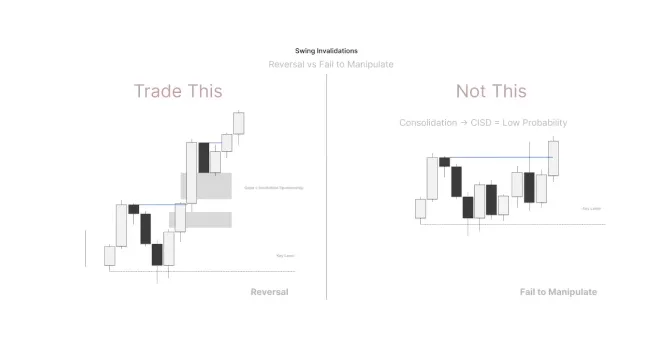
Pay attention to your CISDs, the creation of gaps, and the time spent below the key level. Price does not linger at key levels; it forms a V-shape recovery for the wick. If it lingers, the body of the candle is more likely to close inside the key level's range, and since expansion requires a swing, we may need to form a new one. That is a failure to manipulate: the candle body forms in the level rather than a wick out of it, so the next candle is likely to open, form the wick, and then expand.
Consolidation signatures in a key level are likely to see a swing form from them as an order paired range. If C1 trades into the key level but does not reverse, it may be consolidating, and then Candle 2 can form the swing with a small wick and expand. When you fail to see the reversal signature, Candle 1's low becomes a relevant swing in your key level, order pairing that lower time frame consolidation. So do not trade lower time frame consolidations out of key levels, because they are likely to be swept to create the swing you actually want to trade away from. Many losses are simply trading consolidation out of key levels; wait for order pairing and significant displacement, and your strike rate improves dramatically.
Learning it alone isn’t easy...
Learn The Lathyrus Model with direct guidance from our coaches.
- 10 live streams every week
- Regularly updated in-depth course
- 450+ hours of live stream recordings
+ more
Continuation Sequences
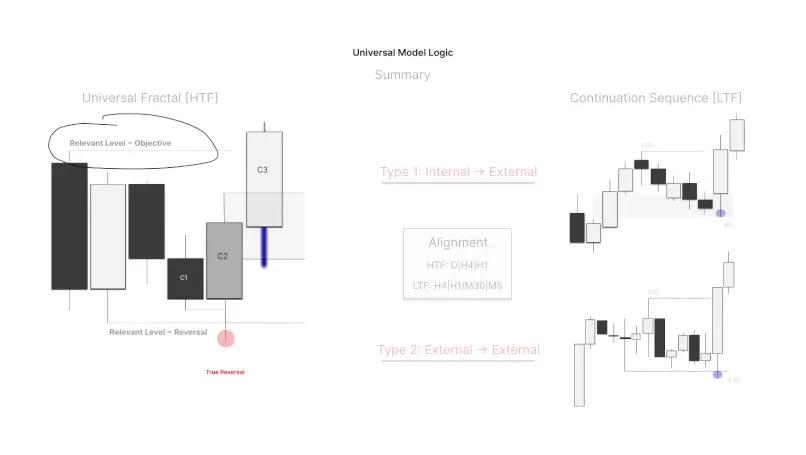
No matter where a swing forms, Candle 2 or Candle 3, it requires a key level; wicks are created in key levels. So any form of continuation is always a model within a model: some form of internal model that takes you to the external, opposite side of the range. A true reversal is a swing that delivers the opposite side of the range, so a continuation away from its extreme forms a model within the higher time frame model to bring you there. There are two types.
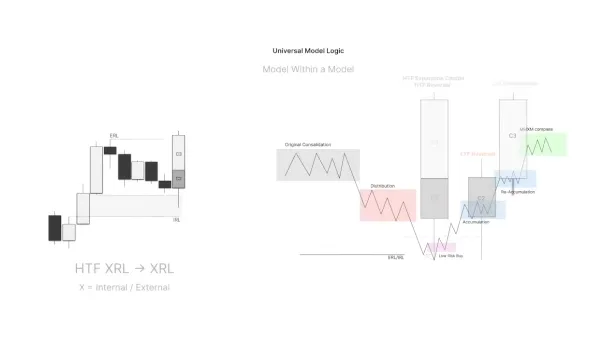
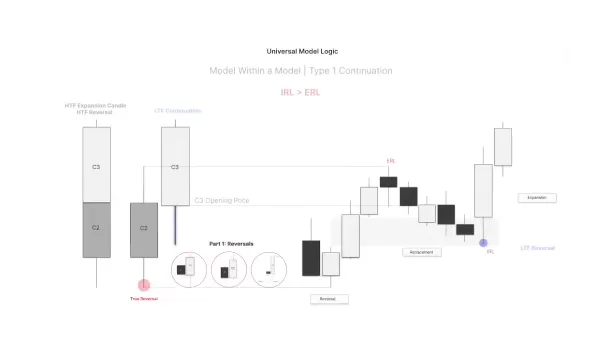
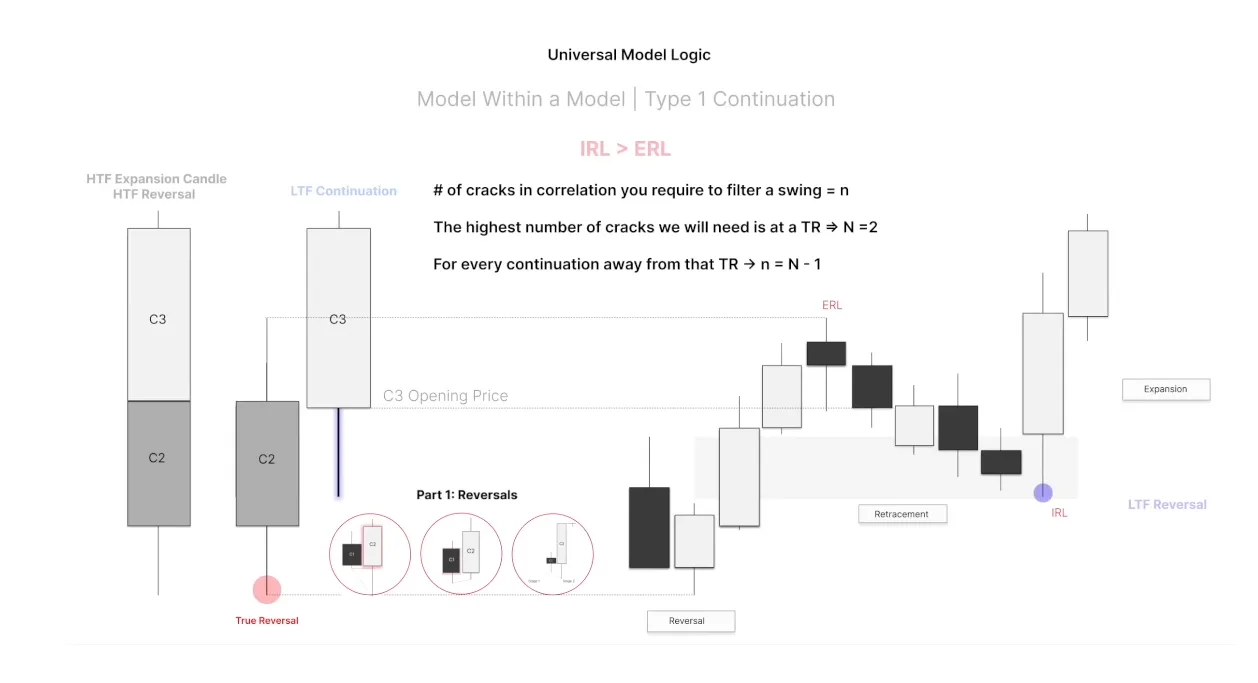
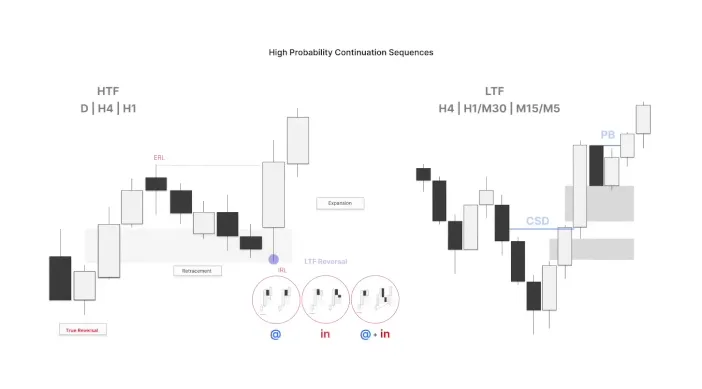
Type 1 is a retracement into expansion, which creates the continuation low inside a gap. This is the highest probability continuation signature the market will offer you: a retracement into lower time frame internal range liquidity, within the higher time frame leg you are trading away from a true reversal. You have a gap away from the true reversal, and you trade a lower time frame reversal from it.
How many cracks in correlation do you need? Call it n. The most you will ever need is at a true reversal, where n = 2. Every continuation away from that true reversal needs one less: n − 1.
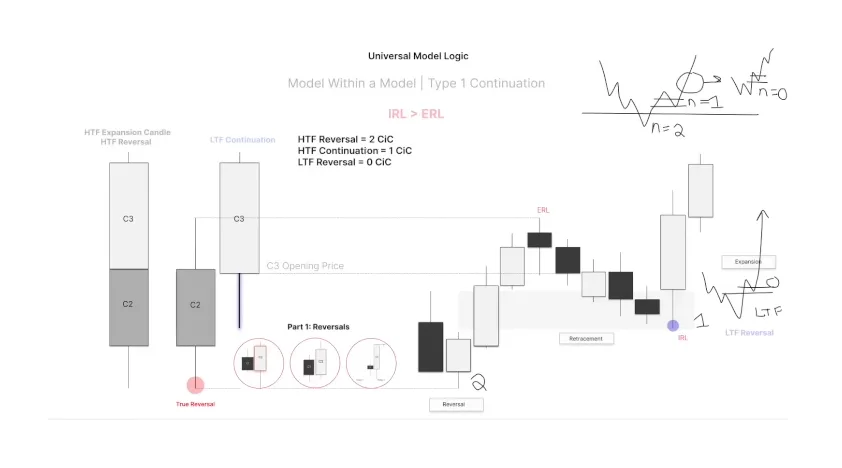
- Higher time frame reversal: 2 cracks in correlation.
- Higher time frame continuation, in the gap: 1 crack in correlation.
- Lower time frame reversal from that continuation, your entry: 0 cracks in correlation.
This is why I never look for cracks in correlation on my entry time frame: no 3-minute SMT fill, no 3-minute PSP, no 1-minute SMT. We filter swings with cracks in correlation down to the entry time frame, and on the entry time frame we use only the phase of price, the reversal signature, because it is fractal and already filtered as a continuation from a gap away from a reversal. More cracks in correlation there are simply noise.
The logic is about confirmation. The point of reversal is the least confirmed in market structure, so it needs the most filters. By the time price has expanded away from it, the continuation in the gap has more structure behind it, but you still need that one stage to make sure the continuation forms from the gap. By the time that one stage forms, the lower time frame V-shape out of the gap is the most confirmed, so it needs none. You may sometimes see an SMT fill or a PSP in the gap on the lower time frame, but you don't need to.
Type 2 is the order paired range. Candle 2 reverses, but then consolidates: reversal into expansion, consolidation, then expansion. We trade away from the established true reversal, a range forms, and price pairs one low to get to a failure swing high, a model within a model. That high becomes the internal model draw. These internal draws are always failure swings to the higher time frame draw, which gives you two pools of liquidity to draw into, the internal high and the external high.
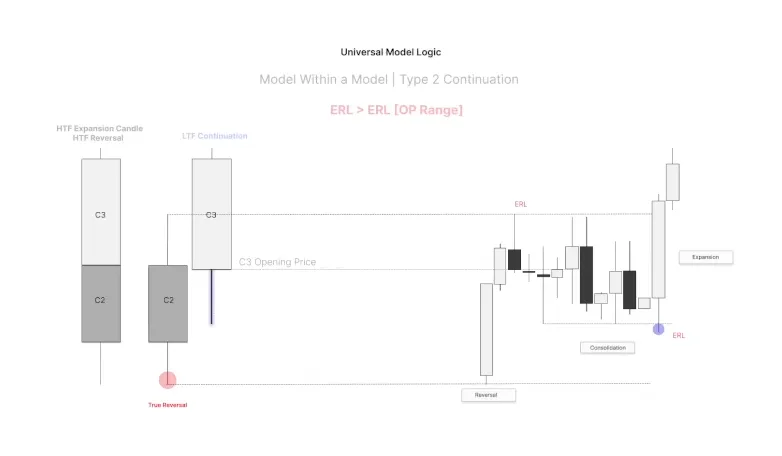
Type 1 is always preferable. It shows you the expansion phase away from the true reversal, followed by a retracement into the gap and then expansion away from it, which tells you the market wants to go higher, with institutionally sponsored moves creating gaps. Type 2 shows expansion met with consolidation, and price does not always pair the low: in expansion the market can expand, consolidate, expand, retrace, expand, a breakout signature, without manipulating the range low, so it is harder to engage. Spend your energy on Type 1.
High Probability Sequences
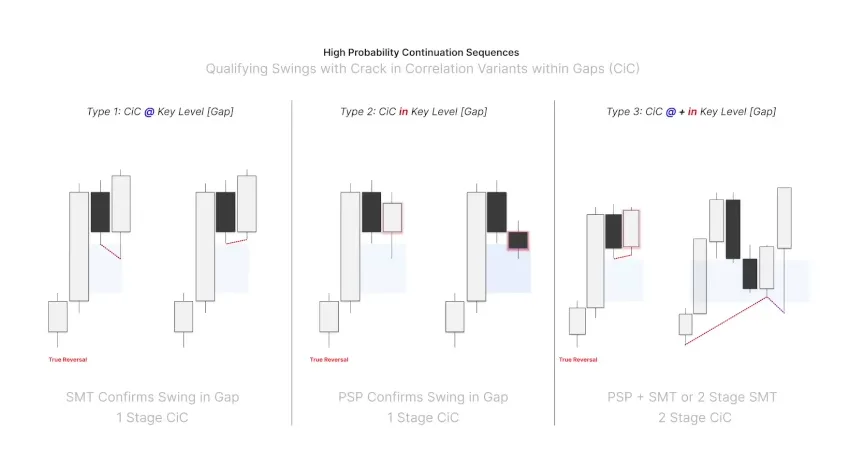
The high probability sequences for continuation are all one-stage or 2-stage cracks in correlation. You don't need a 2-stage, but you must have at least one stage, so n = 1 here, sometimes 2. These are the only three types, and here we focus on gaps, the high probability Type 1 continuation:
- A crack in correlation at the key level: an SMT fill.
- A crack in correlation in the key level, either through consecutive candles (an SMT inside the gap) or through a candle closure, a PSP. A single-stage PSP is the lowest probability one-stage continuation.
- A crack in correlation at and in the key level: an SMT fill and a PSP, or a stage-one SMT and a stage-two SMT. This is much more probable than a one-stage PSP alone.
And for the lower time frame reversal signature from the gap, you do not need a crack in correlation: n = 0. Each step down from the higher time frame reversal needs one less, because it is more and more confirmed by market structure. Asset synchronization, Strength Switching and gap selection build on this in their own lectures.
That's the end of this lecture, I hope you found value reading this and you learned something new that you can apply, or further refined your knowledge on this subject.
Back to the top