Introduction
One of the biggest mistakes I see traders make is treating reversals as an isolated event. They see displacement away from a key level and assume the reversal must be confirmed on that time frame.
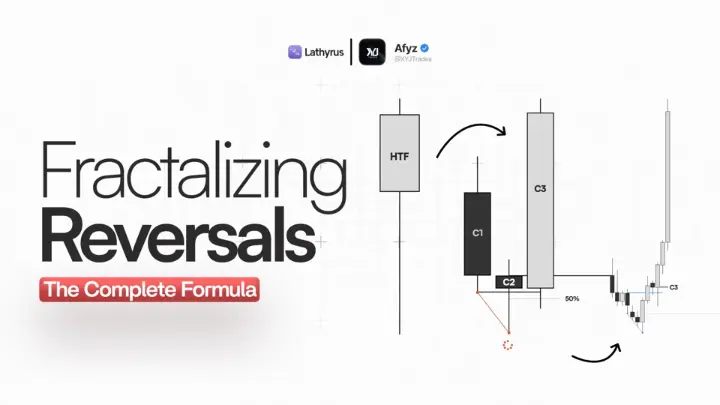
But price is fractal. The 4-hour reversal candle you are trading might be better profiled with a 1-hour or 30-minute swing, where you can use 3 to 5-minute reversal candle signatures to get on side much earlier. This lets you take entry before that higher time frame candle closes, and it preserves the mechanical precision you demand when trading reversals.
How To Fractalize Reversals
Candle Anatomy
This chapter covers the candle anatomy you have already learned in my prior lectures. It gives you the prerequisite information to start fractalizing your reversals.
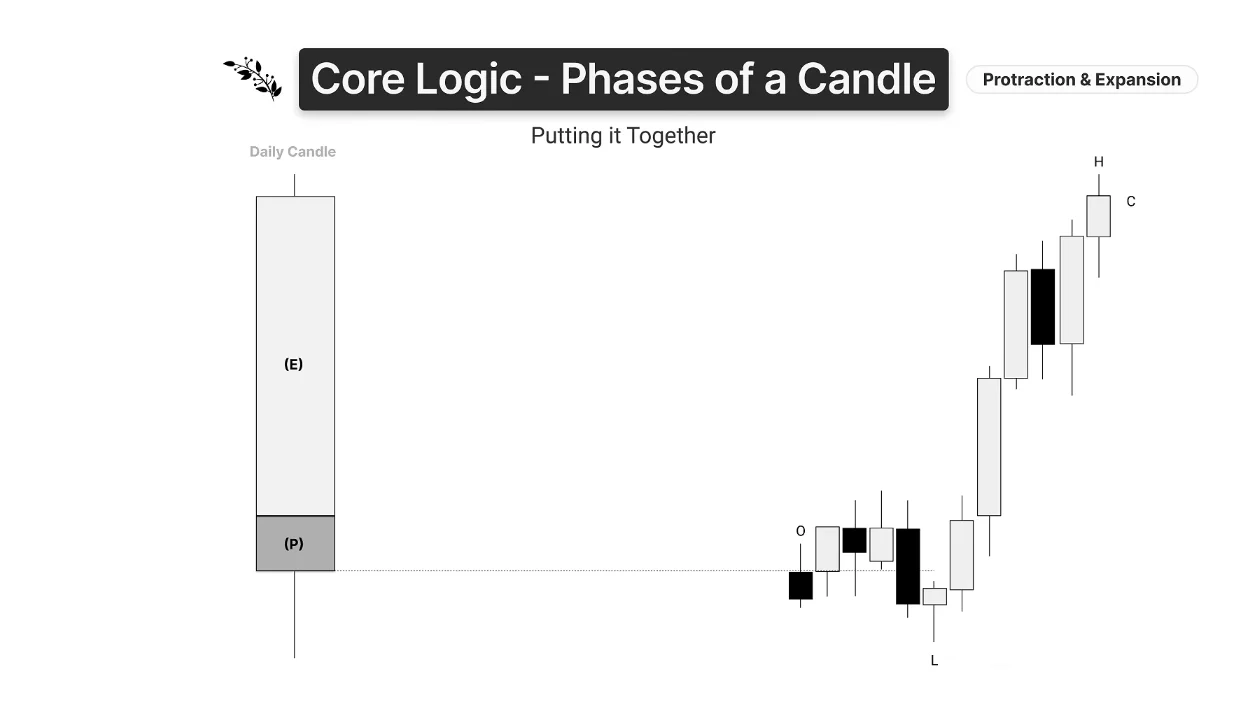
There are two phases of a candle. The protraction phase is the deviation beyond the opening price of the candle, which creates its low or its high. The expansion phase runs from the low to the high, or from the high to the low in the case of a bearish candle, and creates the body. So the protraction phase creates the wick, and the expansion phase creates the body.
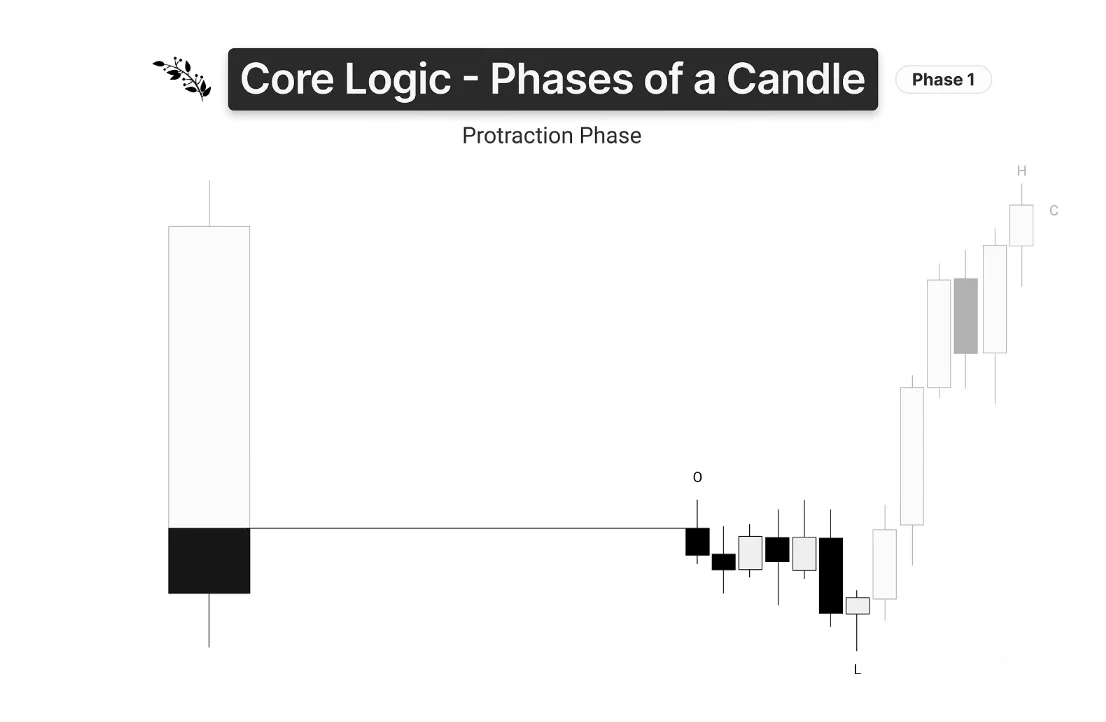
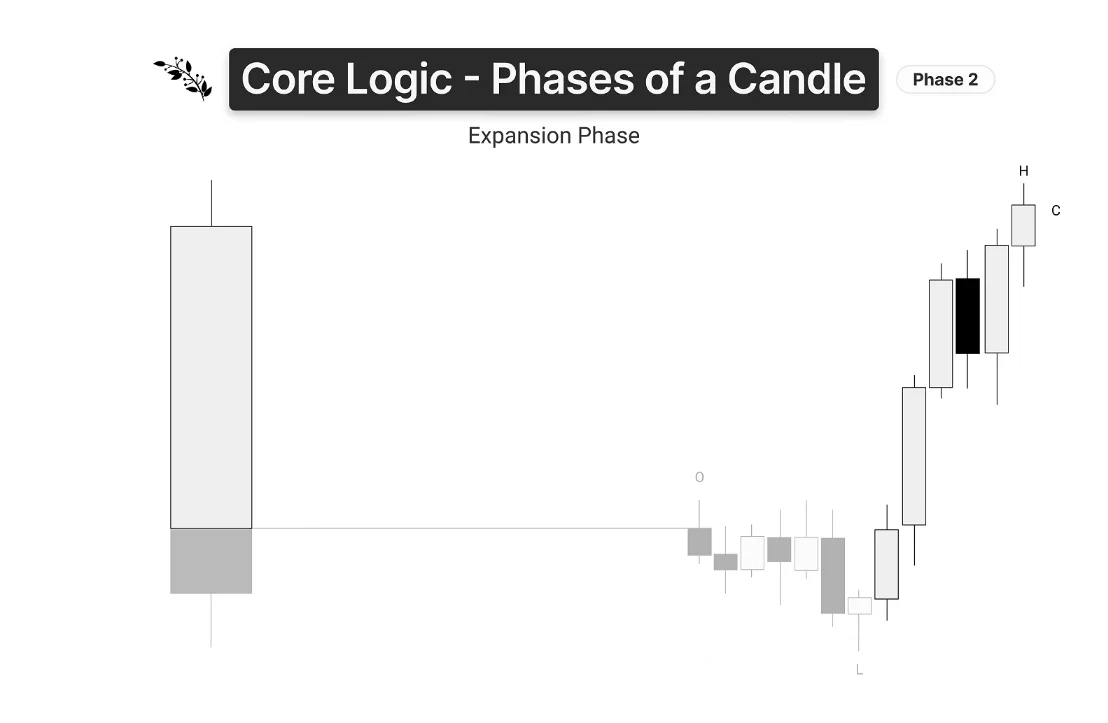
We are going to use these two phases and focus on how we can fractalize them even further, to understand where reversals and continuations occur.
Put together, one part of the candle is the manipulation, or protraction, phase, where we look to profile and fractalize the reversal of the low. Then price expands from its low to its high, the expansion, or continuation, phase, where we look to engage the market in continuations and fractalize that development as well. As long as you understand those two phases, we can zoom in even further and fractalize. That is the purpose of this lecture.
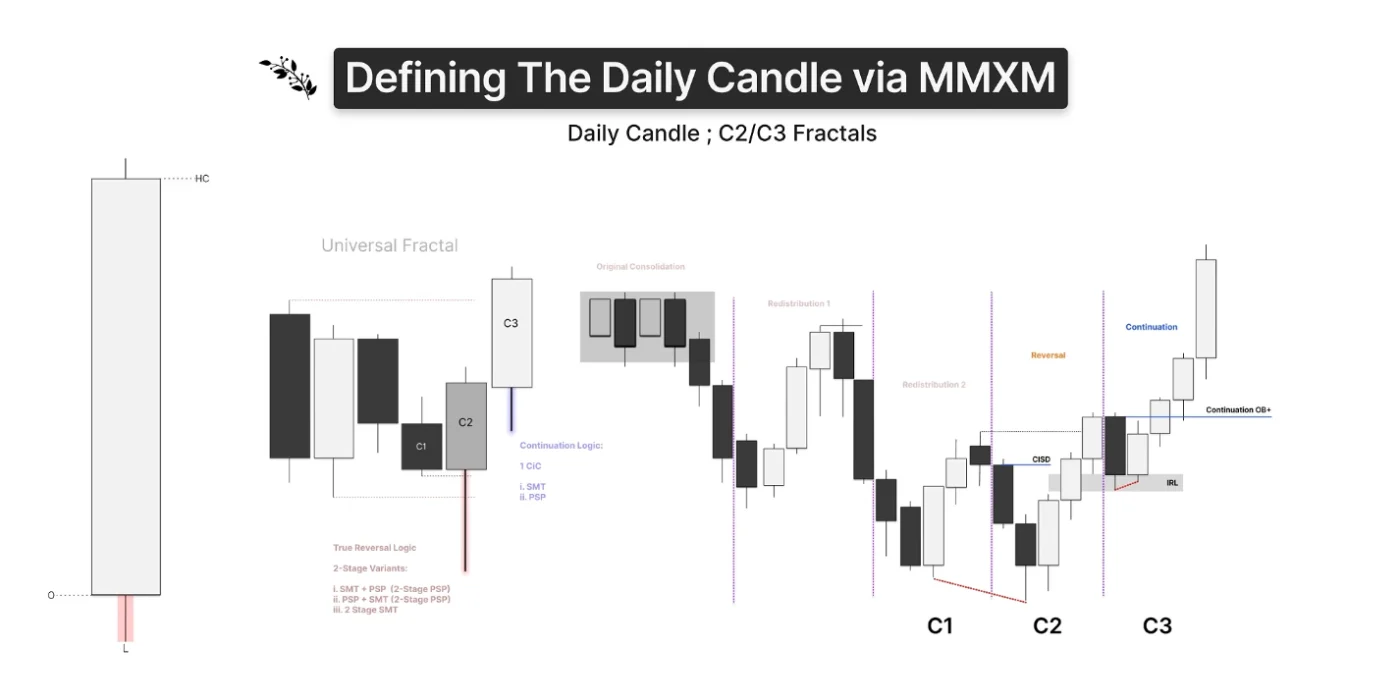
Here is what a daily candle looks like in the context of a reversal and a continuation. If we have a daily MMXM defined by a 4-hour swing formation, a universal model, we can define its Candle 2 and Candle 3 and fractalize them on the lower time frame. If this is the daily expansion candle we are working with, we look at how to engage the 4-hour C2 and the 4-hour C3 that make up this universal model, and we fractalize each of these components.
Understanding How Swings Form
How do swings form? That is the meat of this lecture, and we start with reversal swings.
Consider the daily protraction and expansion phases. As you learned in my previous lecture, the 4-hour profile sees one single session creating the low or the high of the daily candle. If that reversal candle is, say, the 22:00 candle, we can go into the candle itself and fractalize it further. We look for our true reversal variants, our 2-stage cracks in correlation, on a lower time frame swing to the 4-hour chart: a 1-hour or 30-minute 2-stage crack in correlation as a swing formation, or, in the special case of a Strength Switch, which you learned in my Universal Frameworks lecture, the 15-minute chart.
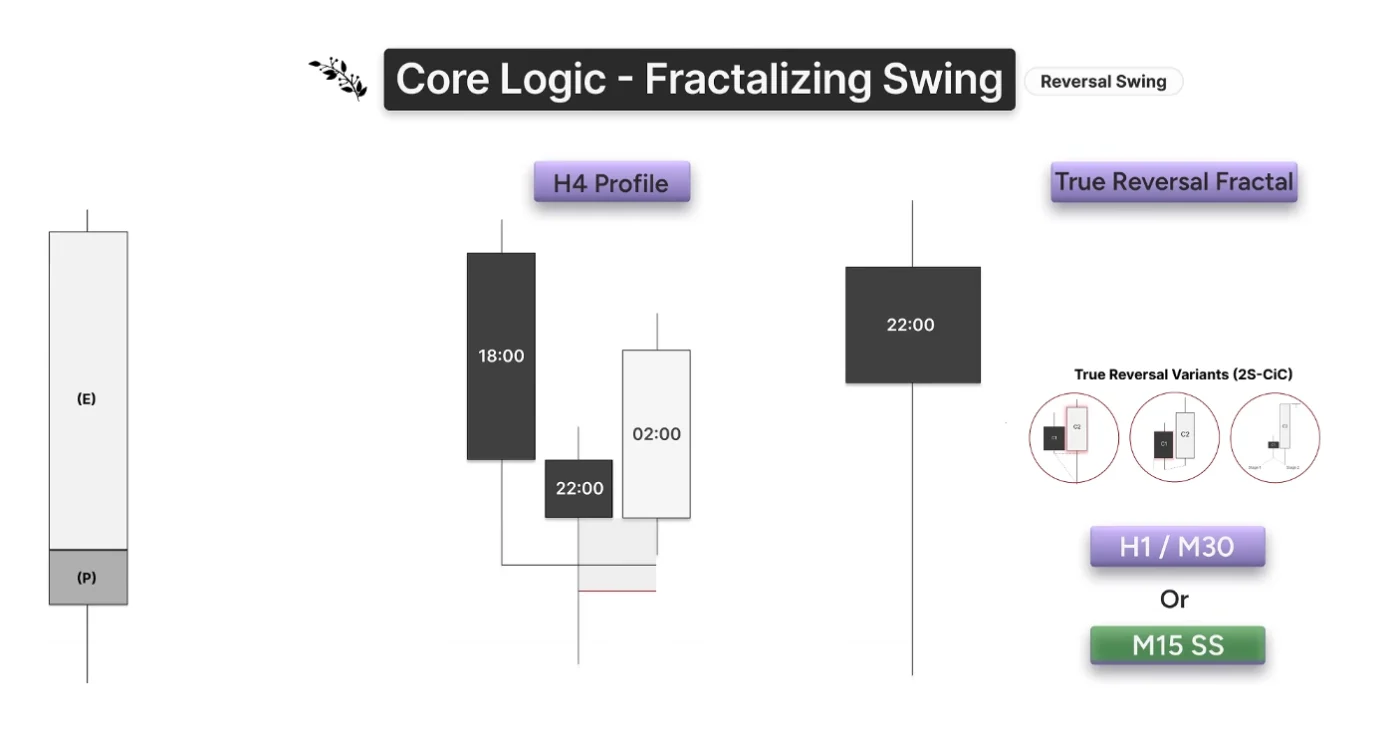
Order paired range. Let's look at a couple of universal model examples. In an order paired range, if the C2 candle is not itself a 2-stage crack in correlation, so we do not see a 2-stage on the 4-hour chart, we go in and confirm the 4-hour swing extreme with a lower time frame swing formation: the 1 hour or 30 minute, or the 15 minute in the case of a Strength Switch.
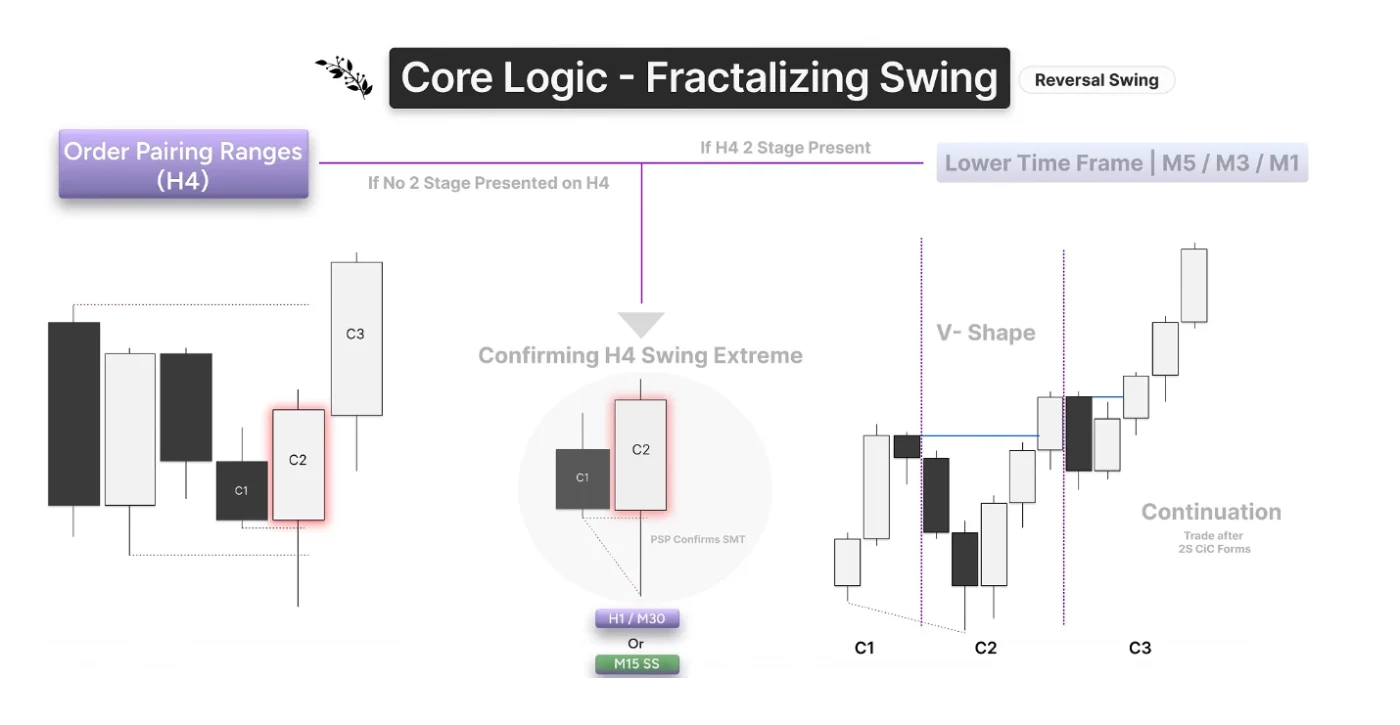
The logic is as follows:
- No 4-hour 2-stage at the extreme. If the extreme of a 4-hour universal model does not present a 2-stage crack in correlation, look to the 1 hour, 30 minute, or even 15 minute to find the 2-stage signature that confirms the low of the candle.
- A 4-hour 2-stage is present. Go straight to your lower time frame entry, the 5, 3 or 1 minute, depending on which time frame shows the clearest V-shape.
To make this crystal clear: when we profile the higher time frame 4-hour candle, we fractalize the reversal with 1-hour, 30-minute or even 15-minute swings if a 2-stage is not present on the 4 hour. Once we confirm that swing formation, we look for our lower time frame entries.
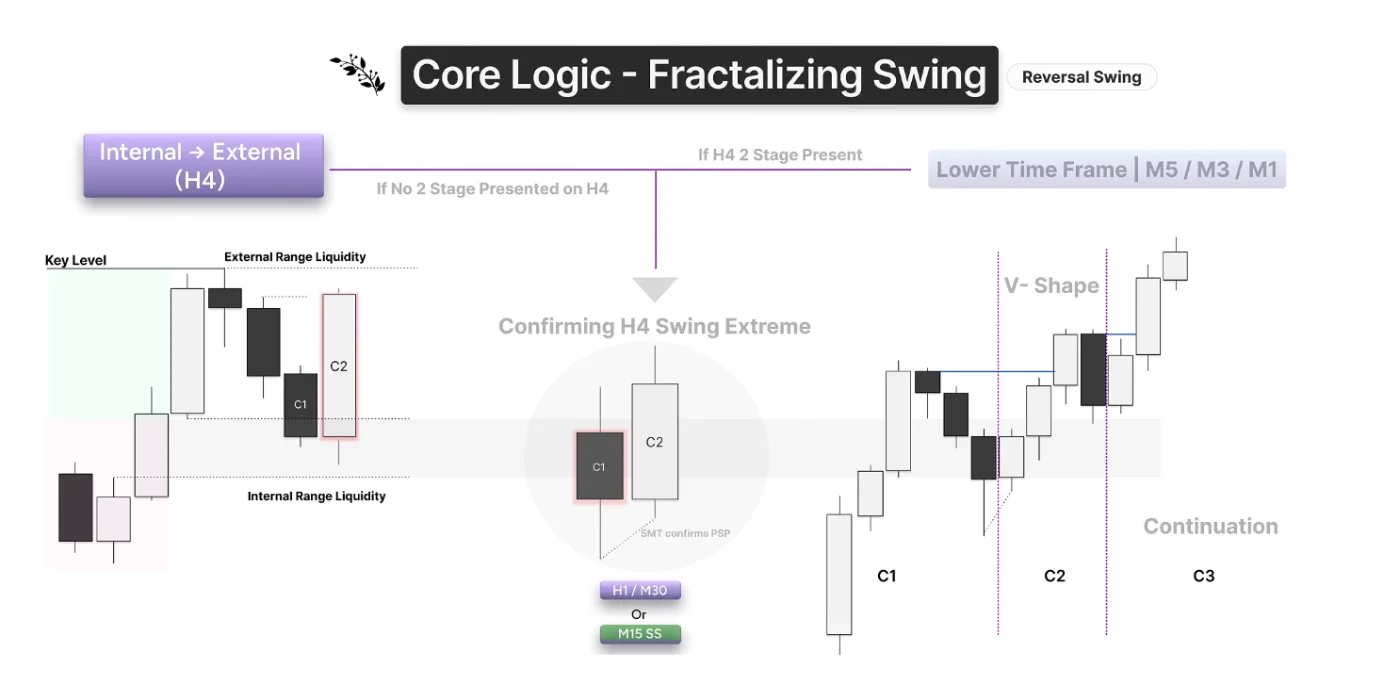
Internal to external. In 4-hour internal to external logic, again, if there is no 2-stage on the reversal candle, the C2, meaning it is not a 2-stage PSP or a 2-stage SMT in the gap, we profile the 4-hour extreme with some form of 2-stage on the 1 hour or 30 minute, or the 15 minute for a Strength Switch. We use that lower time frame fractal to fractalize the 4-hour extreme before we go to entry on our lower time frame charts with that V-shape.
External to external. Finally, here is a case where we can skip fractalizing the 4-hour extreme, because a 2-stage is present. In this reversal swing, external to external, or order paired ranges, we form a 2-stage SMT on the 4-hour chart. Where a 2-stage is present, whether a 2-stage SMT, a 2-stage PSP or another 2-stage crack in correlation variant, we can go directly to the lower time frame entry signature and trade that V-shape.
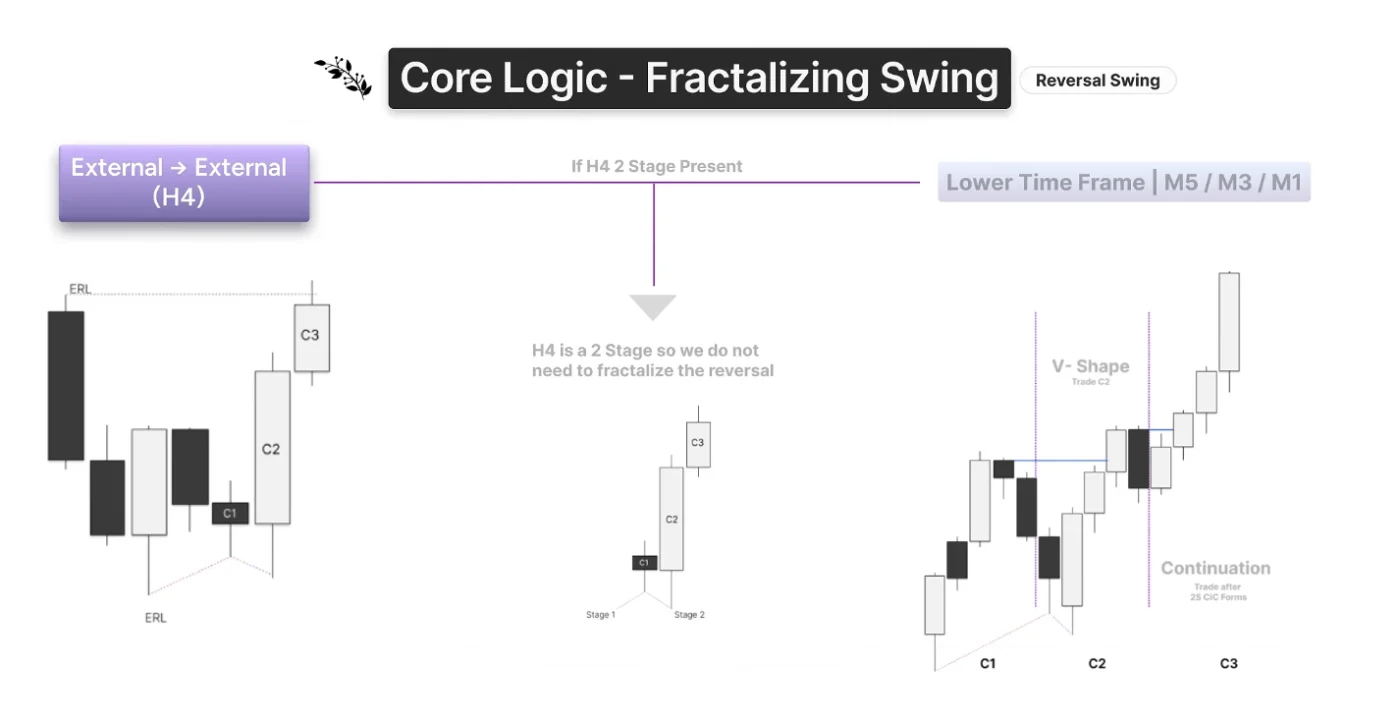
To sum up, it is pretty simple. When we fractalize swings, we look for true reversal variants on the 1 hour or 30 minute, or the 15 minute for a Strength Switch, to understand where the 4-hour candle is forming the reversal inside its reversal phase. The lower time frame swing gives us a 2-stage crack in correlation confirming the higher time frame swing, and then we can move to our entry and get on side with the reversal or continuation candle on the 30 minute, 1 hour or 15 minute, instead of waiting for a 4-hour chart that may not present a 2-stage crack in correlation in and of itself.
Continuation swings. You have already learned from my lecture on continuations that we only demand a one-stage crack in correlation for continuation from a gap. When we confirm reversals, we need some form of 2-stage SMT or crack in correlation, either on the 4-hour chart itself at the extreme, or on the 1 hour, 30 minute, or 15 minute for a Strength Switch, fractalizing that reversal swing on a lower time frame. For continuation, we use gaps as the first invalidation, so we only need a one-stage crack in correlation on whatever time frame is associated with the gap. If it is a 30-minute gap, we need to see a 30-minute SMT fill, a PSP, or a 2-stage crack in correlation in that 30-minute gap.
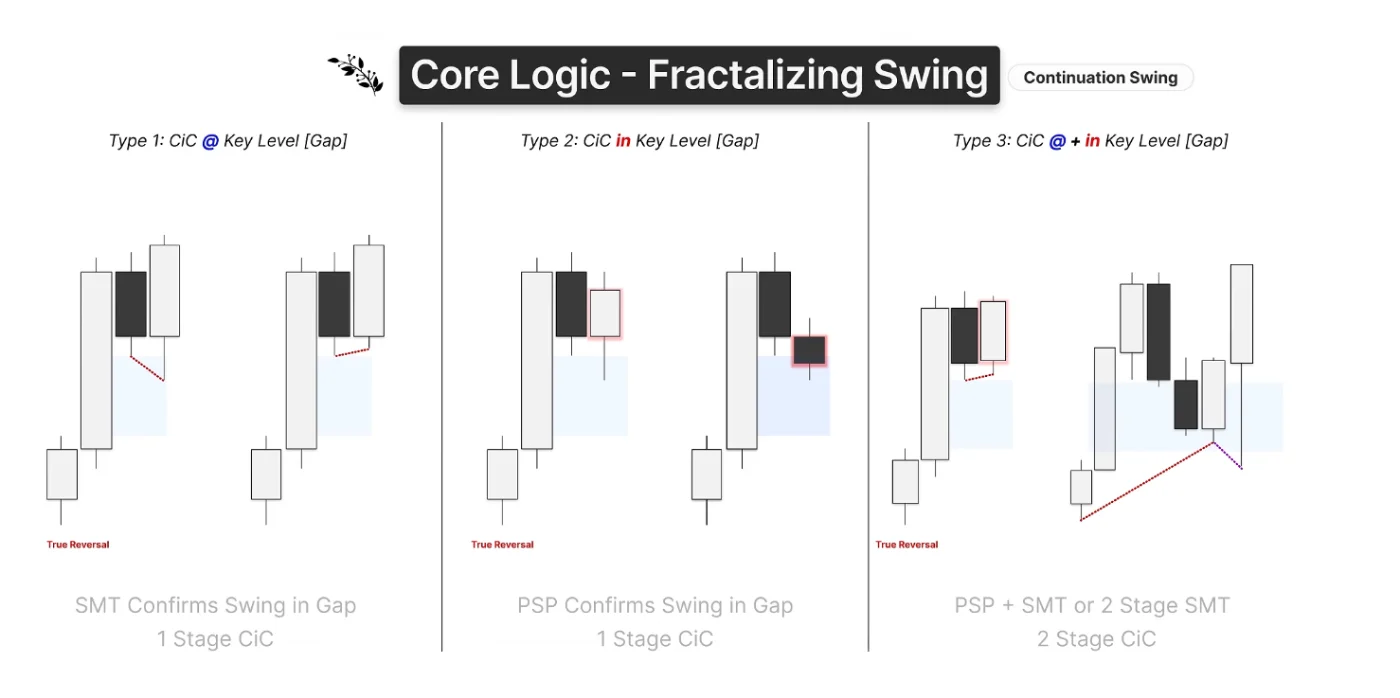
Putting it all together. In the case of a reversal candle, a C2, we profile, or fractalize, it with a 2-stage variant of crack in correlation on the 1 hour or 30 minute, or the 15 minute if we have a Strength Switch. It will be one of three things, the only three forms of true reversal you have learned:
- A PSP confirming SMT
- An SMT confirming PSP
- A 2-stage SMT
Once we expand away from the true reversal, we trade higher time frame continuation, like the 4-hour C3, using gaps on the 15 minute, 30 minute or 1 hour. Refer to my gap selection lecture to learn which time frame gaps to use and which you should expect to hold. There, we only need a one-stage crack in correlation. We do not need to fractalize the continuation, only the reversal.
So for the 4-hour C2, we look for 1-hour or 30-minute swings at the 4-hour swing extreme. Then for the C3, we look for a 30-minute or 1-hour gap and our one-stage crack in correlation variants. Because we are trading continuation, that is either an SMT fill, a PSP in a gap, or a 2-stage SMT or crack in correlation in the gap. That is how we put together fractalizing the reversal and trading continuation.
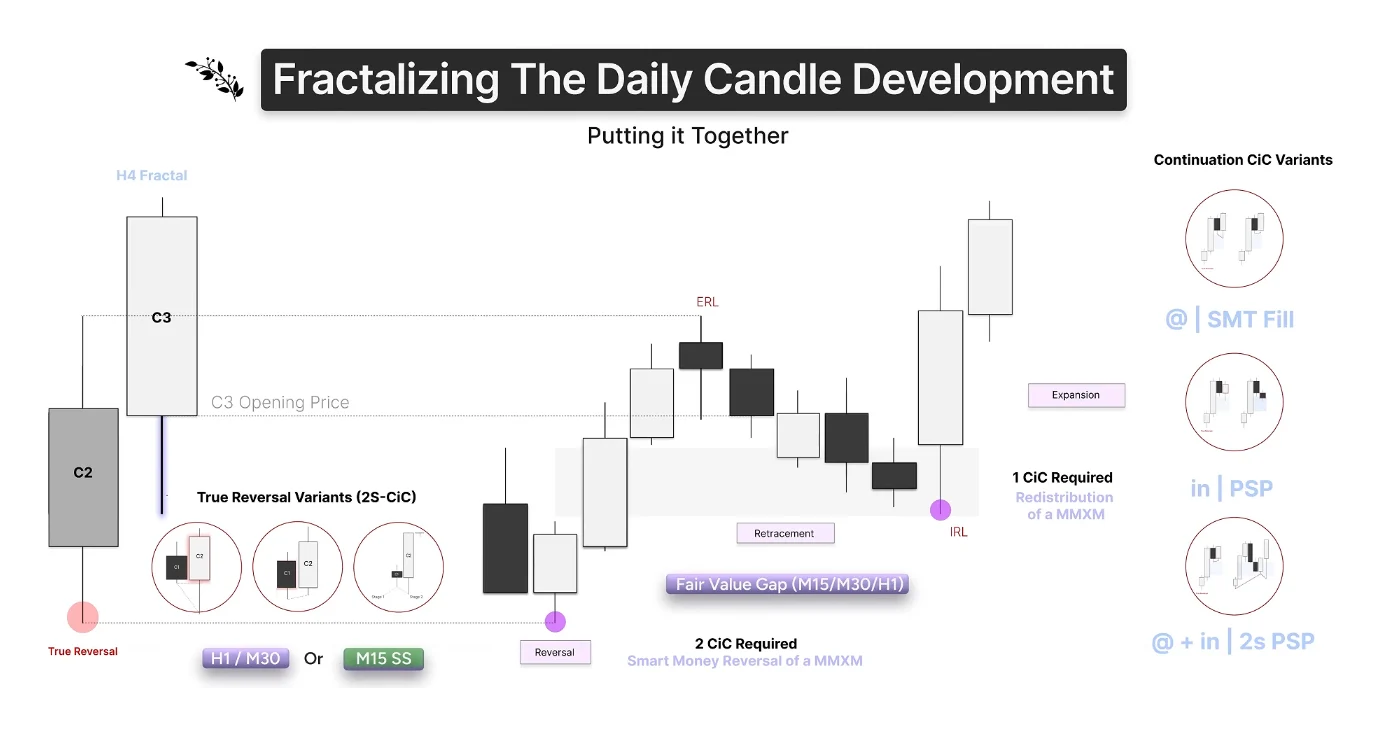
Chart Examples
The chart examples were all live-conducted examples, so please refer to 11:05 in the YouTube video accessible on the right-hand side of this page.
That's the end of this lecture, I hope you found value reading this and you learned something new that you can apply, or further refined your knowledge on this subject.
Back to the top