Introduction
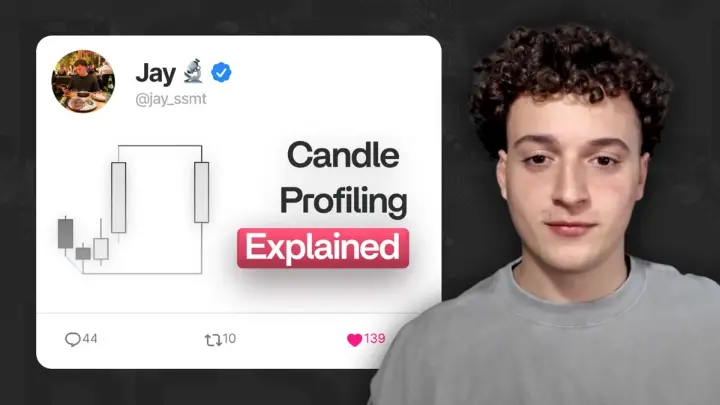
Today we're talking about candle profiling and how I apply it in my trading. This is an in-depth lecture on profiling, and the main subject we cover is 4-hour profiling.
Confirm Bias With Candle Profiling
What Is Candle Profiling?
Candle profiling's foundation stems from candle closures, like C2 and C3 closures.
C2 closures. Here C2 forms, sweeps C1's low and closes back above it, so it is a C2 closure. But this candle has a very large wick, so we don't want to trade it. We want to let it close and trade C3. This is a C2 candle that does not support expansion, because of its wick size. That is the bullish scenario; the example to its right is the bearish one. Again we have a C2 closure with a very large wick, so you do not want to position yourself within that candle; you want to trade C3.
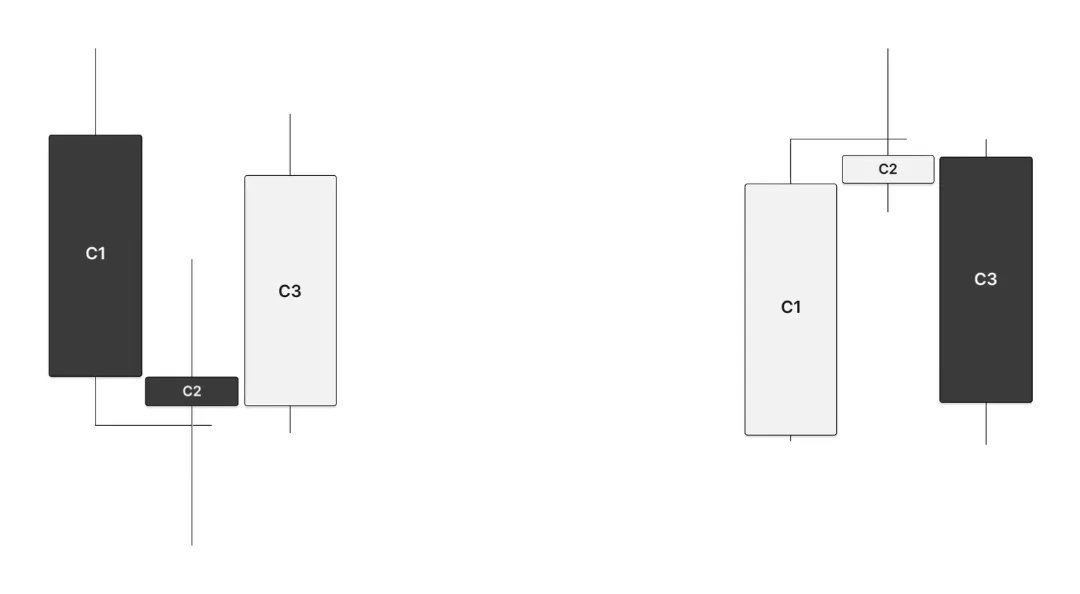
C2 reversal to expansion candles are when a C2 candle does support expansion because of its wick size. In this example C2 has an extremely small wick and a small opposing run, which means it supports expansion back to the downside: C2 sweeps C1's high, reverses lower, and since it has a small wick, you could trade this candle lower. The same applies in the bullish scenario, where C2 sweeps C1's low, has that small wick, and you trade the candle higher.
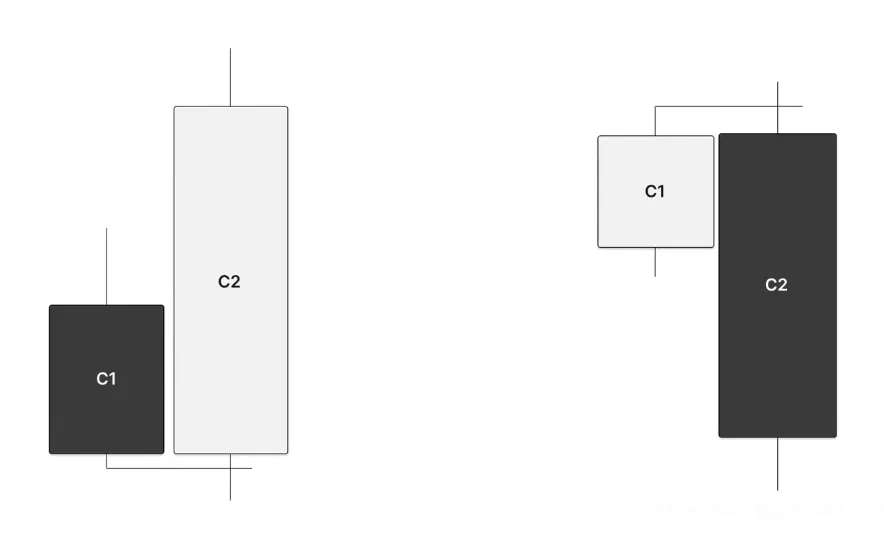
Then there is the case where you can't trade C2, and have to wait for C3's closure to confirm the reversal. There is no manipulation of any of the previous wicks, but this candle reverses and closes above C2's wick high, showing willingness to trade higher and forming a reversal signature we can trade.
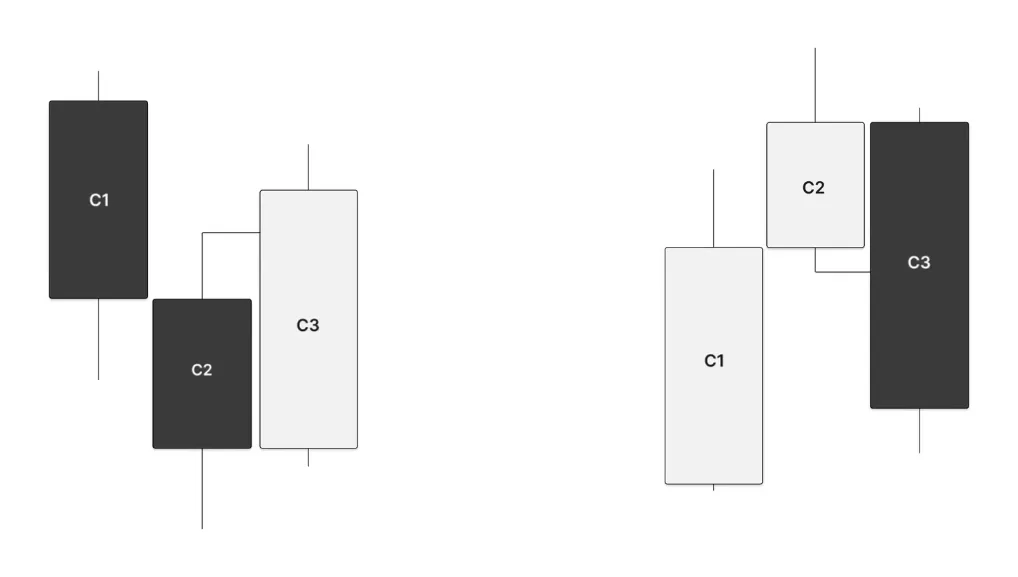
Why Is Profiling So Important?
Profiling is your guideline and your road map to the day, which is where session profiling comes in.
An Asia reversal is when Asia puts in the low of day for the daily candle and forms a reversal signature. Asia opens and starts to trade lower toward the key level; the 10 p.m. candle opens, sweeps out the key level, has a C2 candle that supports expansion because of its small wick, and then reverses and puts in the reversal signature. Then 2 a.m. opens and continues higher.
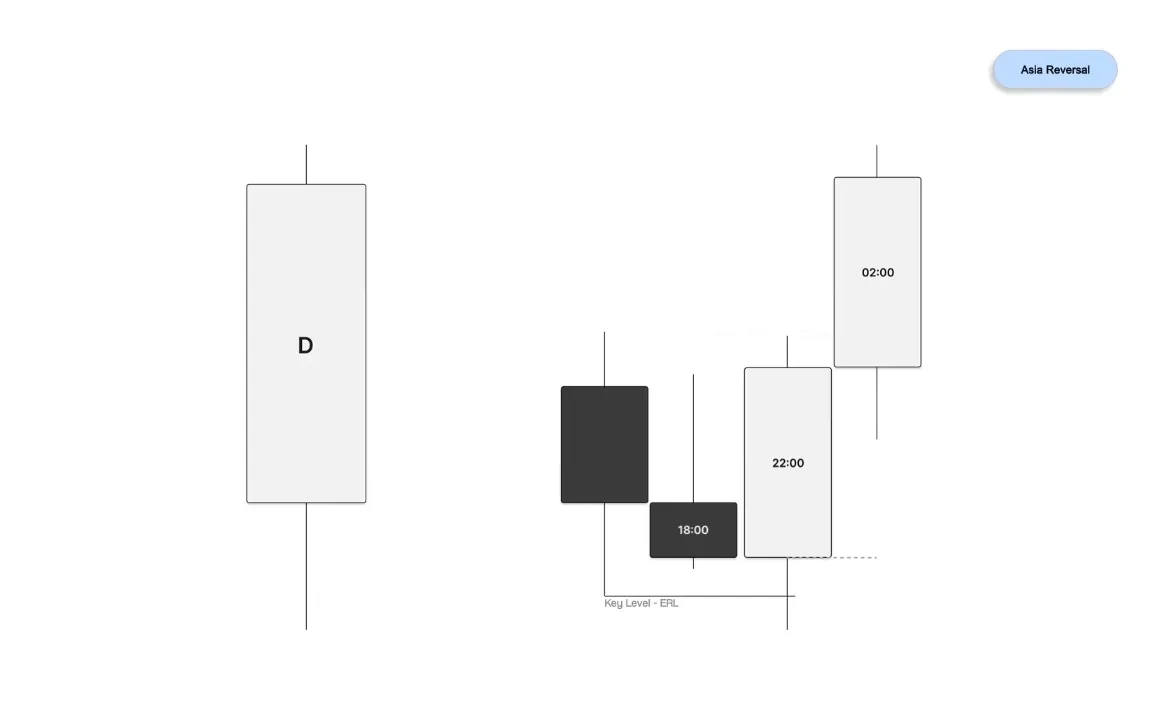
When Asia reverses and leaves an open draw, you can usually expect London to continue toward that draw. The candle forms a reversal signature, which is expansion, and we still have an open draw, so we can expect London to continue.
So how do you profile this to trade it? The 4-hour candle opens and respects 50% of the previous candle's range, the 22:00 C2. When we fractalize it to find a refined key level within this 4-hour candle, we see an hourly PD array, an hourly gap, in the upper quadrant of the candle. Price at 2 a.m. trades into this gap and has the small C2 wick we want to see, so we want price to expand away from the gap toward the draw on liquidity.
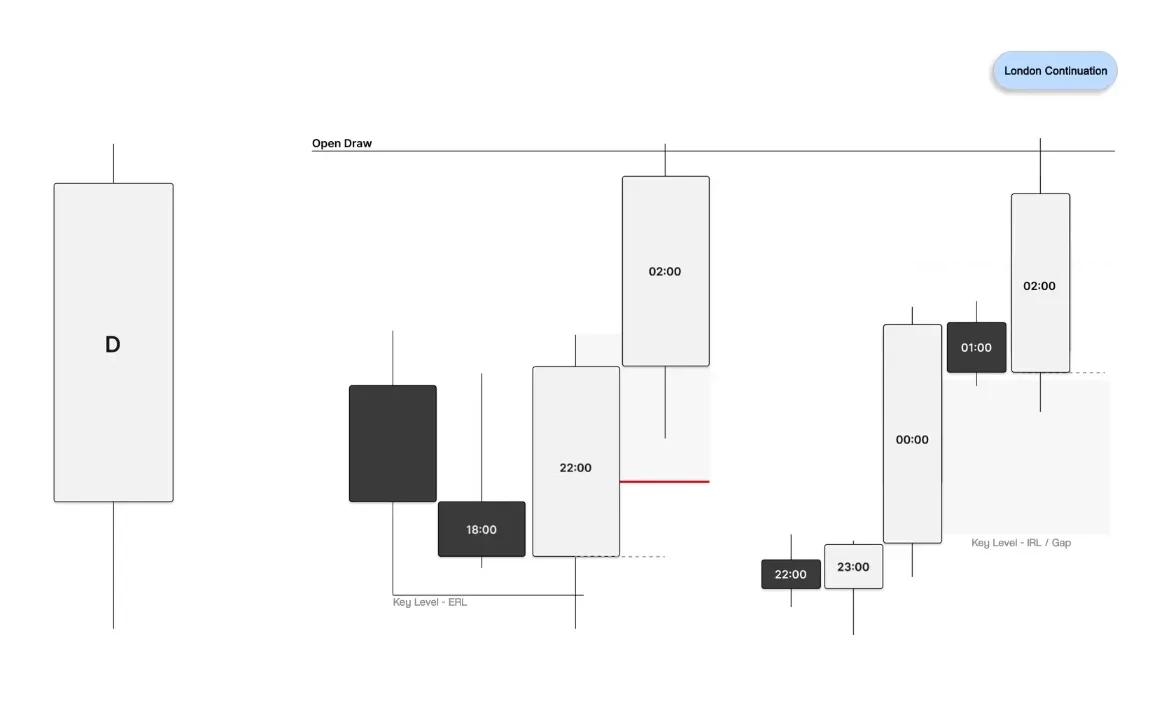
A London reversal is when London forms the high or low of day because Asia consolidated: London opens, manipulates a key level and expands away. Notice how I say key level. Every example I show is on the assumption that a key level was taken before the reversal or the continuation. We cannot trade, and there is no profiling, without two things: an open draw and a key level.
Here Asia consolidates and doesn't take a key level; London opens lower, takes the ERL, the key level, has the wick that supports expansion and reverses away. Now we want London to trade toward the draw on liquidity.
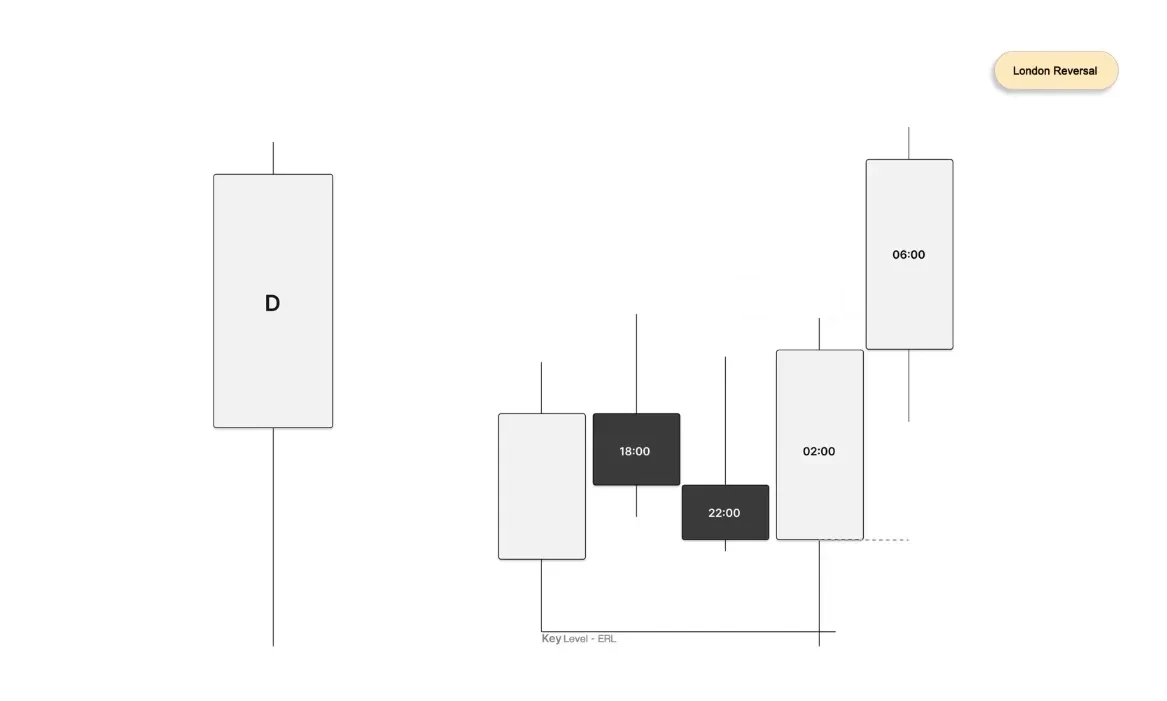
As in the previous example, if London does not take the draw on liquidity, we can expect 6 a.m., the New York open, to trade toward it. This London reversal to New York continuation framework is honestly one of my favorite frameworks, because it is extremely easy to trade.
The only thing I look for here is a gap continuation off the refined key level of the previous 4-hour candle. The previous 4-hour candle expands, the new 4-hour candle opens within a refined key level, and the hourly fractal still supports expansion with its small opposing run, trading into the gap with the draw still open. We want price to expand toward that open draw.
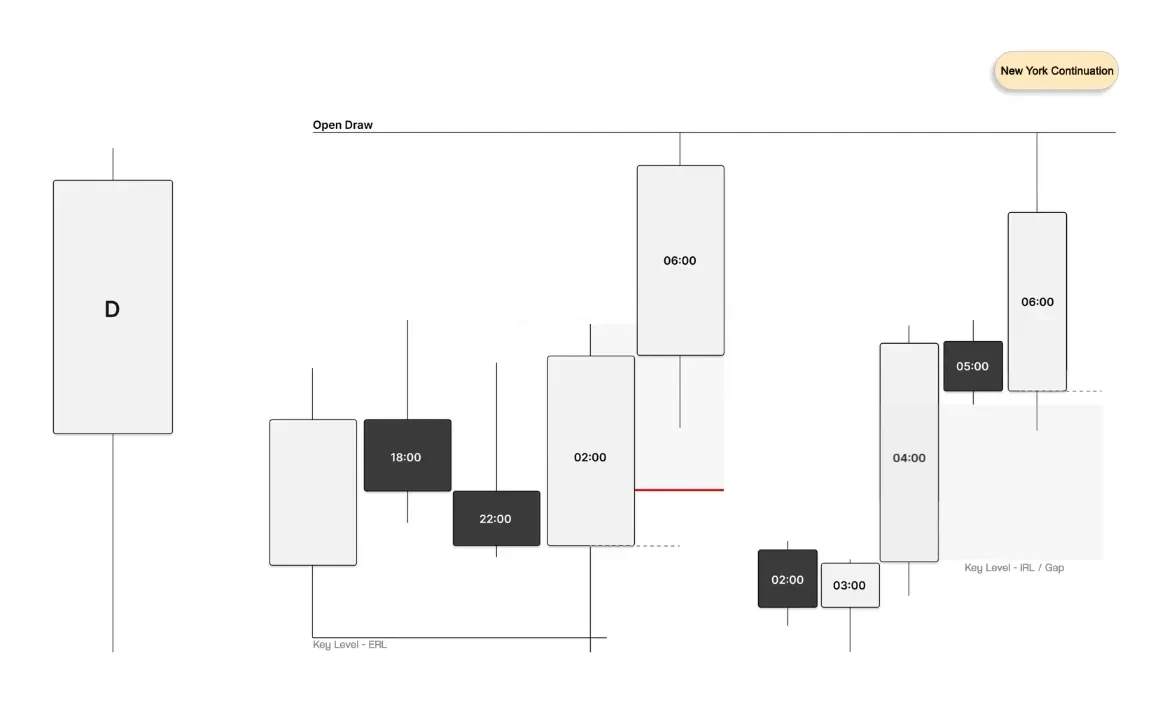
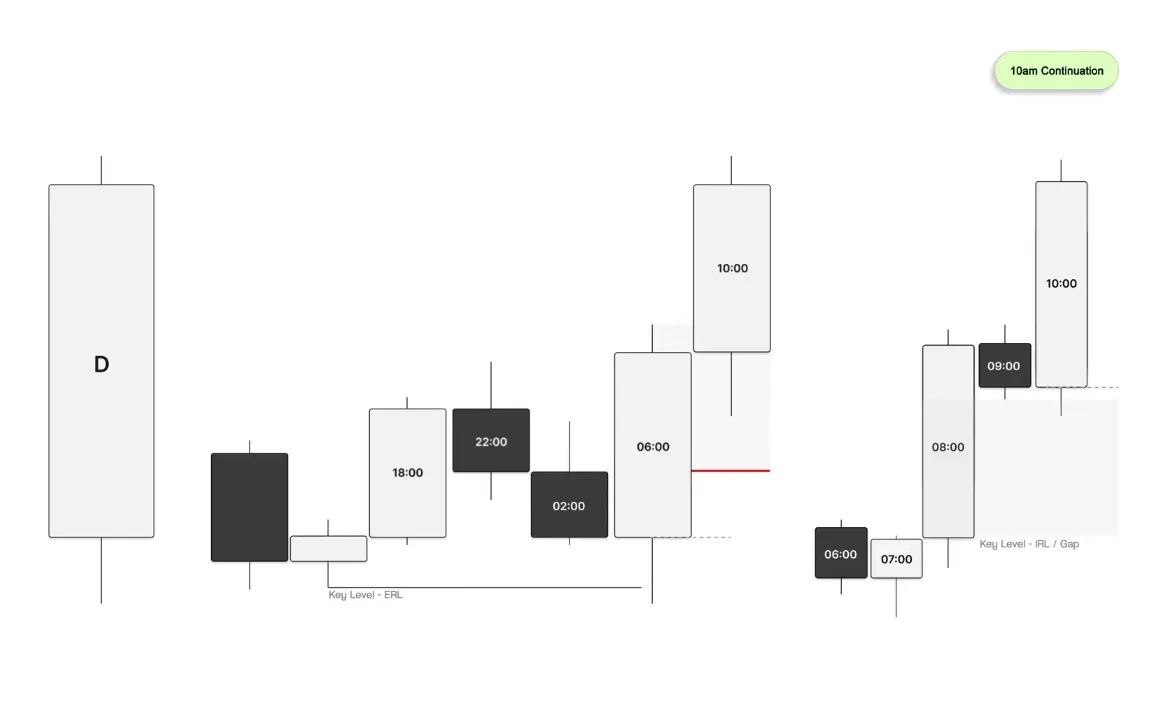
A New York reversal is when Asia and London consolidate, and early New York manipulates and expands toward the draw on liquidity. All these daily candles also have small wicks that support expansion in the direction you want to trade, which is key. Each profile has to align, because price is fractal: I want my daily candle, my 4-hour candle and my 1-hour candle to all support expansion in the direction I want price to go.
The 6 a.m. candle, after the previous sessions consolidated, manipulates the key level, has the small wick that supports expansion, and reverses away.
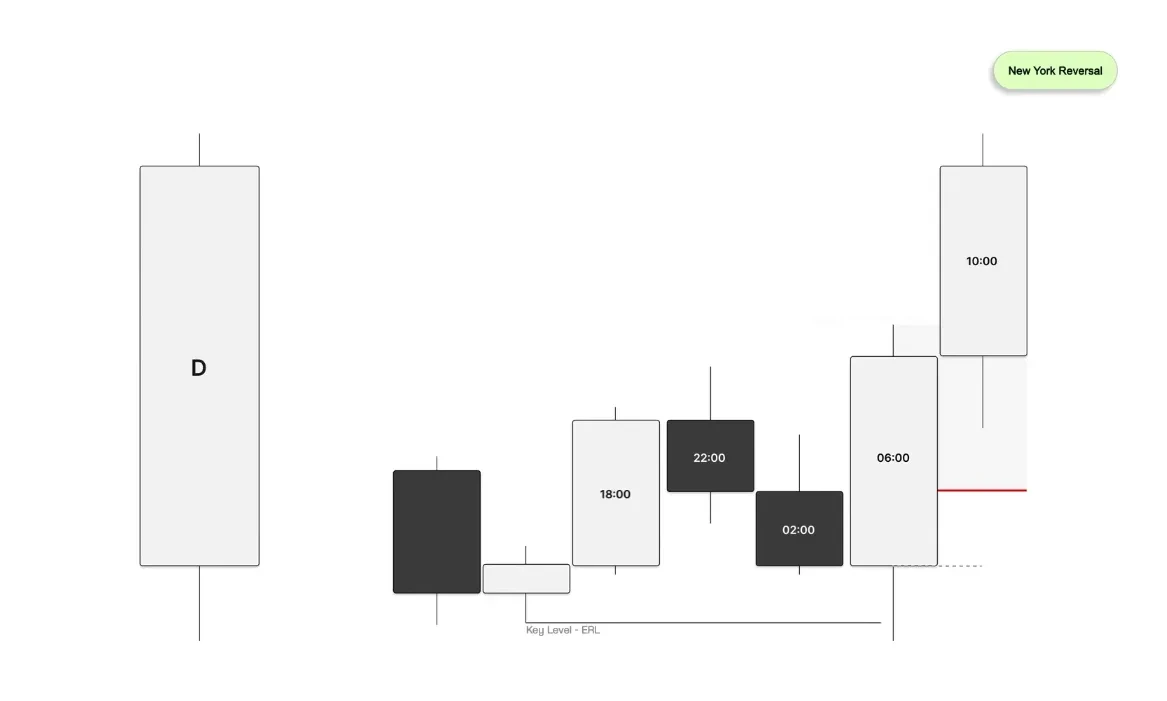
Then, assuming we have an open draw, 10 a.m. opens and respects 50% of the 6 a.m. candle's range, opening in the refined key level, the hourly gap, forming the small opposing run and expanding higher toward the open draw on liquidity.
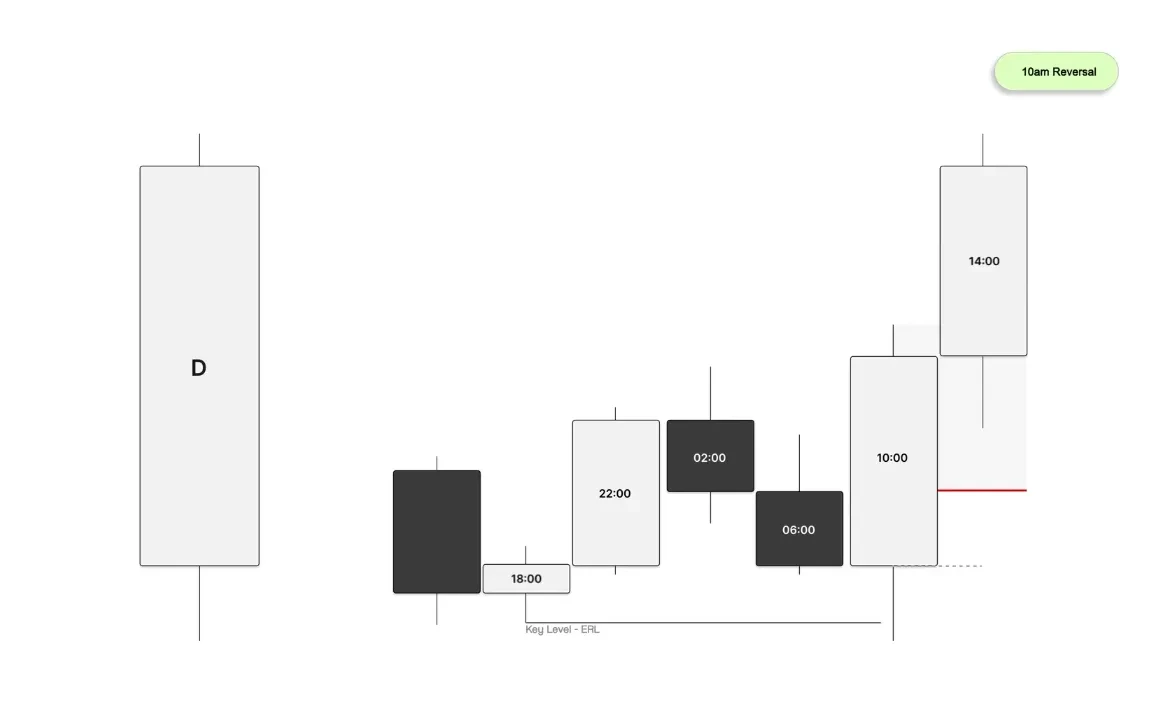
This is also a New York reversal, but where 10 a.m. forms the high or low of day: 10 a.m. opens, sweeps the key level, reverses and expands away, with the small wick that supports expansion. Here you can frame a 2 p.m. continuation if we leave an open draw: 2 p.m. opens in the refined key level, as in the previous examples, and continues toward the open draw if 10 a.m. doesn't take it.
How To Align Expansion Candles
So how do you actually use this in your trading? You need to learn how to align expansion candles. If not, you're just shooting in the dark. We work top down, from the daily all the way to your entry time frame, which for me tends to be the 3 or 5 minute.
Here the daily candle has a small wick that supports expansion. Assuming we trade into a key level on the 4 hour, we again have a C2 reversal to expansion candle that supports expansion to the upside. But when we fractalize price to the hourly, the hourly candle we are trading within does not support expansion higher, because it has a large wick. That is your filtering process when trading higher time frame expansion candles: the candle you are trading needs to support expansion. So we do not trade this C2 candle; we let it close and trade C3.
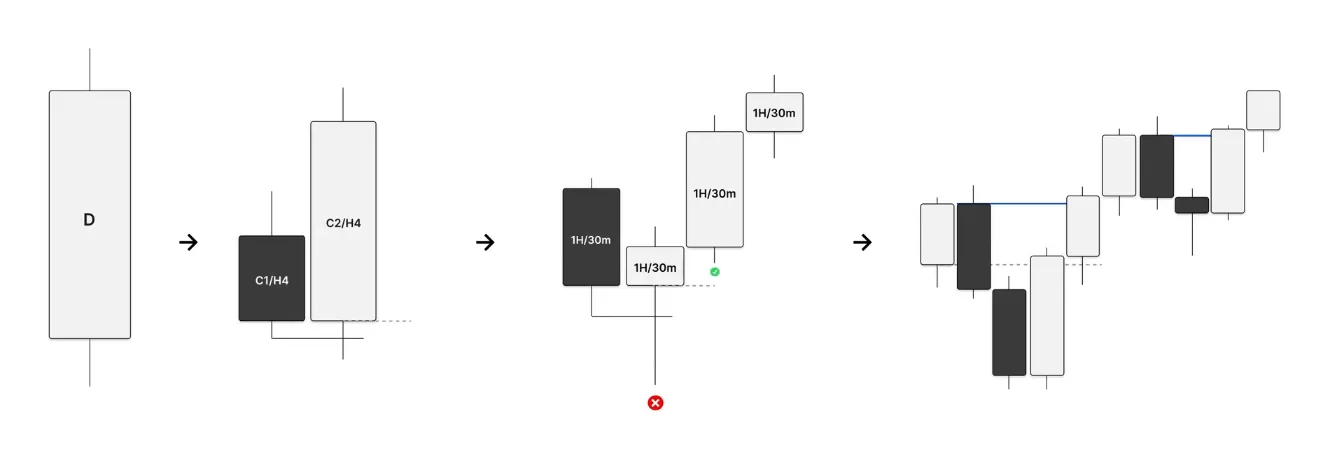
On the lower time frame, this is the initial reversal signature it forms. You skip that reversal signature, let C3 open, and take the clean continuation signature it forms.
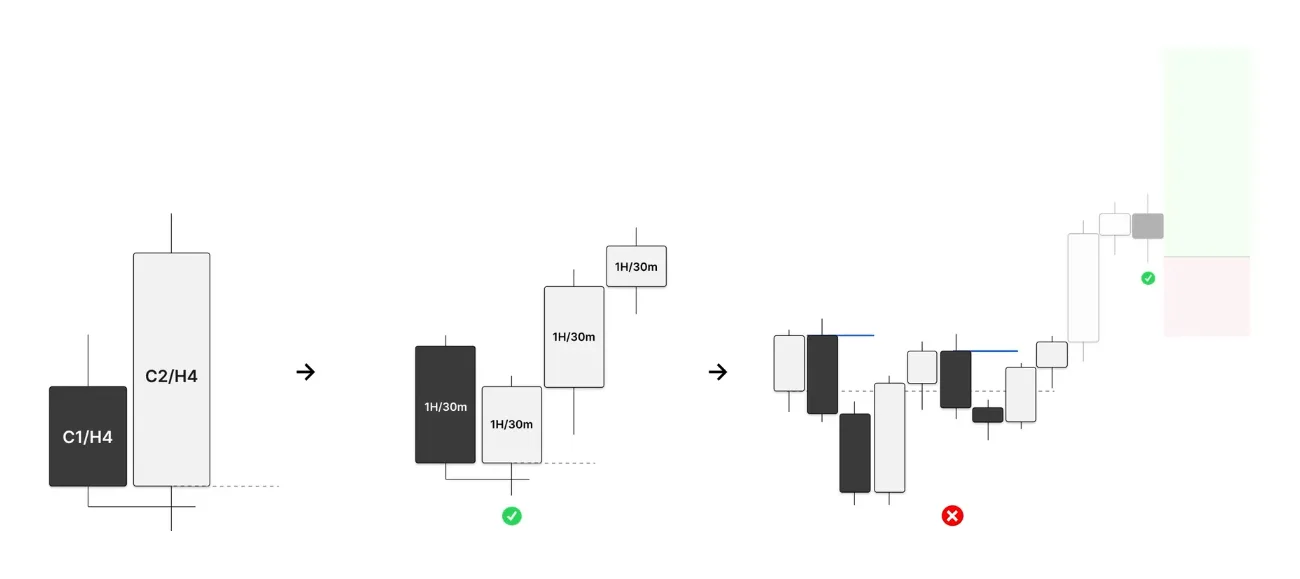
Now that you have the grasp that the daily supports expansion, I won't show it in the next examples, so you get a clear picture of the intraday framework. Again assuming we trade into a key level, the 4 hour reverses away and forms the C2 candle that supports expansion. When you align price to its fractal time frame, the hourly or 30 minute, the C2 candle you are trading within also supports expansion. This is when you want to trade the reversal of the 4-hour candle and position yourself in the lower quadrant of its wick.
Price V-shapes away, which is very important: you don't want to trade lackluster reversal signatures. Price V-shapes away with a strong close and forms the CISD, and this is where you want to position yourself.
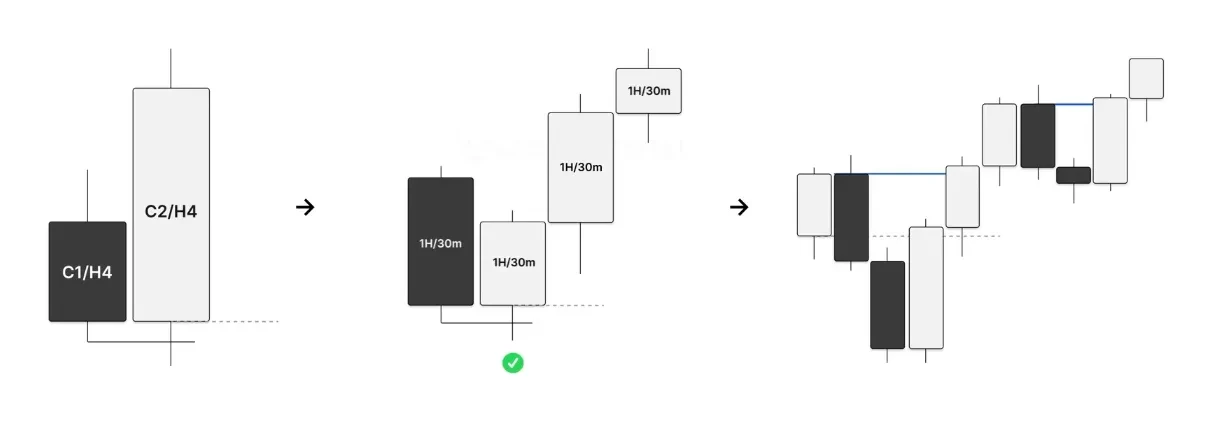
Now an example of invalid reversal signatures, because this is a filter a lot of people struggle with. Here we have very two-sided consolidation, with price making lackluster closes and chopping around. This is when I demand expansion away, which essentially means fair value gaps. Price forms a CISD, but it is extremely lackluster and I would never trust it. I want price to expand away, form a gap, and then I take the retracement into that gap as my entry, positioning myself within this fractal, in some portion of the C3 candle.
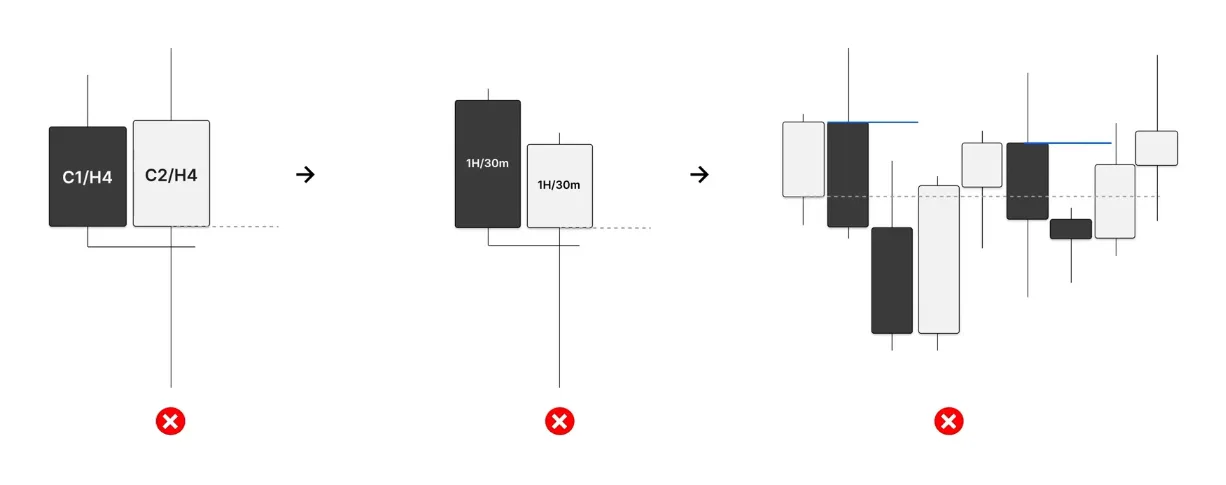
Here is a completely invalid framework, so you know what it looks like. The H4 C2 candle has a very large wick and doesn't support expansion at all, and the 1-hour or 30-minute C2 candle also has an extremely large wick. This is what it looks like when you have those larger wicks: very two-sided movement, reversal signatures formed out of consolidation, no clear direction. This is when you completely skip it, and wait for something like a C3 candle to open within a refined key level and trade away from that.
Learning it alone isn’t easy...
Learn The Lathyrus Model with direct guidance from our coaches.
- 10 live streams every week
- Regularly updated in-depth course
- 450+ hours of live stream recordings
+ more
What Do I Do If I Can't Trade The Reversal?
If I can't trade the reversal, I use the continuation framework: wait for expansion away and trade within C3's refined key level. Here the H4 C2 has an extremely large wick, so you do not want to position yourself in it. Instead you trade the continuation: if price has an open draw, and again assuming we took a key level, we want C3 to open within a refined key level to trade C3 toward the open draw.
C3 opens lower, with a small wick. Within this candle, the hourly or 30-minute framework expanded away and formed a gap. At the open of C3, the dotted line, price trades lower into the fair value gap and then expands away. The continuation signature here is price opening low, trading higher, V-shaping with a strong close: the ideal continuation signature to position yourself within when you can't trade the C2 reversal.
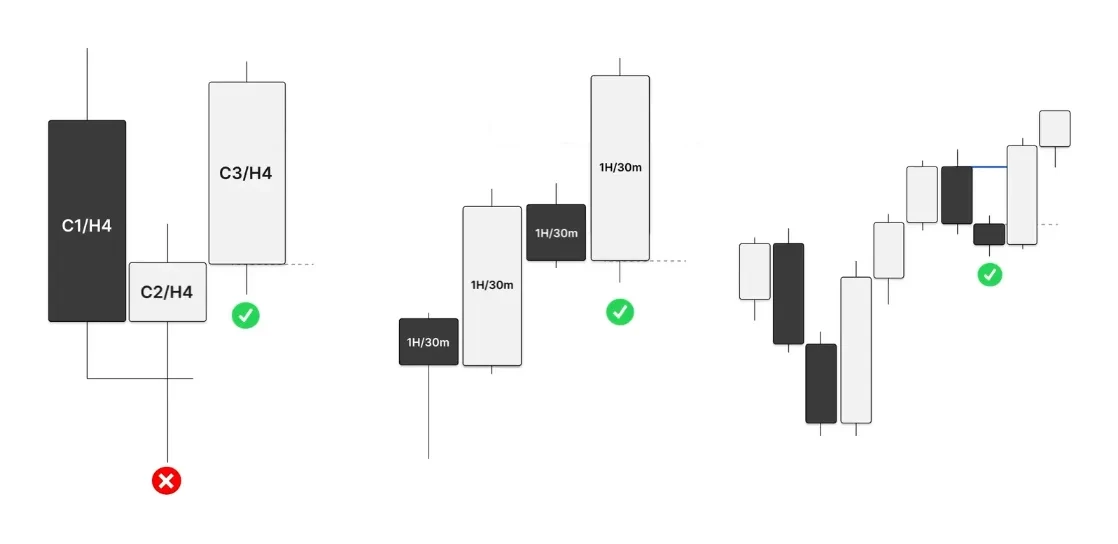
Next is the case where you can't trade C2 or C3, and wait for C3's closure to trade the C4 continuation. It is the same framework as before: you want a refined key level within the fractal time frame to form the higher time frame candle's wick. This 4-hour candle opens, trades lower on the 1 hour or 30 minute into the refined key level, a fair value gap, forms a C2 with a small wick, and supports expansion higher. You could also trade this C3 candle, assuming we have an open draw.
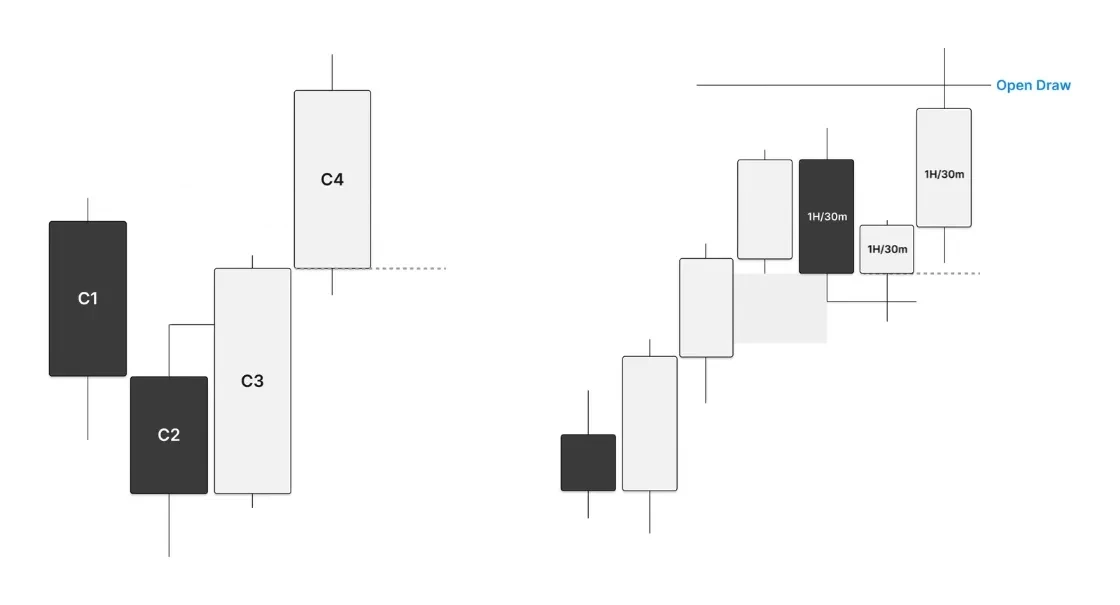
Intra-candle continuations are how you trade within a candle that has already expanded. Assuming the candle still has time left and has already expanded and formed gaps on the hourly or 30 minute, you want to see a refined key level, or a universal model, within the 4-hour candle. Price retraces into the gap, all within the same 4-hour candle, forms a C2 signature within the gap, and then expands toward its open draw. Again, you can only do this if we have an open draw.
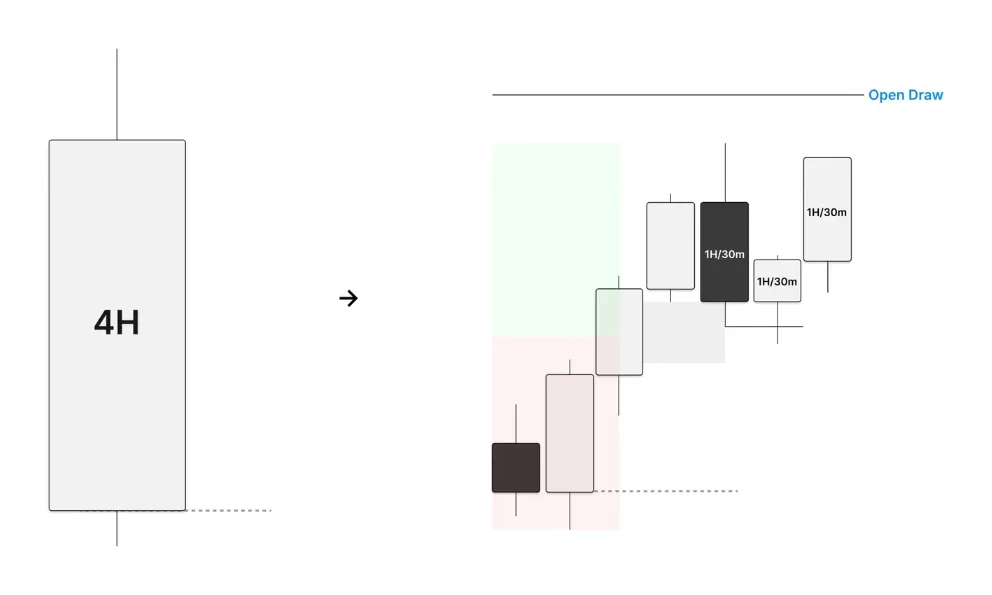
In-Depth Examples
Now the Lathyrus Model step by step, including SMT. If you don't know what SMT is, check out my SMT Master Class Part 1 and Part 2 first.
We start top down, with the H4 and the key level. Price in C1 trades into the key level and forms SMT there: our first-stage crack in correlation, assuming the correlated asset did not take this low. Since this is a reversal from an ERL, you need a 2-stage crack to trade it. C2 opens lower, sweeps C1's low and forms the second-stage crack at that low, again assuming a correlated asset does not take that candle's low while this one does. This candle has a small wick, which supports expansion, so we want price to expand away from the 2-stage SMT.
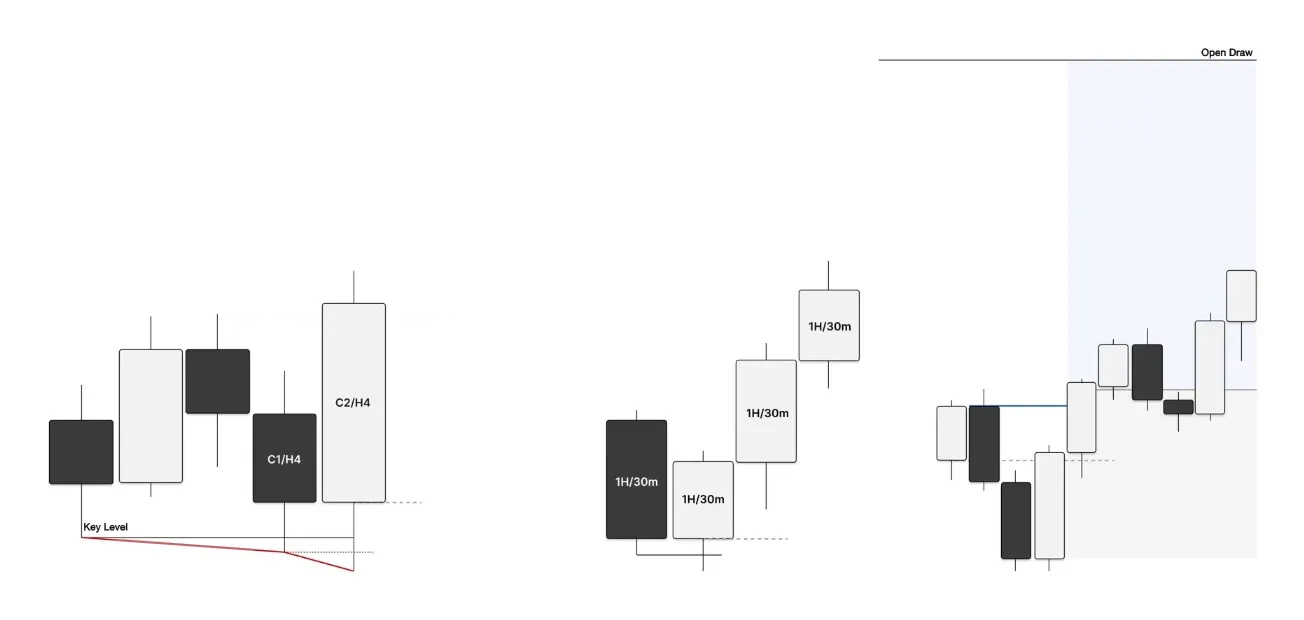
Refining price to the lower time frame fractal, the aligned hourly candle that forms the low also supports expansion: a small-wick C2. Everything aligns. The only thing you need after that is a very clean lower time frame reversal signature.
On the 3 or 5 minute I want to see price V-shape away from the SMT: it takes one or two candles to form the CISD, with a very strong V-shape. I enter near the close of the CISD, put my stop around the bodies, and hold for the open draw. Why the bodies and not the wick? A quick rule:
- If the candle is mostly body, you can put your stop at the bodies.
- If the candle is mostly wick, put your stop at the wick.
This example covers the continuation framework where you can't trade C2, so you trade C3 within a refined key level. The C2 candle has a very large wick and we cannot trade it, so we trade C3. C3 opens with a small opposing run. Within it, on the hourly or 30 minute, aligning those expansion candles, we are retracing into a key level, a gap here, and we have SMT fill, an SMT with the fair value gap, which is a one-stage crack. For continuations, which stem from a fair value gap, you only need a one-stage crack in correlation to trade away from it. The hourly candle has a very small wick and supports expansion to the upside, so we position ourselves within it.
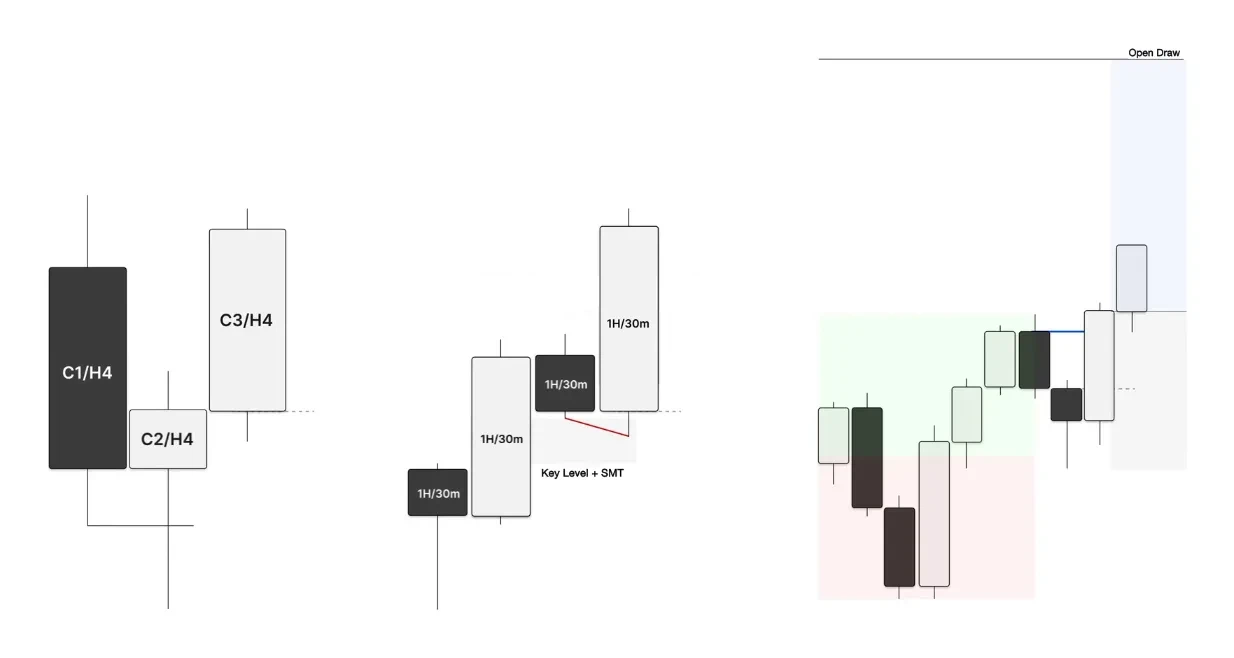
On the lower time frame we still have an open draw, and price is V-shaping away from the gap toward it. One thing to notice is that our stop is still near the discount of the range. You never want to enter so high or so low in the range that your stop sits high into premium; you always want your stop near the discount of the range you are trading in, the range from its current low to its current high.
That's the end of this lecture, I hope you found value reading this and you learned something new that you can apply, or further refined your knowledge on this subject.
Back to the top